


MAKKAH: Raed Abdullah Al-Maliki, a Taif native, developed a love for photography from a young age, particularly in documenting family events, eventually earning him a reputation as the family photographer.
Al-Maliki holds a bachelor’s degree in physical education from Umm Al-Qura University and currently serves as an employee at the Ministry of Education.
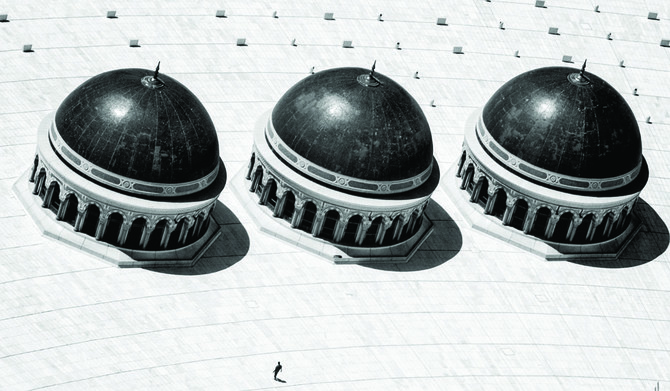
Raed Abdullah Al-Maliki captured an award-winning photo, main, of the Grand Mosque domes from a helicopter during Hajj season, showcasing their size in relation to a solitary figure on the roof. (Supplied)
As an active member of numerous local and international photography clubs, Al-Maliki holds affiliations with key organizations, including the International Federation of Photographic Art and the Photographic Society of America. He has showcased his talent in various local and international photography exhibitions, clinching several accolades.
His most recent recognitions came through the This Is Makkah photography competition, a part of the Makkah Brings Us Together event activities, organized by the Royal Commission for Makkah City and Holy Sites.
HIGHLIGHT
Al-Maliki said that technological advancements have made photography easier, especially with artificial intelligence technologies inside cameras that contribute to solving many problems. ‘From my perspective, so long as there is an idea and a message, your work will reach its audience and you will maintain your position.
Reflecting on his journey, Al-Maliki shared with Arab News: “My belief in the saying, ‘A picture is worth a thousand words,’ is the main motivation for me to continue this hobby, especially since a picture stops a moment in time and allows people to remember what made them happy later on. What the picture means to the photographer is a noble message that must be conveyed correctly.”
Raed Abdullah Al-Maliki captured an award-winning photo, main, of the Grand Mosque domes from a helicopter during Hajj season, showcasing their size in relation to a solitary figure on the roof. (Supplied)
He added: “I will never forget the first professional camera that my father gave me. It was like the exploration stage of a new world. At that time, I began to learn about the camera and then experimented with various types of photography. I believe that this stage was the most important in my journey because it taught me the basics of photography and allowed me to delve into its exceptional world, especially since I started taking diverse pictures and learning from my mistakes.”
Al-Maliki said that he moved on to the stage of practical application and improvement through visual nourishment, attending specialized courses and workshops, especially art exhibitions that help interact with photographers and benefit from their experiences.
Raed Abdullah Al-Maliki captured an award-winning photo, main, of the Grand Mosque domes from a helicopter during Hajj season, showcasing their size in relation to a solitary figure on the roof. (Supplied)
“When I started participating in local and international competitions, I set several goals for myself to strive for, which became a motivation for me to continue. I have achieved some of them. I was awarded the title of ‘international artist’ by the International Federation of Photographic Art, as well as ‘golden exhibitor’ by the Asian Photographers Union.”
Al-Maliki further explained that when he started participating in competitions in 2009, he was not successful, but despite that, he did not hesitate to continue participating.
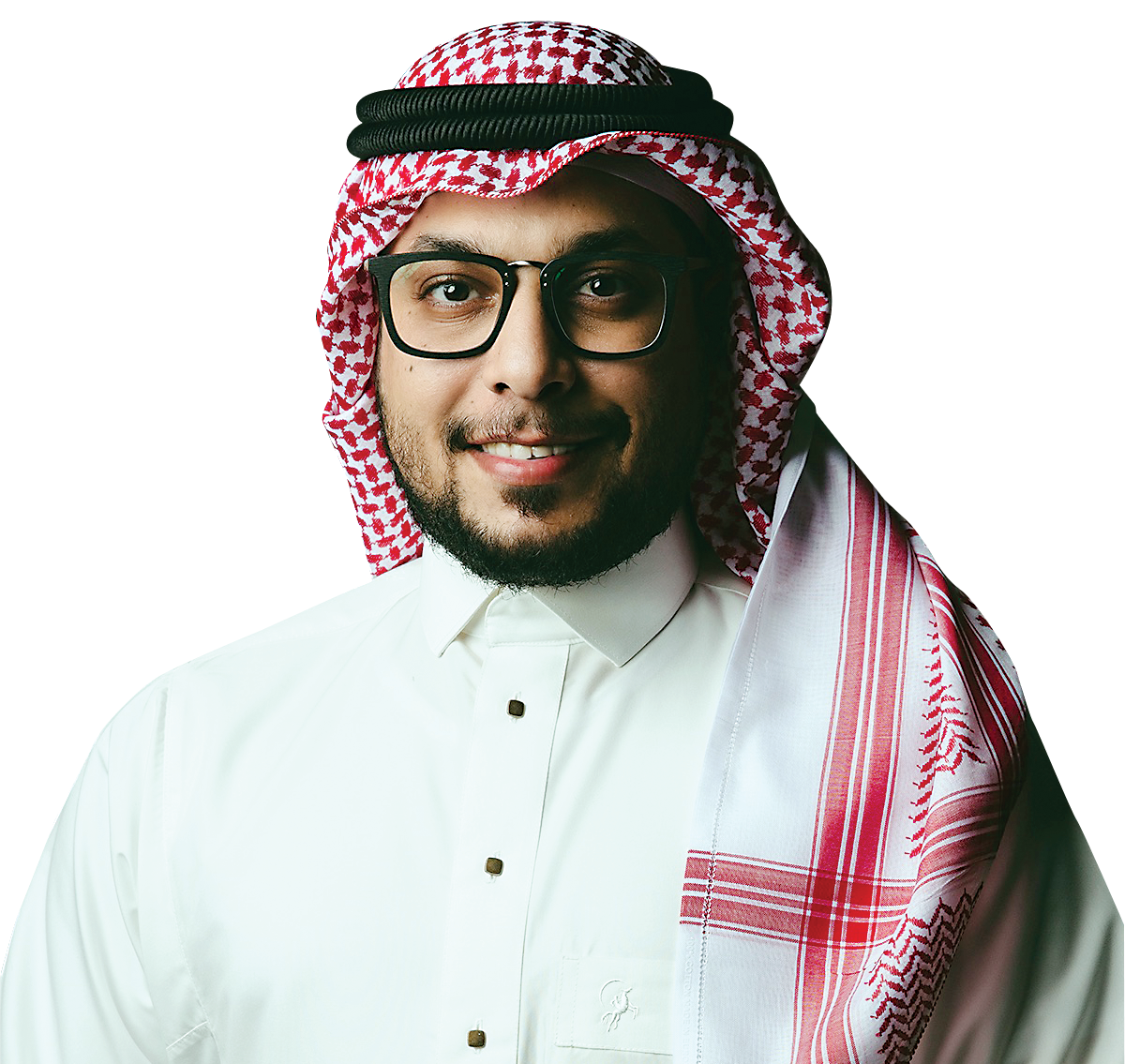
Raed Abdullah Al-Maliki
“With perseverance, attempting to capture different shots, and self-improvement, I won my first international award in 2013. I always made sure to learn and benefit from the community of photographers around me. As for the picture of ‘the domes on the roof of the Grand Mosque,’ I consider it the main player in my submissions.”
Al-Maliki said: “This picture has won more than one award at both local and international levels, including gold, silver, and bronze medals, as well as honorary distinctions in several different countries, including recently Oman, China, France, and India.
Raed Abdullah Al-Maliki captured an award-winning photo, main, of the Grand Mosque domes from a helicopter during Hajj season, showcasing their size in relation to a solitary figure on the roof. (Supplied)
“It is considered one of the closest shots due to the circumstances under which it was captured, as it was taken during the first helicopter flight operated by a security agency during the Hajj season, specifically on the Day of Arafah. This day is known for the Grand Mosque being empty of pilgrims as they stand on the plains of Arafat.
“Also, due to the windy conditions and altitude at midday, multiple rapid shots were taken until success was achieved, with only this person present on the roof of the Grand Mosque, which contributed to highlighting the domes and their size compared to the person, as well as the presence of all shades of monochromatic colors in the work and the contrast of its elements.”
What the picture means to the photographer is a noble message that must be conveyed correctly.
Raed Abdullah Al-Maliki
Speaking about what the Saudi photographer lacks to achieve international recognition, he explained that we are living in the golden age of photography, with the vision of our inspiration, Crown Prince Mohammed bin Salman, who sees us as the true force for achieving the vision.
“The Kingdom is rich in its diverse terrain and beautiful places, be it in the north, south, east, or west.
“Every photographer should seize the opportunity to capture shots that remain in the memory of viewers and leave a special mark, especially since the spread of pictures has become easier than ever through various social media platforms and the ease of access to the world. I will strive diligently to represent my country and achieve top positions because we are always at the forefront and nothing hinders our sky-high ambition.”
Raed Abdullah Al-Maliki captured an award-winning photo, main, of the Grand Mosque domes from a helicopter during Hajj season, showcasing their size in relation to a solitary figure on the roof. (Supplied)
He pointed out that technological advancements have made photography easier, especially with artificial intelligence technologies inside cameras that contribute to solving many problems. From my perspective, so long as there is an idea and a message, your work will reach its audience and you will maintain your position, regardless of the tool used in photography, whether professional cameras or even mobile phones.
“The photographer plays a large part in showing creativity because no matter how many resources are available, without the right person, you cannot impress others.”
Al-Maliki concluded by stating that artists can see their reality differently, even if they are accustomed to it. “Choosing different angles and places at different times and with new ideas will help me find subjects worthy of photography. Usually, I search for new angles photographers have not touched upon, hoping to highlight a different aspect through the picture.”


