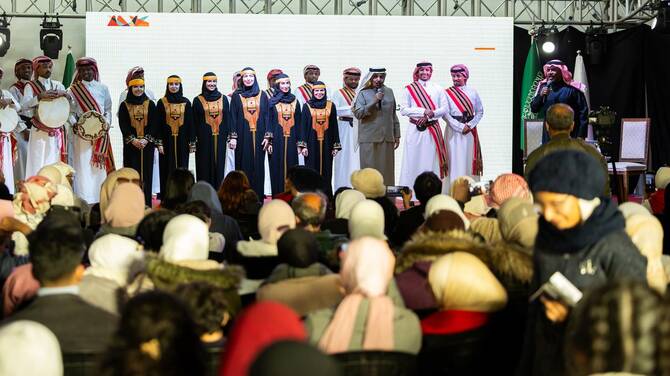
Saudi arts panel explores heritage at Damascus fair

1 / 2
Participants examined the symbolic meanings of folk arts such as Ardah, Samri, and Al-Khatwa, highlighting their role in expressing Saudi values, history, and national identity. (SPA)
2 / 2
Participants examined the symbolic meanings of folk arts such as Ardah, Samri, and Al-Khatwa, highlighting their role in expressing Saudi values, history, and national identity. (SPA)
Short Url
Updated 16 February 2026
Follow

Saudi arts panel explores heritage at Damascus fair

RIYADH: The Theater and Performing Arts Commission hosted a panel discussion on symbolism and heritage in traditional Saudi performing arts at the Kingdom’s pavilion during the Damascus International Book Fair.

Participants examined the symbolic meanings of folk arts such as Ardah, Samri, and Al-Khatwa, highlighting their role in expressing Saudi values, history, and national identity.

Key topics included the significance of collective movements and rhythms in conveying unity and social solidarity, the Saudi Press Agency reported on Monday.

The panel also explored the symbolism of costumes, performance tools, and lyrics, and discussed strategies for preserving authenticity in contemporary cultural contexts.

Saudi Arabia was guest of honor at the fair, which concluded on Feb. 16. The Kingdom’s pavilion highlighted creativity and cultural exchange, supporting Vision 2030’s goals of knowledge sharing and cultural leadership.

The seminar was part of the commission's efforts to promote Saudi culture at regional and international forums, highlighting the rich heritage of traditional performing arts and fostering cultural dialogue with diverse audiences.


Riyadh emerges as Gulf evacuation hub for wealthy amid regional escalation

Updated 6 sec ago
Follow

Riyadh emerges as Gulf evacuation hub for wealthy amid regional escalation

  • Saudi capital’s King Khalid International Airport is among the few major airports in the region still operating normally after Iranian missile and drone strikes

RIYADH: Riyadh has become a principal evacuation hub for wealthy residents and senior executives seeking to leave the Gulf amid escalating regional tensions, according to a report by Semafor.

The Saudi capital’s King Khalid International Airport is among the few major airports in the region still operating normally after Iranian missile and drone strikes targeted cities including Dubai and Abu Dhabi over the weekend, as well as locations in Qatar and Bahrain.

With airspace closures elsewhere, stranded executives and high-net-worth individuals have been travelling overland to Riyadh, in some cases undertaking a roughly 10-hour journey from Dubai, in order to board private or commercial flights out of the region.

Citing people familiar with the arrangements, Semafor reported that private security firms have been hiring fleets of SUVs to transport clients to the Saudi capital before arranging chartered aircraft departures.

Those being evacuated include senior figures at global financial institutions as well as affluent individuals who had been in the Gulf for business or leisure.

The surge in demand has sharply increased costs.

Ameerh Naran, chief executive of private jet brokerage Vimana Private, told Semafor that Riyadh is currently “the only real option” for those seeking to exit the region, with private jet charters from the Saudi capital to Europe reaching as much as $350,000.

Alternative routes have narrowed. Security providers initially explored using Oman as an exit corridor, but that option became unviable after reported Iranian strikes on the country’s port infrastructure and a tanker, leaving Riyadh as the most accessible transit point, the report said.

Riyadh’s role marks a notable shift in regional risk perception. In previous years, security concerns — including cross-border Houthi attacks during the Yemen conflict and earlier periods of regional instability — had led many expatriates and business leaders to favour other Gulf cities as transit hubs.

However, Saudi Arabia’s more flexible visa regime, which now allows many nationalities to obtain visas on arrival, combined with the kingdom’s ability so far to keep its airspace open, has reinforced its position as a temporary gateway out of the region.

While some schools have moved to remote learning and certain companies have advised staff to work from home, Semafor reported that daily life in Riyadh has largely continued uninterrupted compared with other Gulf cities that have faced direct attacks.