WASHINGTON: The Pentagon has voiced skepticism about Russian President Vladimir Putin’s announcement that he had ordered the partial withdrawal of troops from Syria.
Putin visited the war-torn nation on Monday and said a “significant part” of the Russian troop contingent in Syria is heading home after their mission had been largely completed.
But Pentagon spokesman Major Adrian Rankine-Galloway said such declarations were not necessarily reflected by action.
“Russian comments about removal of their forces do not often correspond with actual troop reductions, and do not affect US priorities in Syria,” he said.
A US official said that Putin was likely to carry out a “token withdrawal” of some aircraft, then follow up by demanding the US pulls its forces out of Syria.
The US military last week said it would stay in Syria, where it is fighting Daesh, as long as necessary to ensure the terrorists do not return.
The “coalition will continue to operate in Syria in support of local forces on the ground to complete the military defeat of ISIS (Daesh) and stabilize liberated territory, in turn allowing for displaced Syrians and refugees to return,” Rankine-Galloway said.
Syria’s conflict began in March 2011 with anti-regime protests, but quickly spiraled into a bitter and complex civil war, with Daesh just one element.
The open-ended US commitment in Syria is likely to rile Russia, which since late 2015 has conducted a separate military campaign to prop up the regime of President Bashar Assad. The size of the Russian deployment in Syria is not known, but independent Russian military expert Pavel Felgenhauer has told AFP that up to 10,000 troops and private contractors could have taken part in the conflict.
The EU also warned that the war in Syria was “still ongoing” and civilians were being attacked.
EU diplomatic chief Federica Mogherini said the bloc was ready to do whatever was needed to support UN-brokered peace efforts, but warned the idea that “things can go back to normal unfortunately has no real ground.”
“Conflict is still ongoing, even if some wish to pretend it is over,” she told reporters in Brussels.
“We know very well that on the ground fighting is still going on, civilians are still attacked and we see that with our humanitarian support every single day inside Syria.”


![]()
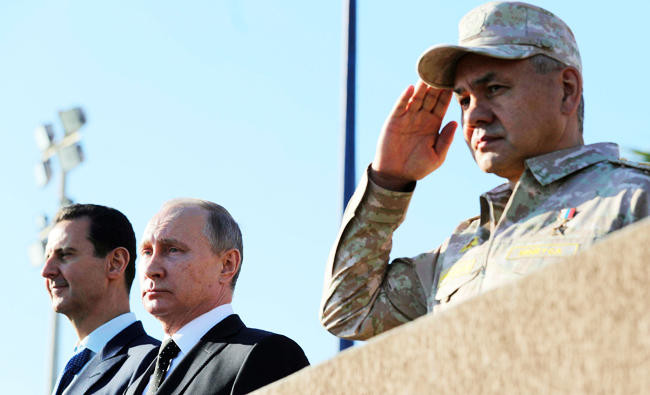
Pentagon skeptical about Russia’s Syria pullout claims
Pentagon skeptical about Russia’s Syria pullout claims

Latest updates


© 2026 SAUDI RESEARCH & PUBLISHING COMPANY, All Rights Reserved And subject to Terms of Use Agreement.