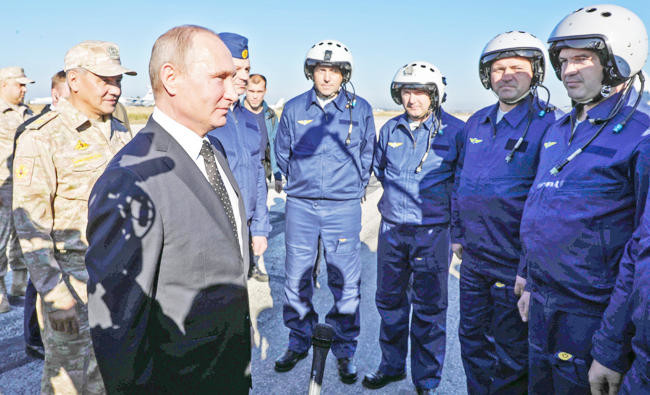
JEDDAH: Russian President Vladimir Putin declared victory in Syria on Monday during a surprise visit to a Russian military base in the country and announced a partial pullout of his troops.
It was Putin’s first trip to Syria, where Russia launched an air campaign in 2015 that allowed the Bashar Assad regime to gain the upper hand against the Syrian opposition. It was also the first visit by a foreign head of state to Syria since the anti-regime protests began in 2011.
Putin ordered “a significant part” of Russia’s military contingent in Syria to start withdrawing on Monday, saying Moscow and Damascus had achieved their mission of defeating Daesh in just over two years.
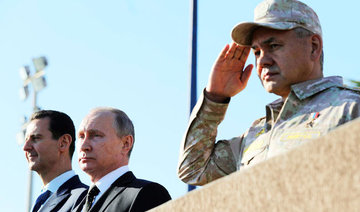
He made the announcement during a visit to Hmeymim air base in Syria, where he held talks with Assad and addressed Russian forces.
Putin told Russian servicemen they would return home as victors. “The task of fighting armed bandits here in Syria, a task that was essential to solve with the help of extensive use of armed force, has for the most part been solved, and solved spectacularly,” he said. “I salute you.”
He said his military had proved its might, Moscow had succeeded in keeping Syria intact as a “sovereign independent state,” and conditions had been created for a political solution.
He said while Russia might be drawing down much of its forces, its military presence in Syria is permanent and will retain enough firepower to destroy any Daesh comeback.
Russia will keep its Hmeymim air base in Latakia province and its naval facility in the Mediterranean port of Tartous “on a permanent basis,” said Putin. Both bases are protected by sophisticated air defense missile systems.
Hamdan Al-Shehri, a political analyst and international relations scholar, said one should not ready much into Putin’s announcement.
“This isn’t a withdrawal, this will simply be a relocation of troops. All Russians troops will be at Hmeymim air base and its naval facility in Tartous,” he told Arab News.
This “maneuvering” stems from the fact that there is no longer an excuse for Russia to stay in Syria because Daesh is finished there and in Iraq, he said, adding: “There’s no pretext anymore to justify the Russian presence in Syria.”
Russia may have accomplished what it wanted to militarily, “but for the people of Syria there’s no light at the end of a very dark tunnel,” Al-Shehri said. “They want to see the end of Assad, the man whose regime spilled the blood of nearly 500,000 fellow Syrians.”
Al-Shehri said Russia should focus on meeting the aspirations of the Syrian people. “It sided with the tyrant, not the people of Syria,” he said. “Now is the time for Russia to hammer out a solution where there’s no room for a killer like Assad.”
Oubai Shahbandar, a Syrian-American analyst and fellow at the New America Foundation’s International Security Program, told Arab News that Russia has long-term basing agreements with the Assad regime, “so as long as Assad is in power, Russian forces will remain to prop him up.”
On Putin’s “mission accomplished” speech in Hmeymim, Shahbandar said: “The manner in which he summoned Assad was clearly indicative of who holds the dominant position in that partnership. The prospect of the Russians withdrawing in total seems unlikely at this juncture.”
Pentagon spokesman Maj. Adrian Rankine-Galloway said: “Russian comments about removal of their forces do not often correspond with actual troop reductions, and do not affect US priorities in Syria.”
An American official told Agence France-Presse that Putin is likely to carry out a “token withdrawal” of some aircraft, then follow up by demanding that the US pull its forces out of Syria.
EU diplomatic chief Federica Mogherini said the bloc is ready to do whatever is needed to support UN-brokered peace efforts, but warned that the idea that “things can go back to normal unfortunately has no real ground.”
She added: “Conflict is still ongoing, even if some wish to pretend it is over. We know very well that on the ground fighting is still going on, civilians are still attacked, and we see that with our humanitarian support every single day inside Syria.”


![]()
Putin orders partial withdrawal of Russian troops from Syria
Putin orders partial withdrawal of Russian troops from Syria
Latest updates




Recommended


© 2026 SAUDI RESEARCH & PUBLISHING COMPANY, All Rights Reserved And subject to Terms of Use Agreement.