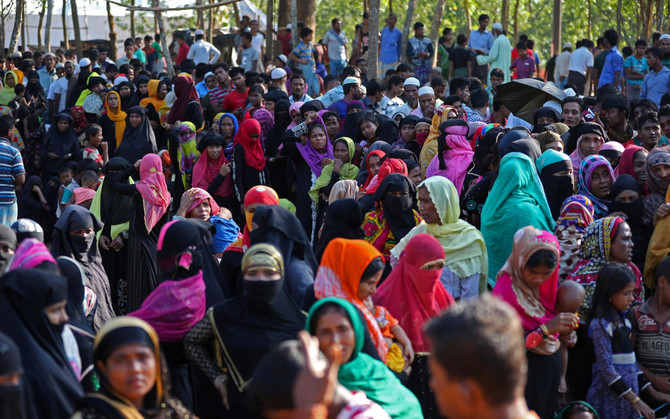
GENEVA: Nearly 1 million Rohingya refugees have fled violence in Myanmar, an “untenable situation” for neighbor Bangladesh, the country’s UN envoy said on Monday, calling on Myanmar to let them return.
About 600,000 people have crossed the border since Aug. 25, when insurgent attacks on security posts were met by a ferocious counter-offensive by the Myanmar army in Rakhine state which the United Nations has called ethnic cleansing.
“This is the biggest exodus from a single country since the Rwandan genocide in 1994,” Shameem Ahsan, Bangladesh’s ambassador to the United Nations in Geneva, told a UN pledging conference.
“Despite claims to the contrary, violence in Rakhine state has not stopped. Thousands still enter on a daily basis,” he said.
Bangladesh’s interior minister was in Yangon on Monday for talks to find a “durable solution,” Ahsan said.
But Myanmar continued to issue “propaganda projecting Rohingyas as illegal immigrants from Bangladesh,” Ahsan said, adding: “This blatant denial of the ethnic identity of Rohingyas remains a stumbling block.”
Myanmar considers the Rohingya to be stateless, although they trace their families’ presence in the country for generations.
Jordan’s Queen Rania visited Rohingya refugee camps on Monday and called for a stronger response from the international community to the plight of the Rohingya who fled to Bangladesh to escape “systematic persecution” in Myanmar.
“One has to ask, why is the plight of this Muslim minority group being ignored? Why has the systematic prosecution been allowed to play out for so long?” she asked after touring the camps.
The United Nations has appealed for $434 million to provide life-saving aid to 1.2 million people for six months.
“We need more money to keep pace with intensifying needs. This is not an isolated crisis, it is the latest round in a decades-long cycle of persecution, violence and displacement,” UN humanitarian chief Mark Lowcock told the talks.
“Children, women and men fleeing Myanmar are streaming into Bangladesh traumatized and destitute,” he added.
“We assess we have pledges of around $340 million,” Lowcock said before the mid-day break in the meeting.
New pledges included 30 million euros announced by the European Union, $15 million by Kuwait, 10 million Australian dollars by Australia and 12 million pounds from Britain.
He reiterated the UN call on Myanmar to allow “full humanitarian access across Rakhine” where aid agencies have been denied entry.
Myanmar must “guarantee the right to safe, voluntary and dignified return so that the Rohingya can live in peace with their human rights upheld in Rakhine,” Lowcock said.

Bangladesh says Rohingya outflow “untenable,” seeks solution
From Jeddah to the world stage: Bader Idrees and Saudi Arabia’s tennis rise
RIYADH: As tennis continues to gain momentum throughout Saudi Arabia, several local players are beginning to emerge on the national and international scene. One of them is Saudi national team player Bader Idrees, whose journey mirrors the Kingdom’s evolving relationship with the sport.
Idrees’ first exposure to tennis came at a time when the local game was still developing. His interest began in early 2010 after watching his older sister train regularly.
“I was five years old when I used to watch my older sister playing tennis every day,” he told Arab News. “One of her coaches recommended that I try it out, and from the first hit, I fell in love with the sport.”
Now 20 years old, Idrees finds himself progressing alongside a country that is investing heavily in tennis. Over the past three months alone, Saudi Arabia has hosted the Six Kings Slam, the WTA Finals, and the Next Gen ATP Finals, an indication of its growing ambitions on the global tennis stage.
A defining moment in Idrees’ development came at the 2025 WTA Finals, where he reached a personal milestone in his role as a hitting partner for some of the world’s best players.
“It was one of the best experiences I’ve had so far,” he said. “To actually see the players and train with them was an eye-opening experience for me.”
The exposure offered by hosting elite tournaments has had a direct impact on aspiring Saudi athletes, providing valuable insight into the professional game.
“Seeing how players prepare for matches — from how they behave off the court to actually practicing on the court — was an amazing experience,” he said.
Beyond individual growth, Idrees believes the broader sporting ecosystem benefits from welcoming international events to the Kingdom.
“Hosting these events motivates every Saudi athlete,” Idrees said. “Foreign players get to know the country and the players who represent it, and it pushes us to perform better knowing that the world is watching.”
That motivation has translated into concrete goals. Idrees is planning a busy start to the year, with four international tournaments scheduled for January.
“I feel very positive about what I’ve accomplished so far, so hopefully I can kick off with a strong start in 2026.”
Despite recent progress, Idrees credits his early development at home as the foundation of his success.
“I don’t think I would be at this level if I weren’t in Saudi Arabia, and if I didn’t meet my coach Wajih there, who played a big role in my journey,” Idrees said.
To further advance his career, he later relocated to Cairo, where increased competition and exposure helped accelerate his development.
“That experience, combined with my coach’s motivation, made me believe I could truly go pro,” he said.
The journey was not without challenges. Idrees reflected on the limitations that once existed in the local tennis landscape.
“Tennis has grown massively in Saudi Arabia over the last few years,” he said. “But before that, we didn’t always have the best facilities or infrastructure. That’s why seeing the progress now makes me happy.”
Today, that transformation is happening at a rapid pace — something Idrees notices each time he returns home from international competition.
“Month by month,” as he puts it.
Whether in Riyadh, Jeddah, or Dammam, the changes are increasingly visible. Looking ahead, Idrees is optimistic about the next generation of Saudi players.
“I wouldn’t be surprised to see the kids playing at the under-10 and under-12 level find themselves in the top 500 or 300 within the next 10 years,” he said. “I see the discipline and motivation in them, and it truly is something special.”
He is also realistic about his own development compared with today’s young talents.
“I wasn’t at this level at 10, 12 years old,” he admitted. “Training with kids at that age now, I’m genuinely impressed. It’s why I’m feeling very positive about their future.”
With growing infrastructure, elite-level exposure, and rising ambition, Idrees’ story represents more than personal achievement. It highlights how Saudi Arabia’s expanding role as a host of global sporting events is reshaping its tennis landscape — and how a new generation of players may be poised to make an impact on the world stage in the years ahead.