

A bittersweet reunion in a Rohingya refugee camp

1 / 2
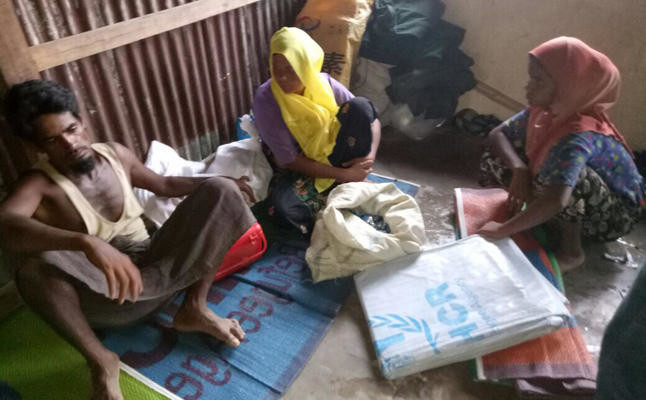
Zobaer Ahmed Rana reunion with his family after 11 years
2 / 2
Abu toyob and Anowara Begum's finally got a little chance to sit under a roof after 14 days of their life saving journey from Buchidong, Myanmar.
Updated 21 October 2017
Follow

A bittersweet reunion in a Rohingya refugee camp

COX’S BAZAR, Bangladesh: Zobaer Ahmed Rana left his parents at the age of 6 and came to Bangladesh with his uncle in search of a better life.

But the Rohingya family was reunited this week as the remaining members fled the ongoing atrocities in Myanmar.

“I haven’t seen my son for 11 years. He’s a grownup now,” Rana’s mother Anowara Begum, who entered Bangladesh as a refugee four days ago, told Arab News.

“This is the first time I see my daughter-in-law. It’s a very happy moment for our family, but we can’t celebrate at this time of crisis.”

The family and 20,000 other refugees had to wait for four days at the border to enter Bangladesh.

The family got clearance from Bangladeshi authorities on Thursday to enter the Balukhali refugee camp in Ukhia Thana.

Recent drone footage from the UN High Commissioner for Refugees (UNHCR) shows thousands of Rohingya refugees lined up for kilometers near the border.

The UNHCR has expressed grave concern over the condition of the stranded refugees, who have little to no food, water or shelter, and are weakened by days of travelling on foot.

“We’re advocating with the Bangladesh authorities to urgently admit these refugees fleeing violence and increasingly difficult conditions back home. Every minute counts given the fragile condition they’re arriving in,” said UNHCR spokesman Andrej Mahecic.

“They’re waiting for permission to move away from the border, where the sound of gunfire continues to be heard every night from the Myanmar side.”

Rana told Arab News: “My 25-member family started the journey toward Bangladesh on Oct. 9. It took them four days to reach the border, during which time I was in contact with them via a cellular phone.”

He visited his family the day they arrived at the camp, giving them dried food. He said no visitors were allowed on the second day, but on the third day he was able to give them rice.

Rana has been living with his uncle in Bangladesh’s port city of Chittagong since 2004. He completed his higher secondary education, and works as an assistant at a men’s hair salon.

Rana’s father Abu Toyob told Arab News: “We lived in Buthidaung town in Myanmar’s Rakhine state for many generations. I had a grocery shop in the local market and around 5 acres of land that I inherited from my father. But now I’m penniless and faced with uncertainty regarding my family of five sons and three daughters.”

Although the international community is urging Myanmar’s military to stop its abuses in Rakhine, there is no sign of improvement in the situation.

The International Organization for Migration (IOM) recently reported that 582,000 Rohingya refugees have taken shelter in Bangladesh since the influx began on Aug. 25.

But unofficial sources put the figure at more than 600,000, and aid agencies are seeking more support from the international community to cope with increasing demand for humanitarian aid.

Top Australian writers’ festival canceled after Palestinian author barred

Updated 4 sec ago
Follow

Top Australian writers’ festival canceled after Palestinian author barred

SYDNEY: One of Australia’s top writers’ festivals was canceled on Tuesday, after 180 authors boycotted the event and its director resigned saying she could not ​be party to silencing a Palestinian author and warned moves to ban protests and slogans after the Bondi Beach mass shooting threatened free speech.
Louise Adler, the Jewish daughter of Holocaust survivors, said on Tuesday she was quitting her role at the Adelaide Writers’ Week in February, following a decision by the festival’s board to disinvite a Palestinian-Australian author.
The novelist and academic Randa Abdel-Fattah said the move to bar her was “a blatant and shameless act of anti-Palestinian racism ‌and censorship.”
Prime ‌Minister Anthony Albanese on Tuesday announced a national day ‌of ⁠mourning ​would ‌be held on January 22 to remember the 15 people killed in last month’s shooting at a Jewish Hanukkah celebration on Bondi Beach.
Police say the alleged gunmen were inspired by the Islamic State militant group, and the incident sparked nationwide calls to tackle antisemitism, and prompted state and federal government moves to tighten hate speech laws.
The Adelaide Festival board said on Tuesday its decision last week to disinvite ⁠Abdel-Fattah, on the grounds it would not be culturally sensitive for her to appear at the literary ‌event “so soon after Bondi,” was made “out of respect ‍for a community experiencing the pain ‍from a devastating event.”
“Instead, this decision has created more division and ‍for that we express our sincere apologies,” the board said in a statement.
The event would not go ahead and remaining board members will step down, it added.
Former New Zealand Prime Minister Jacinda Ardern, British author Zadie Smith, Australian author Kathy Lette, Pulitzer Prize-winning American Percival ​Everett and former Greek finance minister Yanis Varoufakis are among the authors who said they would no longer appear at the festival ⁠in South Australia state, Australian media reported.
The festival board on Tuesday apologized to Abdel-Fattah for “how the decision was represented.”
“This is not about identity or dissent but rather a continuing rapid shift in the national discourse around the breadth of freedom of expression in our nation following Australia’s worst terror attack in history,” it added.
Abdel-Fattah wrote on social media that she did not accept the apology, saying she had nothing to do with the Bondi attack, “nor did any Palestinian.”
Adler earlier wrote in The Guardian that the board’s decision to disinvite Abdel-Fattah “weakens freedom of speech and is the harbinger of a less free nation, where lobbying and political ‌pressure determine who gets to speak and who doesn’t.”
The South Australian state government has appointed a new festival board.