COX’S BAZAR: The worsening conditions of thousands for Rohingya refugees stranded in no-man’s land at the Bangladesh-Myanmar border have sparked concern among human rights organizations and NGOs.
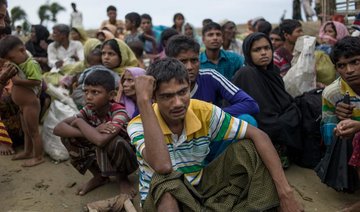
More than 6,000 Rohingya — fleeing persecution in Rakhine State, Myanmar — have been stuck in makeshift camps on the banks of Tombru Canal, on Myanmar’s side of the border, for the past 53 days.
Border Guard Bangladesh (BGB) is currently looking after them, providing food and support to around 1,279 families. Local and international NGOs are also helping to ensure clean drinking water and sanitation are available.
“Until now, 80 lavatories and more than 100 wells have been established by the NGOs for the well-being of refugees,” said Jahangir Kashem, Ghumdhum union council chairman in Bangladesh’s Bandarban district. “We are yet to receive orders from authorities regarding the eventual destination of these refugees, but, while here, they are receiving the maximum level of aid from our administration.”
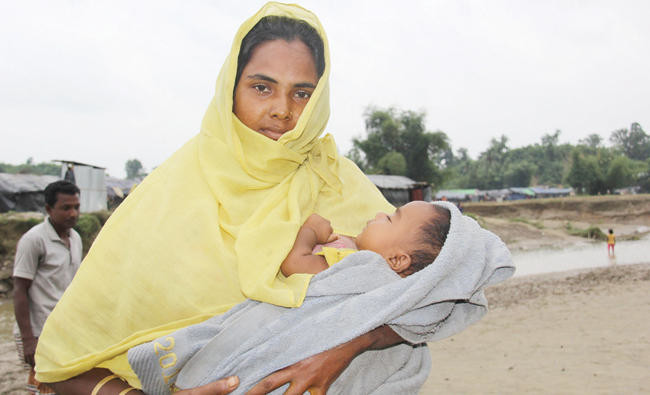
Anowara Begum, a 25-year-old refugee, told Arab News, “I gave birth to a child here at this makeshift house just 13 days after my arrival. It was a nightmare for me to deliver without the support of any doctor or midwife. The child, Yasin Arafat, is 40 days old now.”
Begum said she later received medical support from the mobile medical camps run by Bangladesh’s government, the Bangladesh Islamic foundation, the BGB, and an NGO called BRAC. In the last 53 days, around 150 babies have reportedly been born in the no-man’s land on the Bangladesh-Myanmar border.
Begum’s husband Jafor Alam, 30, was a well-off farmer in Garatobil village in Myanmar’s Mongdu district. He owned two acres of land and cultivated his own field. Begum says she and her husband began their four-day walk to the Bangladesh border after witnessing the army setting their house on fire.
“The Myanmar army approached our village, (shooting their guns in the air) and torched all the houses,” she said. “We were around 8,000 to 10,000 villagers who fled from Myanmar in one big group.”
Although the refugees receive food, medical care and other support, their position is precarious. The BGB will not allow them to cross into Bangladesh, but turning back is not an option.
“These Rohingyas are not allowed to enter into mainland Bangladesh. But considering the humanitarian ground, we allow them to shop in the local markets to fulfill their daily needs,” a member of the BGB told Arab News on condition of anonymity.
However, it is hard to find firewood in no-man’s land, so fuel for cooking is at a premium. Some refugees have risked their lives returning to Myanmar looking for wood — excursions which have reportedly led to fatal encounters with Myanmar’s Border Guard Police.
“In the border area, the Myanmar army is planting land mines so we cannot go back to our homeland,” said 43-year old Mohammad Nobi Hossain of Arakan State. “We pulled out six of these mines and dumped them in a big hole in the nearby hills right after the army planted them.
“We don’t want to go back to Myanmar amidst this violence. We are better off here,” Hossain continued. “We will live anywhere the Bangladesh government wants.”

Thousands of Rohingya fight for survival at Bangladesh border

Near record number of small boat migrants reach UK in 2025
- The second-highest annual number of migrants arrived on UK shores in small boats since records were started in 2018, the government was to confirm Thursday
LONDON: The second-highest annual number of migrants arrived on UK shores in small boats since records were started in 2018, the government was to confirm Thursday.
The tally comes as Brexit firebrand Nigel Farage’s anti-immigration party Reform UK surges in popularity ahead of bellwether local elections in May.
With Labour Prime Minister Keir Starmer increasingly under pressure over the thorny issue, his interior minister Shabana Mahmood has proposed a drastic reduction in protections for refugees and the ending of automatic benefits for asylum seekers.
Home Office data as of midday on Wednesday showed a total of 41,472 migrants landed on England’s southern coast in 2025 after making the perilous Channel crossing from northern France.
The record of 45,774 arrivals was recorded in 2022 under the last Conservative government.
The Home Office is due to confirm the final figure for 2025 later Thursday.
Former Tory prime minister Rishi Sunak vowed to “stop the boats” when he was in power.
Ousted by Starmer in July 2024, he later said he regretted the slogan because it was too “stark” and “binary” and lacked sufficient context “for exactly how challenging” the goal was.
Adopting his own “smash the gangs” slogan, Starmer pledged to tackle the problem by dismantling the people smuggling networks running the crossings but has so far had no more success than his predecessor.
Reform has led Starmer’s Labour Party by double-digit margins in opinion polls for most of 2025.
In a New Year message, Farage predicted that if Reform got things “right” at the forthcoming local elections “we will go on and win the general election” due in 2029 at the latest.
Without addressing the migrant issue directly, he added: “We will then absolutely have a chance of fundamentally changing the whole system of government in Britain.”
In his own New Year message, Starmer insisted his government would “defeat the decline and division offered by others.”
Conservative Party leader Kemi Badenoch, meanwhile, urged people not to let “politics of grievance tell you that we’re destined to stay the same.”
- Protests -
The small boat figures come after Home Secretary Mahmood in November said irregular migration was “tearing our country apart.”
In early December, an interior ministry spokesperson called the number of small boat crossings “shameful” and said Mahmood’s “sweeping reforms” would remove the incentives driving the arrivals.
A returns deal with France had so far resulted in 153 people being removed from the UK to France and 134 being brought to the UK from France, border security and asylum minister Alex Norris said.
“Our landmark one-in one-out scheme means we can now send those who arrive on small boats back to France,” he said.
The past year has seen multiple protests in UK towns over the housing of migrants in hotels.
Amid growing anti-immigrant sentiment, in September up to 150,000 massed in central London for one of the largest-ever far-right protests in Britain, organized by activist Tommy Robinson.
Asylum claims in Britain are at a record high, with around 111,000 applications made in the year to June 2025, according to official figures as of mid-November.
Labour is currently taking inspiration from Denmark’s coalition government — led by the center-left Social Democrats — which has implemented some of the strictest migration policies in Europe.
Senior British officials recently visited the Scandinavian country, where successful asylum claims are at a 40-year low.
But the government’s plans will likely face opposition from Labour’s more left-wing lawmakers, fearing that the party is losing voters to progressive alternatives such as the Greens.