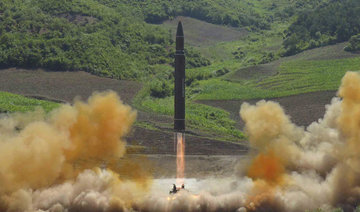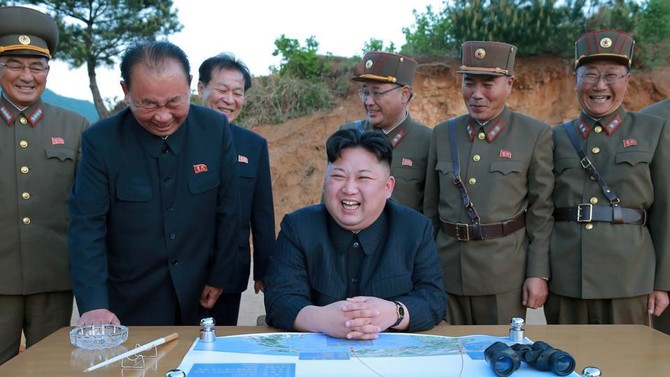
SEOUL: Kim Jong-Un boasted of North Korea’s ability to strike any target in the US after a second ICBM test that weapons experts said Saturday could even bring New York into range — in a potent challenge to President Donald Trump.
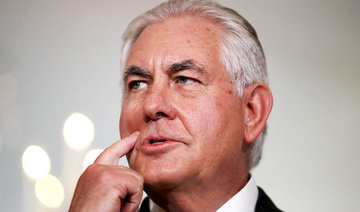
China condemned the test but US Secretary of State Rex Tillerson said Beijing and Moscow bore “unique responsibility” for the growing threat posed by the reclusive North.
Under Kim’s leadership North Korea has accelerated its drive toward a credible nuclear strike capability, in defiance of international condemnation and multiple sets of UN sanctions.
Kim said the test “is meant to send a grave warning to the US” and demonstrated the North’s ability to launch “at any place and time,” the official Korean Central News Agency (KCNA) said.
The “leader said proudly the test also confirmed all the US mainland is within our striking range,” it said.
Trump denounced the launch as “reckless and dangerous” and rejected Pyongyang’s claims that such tests helped ensure its security.
“The United States will take all necessary steps to ensure the security of the American homeland and protect our allies in the region.”
Weapons experts said the altitude and flight time of Friday’s missile suggested it was significantly more powerful than the July 4 test, with a theoretical range of around 10,000 kilometers (6,200 miles) meaning it might be able to reach east coast US cities like New York, depending on the payload size.
“North Korea seems to have made a logical step forward, as it tries to perfect the technologies to build and field an operationally-viable ICBM that can threaten the mainland United States,” said Michael Elleman, missile defense specialist at the London-based International Institute for Strategic Studies.
Kim Dong-Yub, a defense analyst at the Institute for Far Eastern Studies at Kyungnam University, said the North may have succeeded in miniaturising warheads down to 750 kilograms (1,650 pounds).
“If the missile carries a 750 kg payload, its range could be 10,000 kilometers. Taking into account the Earth’s rotation, it means it could reach not only the western cities but New York and Washington as well,” he told AFP.
Tillerson said Pyongyang’s main ally Beijing, together with Moscow, bore responsibility for the growing threat from Pyongyang.
“As the principal economic enablers of North Korea’s nuclear weapon and ballistic missile development program, China and Russia bear unique and special responsibility for this growing threat to regional and global stability,” he said.
Japanese Foreign Minister Fumio Kishida said he held telephone talks with Tillerson and agreed on the need to put “the heaviest possible pressure” on North Korea.
“We confirmed that we will closely cooperate in adopting a fresh UNSC (UN Security Council) resolution, including severe measures, and working on China and Russia,” Kishida told reporters.
In a standard response to the test, Beijing urged restraint by all sides, after the US and South Korea conducted a live-fire exercise using surface-to-surface missiles.
The heads of the US and South Korean militaries also discussed “military response options” after North Korea’s launch, the Pentagon said.
South Korea said the test had prompted it to speed up deployment of a US missile defense system.
North Korea’s unrelenting pursuit of its missile and nuclear programs poses a thorny policy challenge for Trump, who is at loggerheads with Beijing over how to handle Kim’s regime.
Trump has repeatedly urged China to rein in its recalcitrant neighbor, but Beijing insists dialogue is the only practical way forward.
Joel Wit, a senior fellow at the US-Korea Institute at Johns Hopkins University and an expert on the North’s nuclear weapons program, said Friday’s launch confirmed time was running out for Washington to find a way out of a pressing security crisis.
“Another North Korean test of what appears to be a missile that can reach the United States further emphasises the need for the Trump administration to focus like a laser on this increasingly dangerous situation,” Wit said on the institute’s 38 North website.
The North’s July 4 test triggered global alarm, with experts saying the missile had a theoretical range to reach Alaska.
There remain doubts whether the North can miniaturise a nuclear weapon to fit a missile nose cone, or if it has mastered the technology needed for the projectile to survive re-entry into the Earth’s atmosphere.
But since Kim came to power there has been a series of technical advances, including three nuclear tests and a string of missile launches.
In all, six sets of UN sanctions have been imposed on North Korea since it first tested an atomic device in 2006, but two resolutions adopted last year significantly toughened the sanctions regime.