

UAE President to make first official Pakistan visit today with Islamabad set for arrival

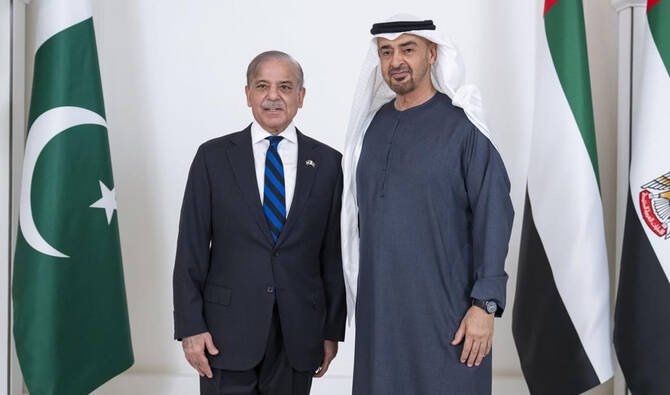
In this handout photo, released by the Pakistan Prime Minister’s Office, United Arab Emirates President Sheikh Mohamed bin Zayed Al Nahyan receives Pakistan Prime Minister Shehbaz Sharif (left) at the Qasr Al Shati in Abu Dhabi, UAE, on June 12, 2025. (PMO/File)
Short Url
Updated 26 December 2025
Follow

UAE President to make first official Pakistan visit today with Islamabad set for arrival

  • Foreign office says talks will cover investment, energy cooperation and regional stability
  • UAE is Pakistan’s third-largest trading partner and a key source of long-term investment

ISLAMABAD: Sheikh Mohamed bin Zayed Al Nahyan, President of the United Arab Emirates, is scheduled to arrive in Pakistan today, Friday, for his first official visit since assuming office, with Islamabad adorned with Pakistani and Emirati flags to mark the occasion.

The visit, taking place at the invitation of Prime Minister Shehbaz Sharif, is aimed at reviewing bilateral ties and exploring ways to deepen cooperation in trade, investment, energy and development, according to Pakistan’s foreign office.

Ahead of the visit, Islamabad has been decked out with large billboards carrying images of the visiting UAE president alongside President Asif Ali Zardari and Prime Minister Sharif.

Rehearsals were also held a day earlier along roads leading to Constitution Avenue, the seat of the government, where groups dressed in traditional attire lined both sides of the route to welcome the visiting delegation.

“During the visit, His Highness will hold a meeting with the Prime Minister of Pakistan, where the two leaders will review the entire spectrum of bilateral relations and exchange views on regional and international issues of mutual interest,” the foreign office said in a statement announcing the UAE president’s planned arrival earlier this week.

“The visit will provide an important opportunity to further strengthen the longstanding brotherly relations between Pakistan and the United Arab Emirates,” it added.

The Islamabad administration has declared a public holiday in the capital, while the traffic police have rolled out an extensive plan to manage vehicular movement during the visit.

According to the state-run Associated Press of Pakistan, heavy traffic entering the city has been barred from 6 a.m. to 12:30 a.m., with several main arteries closed and alternative routes designated.

Pakistan considers the UAE one of its closest regional and economic partners. The Gulf state is Islamabad’s third-largest trading partner after China and the United States and remains a major source of foreign investment.

Over the past two decades, Emirati investment in Pakistan has exceeded $10 billion, according to the UAE’s foreign ministry.

Policymakers in Pakistan also consider the UAE an optimal export destination due to its geographical proximity, which minimizes transportation and freight costs while facilitating commercial transactions.


Pakistan’s president defends ongoing strikes in Afghanistan, urges Kabul to dismantle militants

Updated 02 March 2026
Follow

Pakistan’s president defends ongoing strikes in Afghanistan, urges Kabul to dismantle militants

  • Afghanistan on Thursday launched attacks in retaliation for Pakistani airstrikes the previous Sunday
  • Pakistan’s military says it is only targeting Afghan military installations to avoid civilian casualties

ISLAMABAD: Pakistan’s president on Monday defended his country’s ongoing military strikes in neighboring Afghanistan, saying Islamabad tried all forms of diplomacy before targeting militants operating from Afghan territory, and called on the Taliban government in Kabul to disarm groups responsible for attacks in Pakistan.

Pakistan earlier said it is in “open war” with Afghanistan, alarming the international community. The border area remains a stronghold for militant organizations including Al-Qaeda and the Daesh (Islamic State) group.

“(The Afghan Taliban) must choose to dismantle the terror groups that survive on conflict and its war economy,” Asif Ali Zardari said during a speech to lawmakers, adding that “no state accepts serial attacks on its soil.”

Afghanistan on Thursday launched attacks in retaliation for Pakistani airstrikes the previous Sunday. Since then, Pakistan has carried out operations along the border, with Information Minister Attaullah Tarar claiming the killing of 435 Afghan forces and the capture of 31 Afghan positions.

Kabul has denied such claims.

In Afghanistan, the deputy government spokesman Hamdullah Fitrat said Pakistan’s military fired mortar shells at a refugee camp in eastern Kunar province, killing three children and injuring three others.

Afghanistan’s defense ministry said Afghan forces carried out strikes targeting a Pakistani military facility near Paktia province, causing “substantial losses and heavy casualties.”

Pakistan’s military did not respond to questions. It has said Pakistan is only targeting Afghan military installations to avoid civilian casualties.

Pakistan has witnessed a surge of violence in recent months and blames it on the outlawed Pakistani Taliban, known as Tehreek-e-Taliban Pakistan or TTP. It operates both inside Pakistan and from Afghan territory.
Islamabad accuses Afghanistan’s Taliban government of providing safe havens for the TTP, which Kabul denies.

The latest cross-border fighting ended a ceasefire brokered by Qatar and Turkiye in October. The two sides failed to reach a permanent agreement during talks in Istanbul.

Zardari reiterated Pakistan’s call for talks, saying, “We have never walked away from dialogue.”

The Pakistani leader again accused Afghanistan of acting as a proxy for India by sheltering militant groups.

“Stop being used by another country as a battlefield for their ambitions,” he said.

Zardari cited a recent report from the United Nations Security Council’s monitoring team that described the presence of militant groups in Afghanistan as an extra-regional threat.