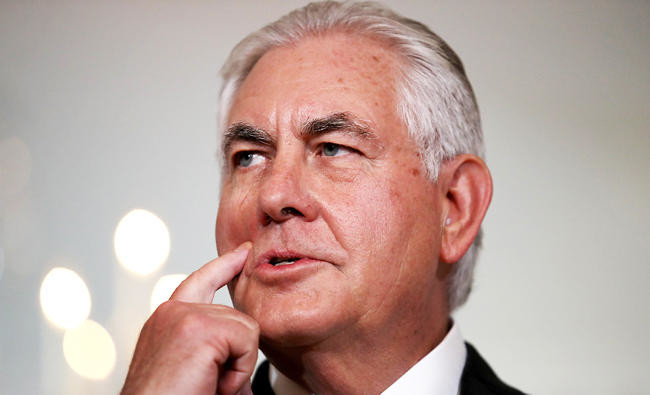
WASHINGTON: China and Russia bear “unique and special reponsibility” for the growing threat posed by North Korea, the US Secretary of State said Saturday following Pyongyang’s latest intercontinental ballistic missile test.
Leader Kim Jong-Un said the test confirmed all the US mainland was within striking range after the North’s second ICBM this month on Friday.
“As the principal economic enablers of North Korea’s nuclear weapon and ballistic missile development program, China and Russia bear unique and special responsibility for this growing threat to regional and global stability,” Rex Tillerson said in a statement.
The launch was a “blatant violation of multiple United Nations Security Council resolutions that reflect the will of the international community,” he added.
China is the regime’s last remaining major ally, while Russia’s Vladimir Putin has warned the international community should not “lose its cool” over the nuclear-armed regime.
US President Donald Trump denounced the latest ICBM launch as a “reckless and dangerous” action and rejected Pyongyang’s claims that such tests helped ensure its security.
“By threatening the world, these weapons and tests further isolate North Korea, weaken its economy, and deprive its people,” he said in a statement.
Friday’s test came just hours after the US Senate passed bipartisan sanctions on Pyongyang.
North Korea’s accelerated drive toward a credible nuclear strike capability poses a thorny policy challenge for Trump, who is at loggerheads with Beijing over how to handle Kim Jong-Un’s regime.
In all, six sets of UN sanctions have been imposed on North Korea since it first tested an atomic device in 2006, but two resolutions adopted last year significantly toughened the sanctions regime.

China, Russia responsible for North Korea nuclear threat: Tillerson
Top Australian writers’ festival canceled after Palestinian author barred
SYDNEY: One of Australia’s top writers’ festivals was canceled on Tuesday, after 180 authors boycotted the event and its director resigned saying she could not be party to silencing a Palestinian author and warned moves to ban protests and slogans after the Bondi Beach mass shooting threatened free speech.
Louise Adler, the Jewish daughter of Holocaust survivors, said on Tuesday she was quitting her role at the Adelaide Writers’ Week in February, following a decision by the festival’s board to disinvite a Palestinian-Australian author.
The novelist and academic Randa Abdel-Fattah said the move to bar her was “a blatant and shameless act of anti-Palestinian racism and censorship.”
Prime Minister Anthony Albanese on Tuesday announced a national day of mourning would be held on January 22 to remember the 15 people killed in last month’s shooting at a Jewish Hanukkah celebration on Bondi Beach.
Police say the alleged gunmen were inspired by the Islamic State militant group, and the incident sparked nationwide calls to tackle antisemitism, and prompted state and federal government moves to tighten hate speech laws.
The Adelaide Festival board said on Tuesday its decision last week to disinvite Abdel-Fattah, on the grounds it would not be culturally sensitive for her to appear at the literary event “so soon after Bondi,” was made “out of respect for a community experiencing the pain from a devastating event.”
“Instead, this decision has created more division and for that we express our sincere apologies,” the board said in a statement.
The event would not go ahead and remaining board members will step down, it added.
Former New Zealand Prime Minister Jacinda Ardern, British author Zadie Smith, Australian author Kathy Lette, Pulitzer Prize-winning American Percival Everett and former Greek finance minister Yanis Varoufakis are among the authors who said they would no longer appear at the festival in South Australia state, Australian media reported.
The festival board on Tuesday apologized to Abdel-Fattah for “how the decision was represented.”
“This is not about identity or dissent but rather a continuing rapid shift in the national discourse around the breadth of freedom of expression in our nation following Australia’s worst terror attack in history,” it added.
Abdel-Fattah wrote on social media that she did not accept the apology, saying she had nothing to do with the Bondi attack, “nor did any Palestinian.”
Adler earlier wrote in The Guardian that the board’s decision to disinvite Abdel-Fattah “weakens freedom of speech and is the harbinger of a less free nation, where lobbying and political pressure determine who gets to speak and who doesn’t.”
The South Australian state government has appointed a new festival board.