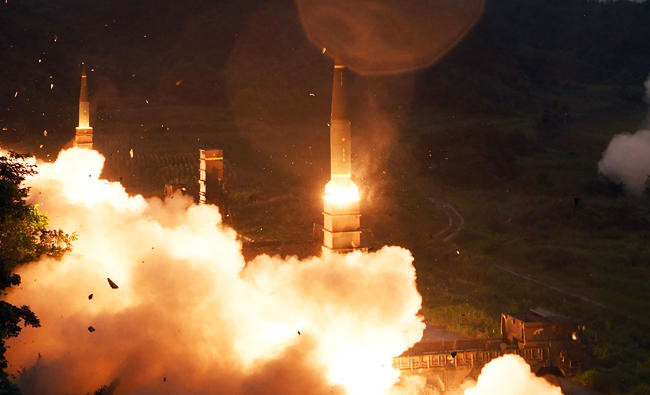
PYONGYANG, North Korea: North Korea test-fired on Friday its second intercontinental ballistic missile, which flew longer and higher than its first ICBM launched earlier this month, officials said.
“We assess that this missile was an intercontinental ballistic missile, as had been expected,” Pentagon spokesman Navy Capt. Jeff Davis said in Washington.
The missile was launched on very high trajectory, which limited the distance it traveled, and landed west of Japan’s island of Hokkaido.
Japanese Prime Minister Shinzo Abe called it a “serious and real threat” to the country’s security. North Korea’s development of ICBM technology is a major step toward its goal of developing nuclear-armed missiles capable of reaching as far as the United States.
Japanese government spokesman Yoshihide Suga said the missile, launched late Friday night, flew for about 45 minutes — about five minutes longer than the ICBM North Korea test-fired on July 4. He said Japan has lodged a strong protest with North Korea.
“North Korea’s repeated provocative acts absolutely cannot be accepted,” he said.
Prime Minister Abe said Japan would cooperate closely with the US, South Korea and other nations to step up pressure on North Korea to halt its missile programs.
South Korea’s Joint Chiefs of Staff said the missile reached an estimated height of 3,700 kilometers (2,300 miles) before landing at sea about 1,000 kilometers (625 miles) away. It appeared to be more advanced than the ICBM North Korea previously launched, it said.
The “Hwasong 14” ICBM test-fired earlier this month was also launched at a very steep angle, a technique called lofting, and reached a height of more than 2,500 kilometers (1,550 miles) before splashing down in the ocean 930 kilometers (580 miles) away. Analysts said that missile could be capable of reaching most of Alaska or possibly Hawaii if fired in an attacking trajectory.
Jeffrey Lewis, a missile and nonproliferation expert with the Middlebury Institute of International Studies, said in tweet that early data from Friday’s test suggest a missile with a range of about 10,000 kilometers (6,250 miles) that would be capable of reaching targets deep into the United States mainland.
South Korea’s Joint Chiefs of Staff said the missile was launched from North Korea’s northern Jagang province near the border with China. President Moon Jae-in presided over an emergency meeting of the National Security Council, which called for an emergency meeting of the UN Security Council and stronger sanctions on North Korea.
There was no immediate confirmation of the launch by North Korea. The day’s broadcast on state-run television had already ended when the news broke at around midnight Pyongyang time.
July 27 is a major national holiday in North Korea called Victory in the Fatherland Liberation War Day, marking the day when the armistice was signed ending the 1950-53 Korean War. That armistice is yet to be replaced with a peace treaty, leaving the Korean Peninsula technically in a state of war.
North Korea generally waits hours or sometimes a day or more before announcing launches, often with a raft of photos in the ruling party newspaper or on the television news. North Korean leader Kim Jong Un is usually shown at the site to observe and supervise major launches.
Late night launches are rare. North Korea usually conducts its missile and underground nuclear tests in the morning. It’s likely the North launched the missile at night and from the remote province of Jagang to demonstrate its operational versatility. To have a real deterrent, it’s important for North Korea to prove it can launch whenever and wherever it chooses, making it harder for foreign military observers trying to detect their activities ahead of time.

North Korea test-fires second ICBM, lands in sea off Japan
Walk for peace: Buddhist monks arrive in Washington after 2,300-mile journey
- Monks started in Texas, walked through nine states
- Walkers trod daily through frigid winter weather
WASHINGTON: Draped in burnt-orange robes, two dozen Buddhist monks arrived in Washington, D.C., on Tuesday on a 2,300-mile “Walk for Peace,” a self-described spiritual journey across nine states that has been cheered on by crowds of thousands. “People want this,” said Joan Donoghue, 59, from Silver Spring, Maryland, who had come out with four of her friends on Tuesday to see the monks. “I went on Sunday in Virginia and I waited outside for a long time and I talked to so many people and they all said the same thing: that our country needs this. We feel divided and people want more kindness and more compassion and more peace.”
The monks began their walk in Texas more than three months ago, at times braving frigid winter temperatures, sometimes with bare feet, to raise “awareness of peace, loving kindness, and compassion across America and the world.” The marchers continued on despite a powerful winter storm that spread a paralyzing mix of heavy snow, sleet and freezing rain from the Ohio Valley and mid-South to New England, compounded by bitter, Arctic cold gripping much of the US Accompanied by Aloka, a rescue dog from India who has gained a following on social media as “the Peace Dog,” their journey comes at a time of growing tensions in the US President Donald Trump’s tough immigration policy has seen surges of immigration agents and National Guard troops deployed in some cities, with both American citizens and immigrants killed by federal agents.
“We walk not to protest, but to awaken the peace that already lives within each of us,” said Bhikkhu Pannakara, spiritual leader of the Walk for Peace. “The Walk for Peace is a simple yet meaningful reminder that unity and kindness begin within each of us and can radiate outward to families, communities, and society as a whole.”
They will spend Tuesday and Wednesday in Washington and end their journey in nearby Annapolis, Maryland on Thursday.
The walk has garnered support from millions of people on social media, with many sharing messages of support for the monks. Supporters have braved snow and rain to meet and offer flowers to the monks as they passed through their cities. In Washington, hundreds of people came out to see the monks as they walked along a road informally known as Embassy Row because of the high number of embassies and diplomatic residences.
Coleman O’Donoghue, 62, of Washington, caught the attention of many of those onlookers as he carried a large flag with the peace symbol on a sea of blue. Tuesday was the fourth time he and his wife, Bonnie, had seen the monks.
“They are beautiful distraction from the chaos that is taking place in the city, the country and in the world right now,” O’Donoghue said. “It gives everyone a second to pause and think about something that is not as stressful as what the chaos is creating.”
While they waited hours just to see the monks for less than a minute, many of the spectators said the camaraderie and good energy made the experience worthwhile.
Julie Segor, 58, of Washington, made friends with a couple she met while waiting. Carl, 61, and Christine Varner, 65, of Maryland, pooled their flowers and fruit with her to give to the monks as they passed.
“It was a shared common interest to see the monks on the peace walk and give them some fruit and flowers,” Christine said.
During their stop in North Carolina, the state’s governor, Josh Stein, thanked the monks for bringing hope to millions with their message of peace, equality, justice and compassion.
“You are inspiring people at a time when so many are in need of inspiration,” Stein said. The Walk for Peace has made stops in Texas, Louisiana, Mississippi, Alabama, Georgia, South Carolina, North Carolina and Virginia. The monks met with spiritual and other leaders after arriving in Washington. They also held an interfaith ceremony at the National Cathedral.
During the ceremony at the cathedral, Kimberly Bassett, the District of Columbia’s secretary of state, presented the monks with a proclamation honoring them on behalf of the Washington Mayor Muriel Bowser.
“Today may mark the end of a 2,300-mile walk but it is not the end of our journey for peace. Your pilgrimage has brought people together across cities, states and communities,” Bassett said.
Although the walk has been positive, it has not been without obstacles. While walking through Dayton, Texas, a truck struck the monks’ escort vehicle, injuring several people, according to local media. Two monks sustained serious injuries and one had his leg amputated.
Despite the accident, the group continued to trek across the US to honor not only their original message of peace but also their brothers.