Culture being strangled by Kosovo’s political crisis

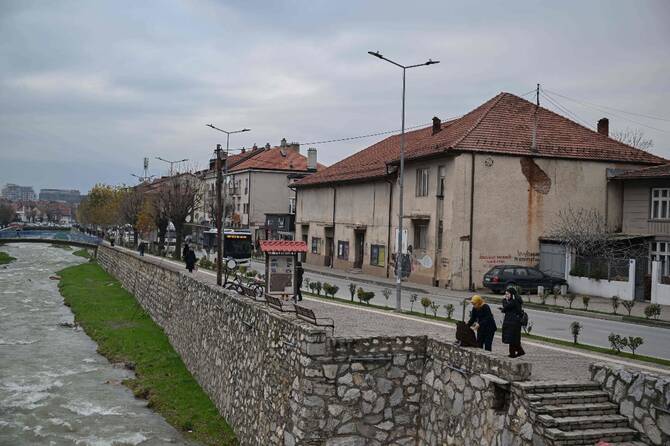
Pedestrians walk past the Lumbardhi cinema in Prizren, Kosovo. (AFP)
Short Url
Updated 26 December 2025
Follow

Culture being strangled by Kosovo’s political crisis

  • Cultural institutions have been among the hardest-hit sectors, as international funding dried up and local decisions were stalled by the parliamentary crisis

PRIZREN: Kosovo’s oldest cinema has been dark and silent for years as the famous theater slowly disintegrates under a leaky roof.
Signs warn passers-by in the historic city of Prizren that parts of the Lumbardhi’s crumbling facade could fall while it waits for its long-promised refurbishment.
“The city deserves to have the cinema renovated and preserved. Only junkies gathering there benefit from it now,” nextdoor neighbor butcher Arsim Futko, 62, told AFP.
For seven years, it waited for a European Union-funded revamp, only for the money to be suddenly withdrawn with little explanation.
Now it awaits similar repairs promised by the national government that has since been paralyzed by inconclusive elections in February.
And it is anyone’s guess whether the new government that will come out of Sunday’s snap election will keep the promise.

‘Collateral damage’ 

Cinema director Ares Shporta said the cinema has become “collateral damage” in a broader geopolitical game after the EU hit his country with sanctions in 2023.
The delayed repairs “affected our morale, it affected our lives, it affected the trust of the community in us,” Shporta said.
Brussels slapped Kosovo with sanctions over heightened tensions between the government and the ethnic Serb minority that live in parts of the country as Pristina pushed to exert more control over areas still tightly linked to Belgrade.
Cultural institutions have been among the hardest-hit sectors, as international funding dried up and local decisions were stalled by the parliamentary crisis.
According to an analysis by the Kosovo think tank, the GAP Institute for Advanced Studies, sanctions have resulted in around 613 million euros ($719 million) being suspended or paused, with the cultural sector taking a hit of 15-million-euro hit.

‘Ground zero’ 

With political stalemate threatening to drag on into another year, there are warnings that further funding from abroad could also be in jeopardy.
Since February’s election when outgoing premier Albin Kurti topped the polls but failed to win a majority, his caretaker government has been deadlocked with opposition lawmakers.
Months of delays, spent mostly without a parliament, meant little legislative work could be done.
Ahead of the snap election on Sunday, the government said that more than 200 million euros ($235 million) will be lost forever due to a failure to ratify international agreements.
Once the top beneficiary of the EU Growth Plan in the Balkans, Europe’s youngest country now trails most of its neighbors, the NGO Group for Legal and Political Studies’ executive director Njomza Arifi told AFP.
“While some of the countries in the region have already received the second tranches, Kosovo still remains at ground zero.”
Although there have been some enthusiastic signs of easing a half of EU sanctions by January, Kurti’s continued push against Serbian institutions and influence in the country’s north continues to draw criticism from both Washington and Brussels.

 ‘On the edge’

Across the river from the Lumbardhi, the funding cuts have also been felt at Dokufest, a documentary and short film festival that draws people to the region.
“The festival has had to make staff cuts. Unfortunately, there is a risk of further cuts if things don’t change,” Dokufest artistic director Veton Nurkollari said.
“Fortunately, we don’t depend on just one source because we could end up in a situation where, when the tap is turned off, everything is turned off.”
He said that many in the cultural sector were desperate for the upcoming government to get the sanctions lifted by ratification of the agreements that would allow EU funds to flow again.
“Kosovo is the only one left on the edge and without these funds.”


‘Peace and stability are ultimate prerequisites for growth and prosperity,’ Indonesia’s president tells WEF

Updated 9 sec ago
Follow

‘Peace and stability are ultimate prerequisites for growth and prosperity,’ Indonesia’s president tells WEF

  • While world faces tightening financial conditions, trade tensions, political uncertainty, ‘Indonesia continues to grow,’ says Prabowo Subianto
  • He says country does not fear economic integration

BEIRUT: History teaches us that “peace and stability are our most valuable assets” and the “ultimate prerequisites for growth and prosperity” as there will be no prosperity without peace, Indonesia’s president said on Thursday.
Prabowo Subianto, in his special address before the World Economic Forum, said: “We gather here in Davos at a time of great uncertainty; a time when wars continue to break out … a time when trust between nations, between institutions, between peoples is fragile.”
According to Subianto, the International Monetary Fund recently described Indonesia as “a global bright spot with strong economic growth amid a challenging external environment.”
While the world faced tightening financial conditions, trade tensions and political uncertainty, “Indonesia continues to grow,” Subianto said, adding that his country’s economy had grown by more than 5 percent every year over the last decade.
“I am confident that this year our growth will be higher,” he said, noting that inflation remained at about 2 percent, while the government deficit had been kept below 3 percent of gross domestic product.
He said that international institutions did not praise Indonesia because of unfounded optimism, but because of evidence. “They recognized that Indonesia’s economy is resilient,” he said, emphasizing that “peace and stability in Indonesia over the years” did not happen by chance.
He added that his country had always chosen unity over fragmentation, and friendship and collaboration over confrontation. He stressed “friendship over enmity.”
Subianto explained that his country had never defaulted on paying its debts and “succeeding regimes always pay the debts of the preceding regime.”
Regarding the economy, the Indonesian president said his country did not fear economic integration, adding: “We have been a trading nation for hundreds of years, and we now conclude trade agreements, not because it is fashionable but we consider it necessary.
“We believe in the concept of win-win. Last year we signed free trade agreements and comprehensive economic partnership agreements with Europe, the EU, Canada (and) Peru, and I have just visited the UK to sign our new strategic partnership and also an economic growth agreement.” He hopes that by 2027 Indonesia has in place a comprehensive economic partnership agreement with the UK.
Its policy is part of the country’s strategy to deepen productivity, reduce barriers and unlock private sector growth for Indonesia, ASEAN (the Association of Southeast Asian Nations) and the Global South, he said.
Subianto added in a session chaired by Borge Brende, WEF’s president and CEO: “We believe that trade integration, when done fairly, is not a threat to sovereignty. We believe trade is a tool for prosperity.
“Indonesia has a clear vision, as we are determined to become a modern country integrated with the global economy (while) providing (a) good quality of life for its citizens, living free of poverty and hunger.”
He further highlighted the importance of political and economic stability as a prerequisite for investments.
Toward the end of his address, the Indonesian president reiterated that “peace and stability is a long and arduous program.”
He added: “Indonesia chooses peace versus chaos. We want to be a friend to all, and an enemy to none. We want to be a good neighbor and a good, responsible citizen of the world, protecting the environment and protecting nature. We must not destroy nature, and live with it.
“Let us build the world we want to live in together. Let us continue the journey to improve the quality of life for all to live in peace, freedom, friendship, tolerance, coexistence, and (with) cooperation for all races, ethnicities, and religions.
“Let us continue our pursuit of justice for all, and security and freedom for all.”