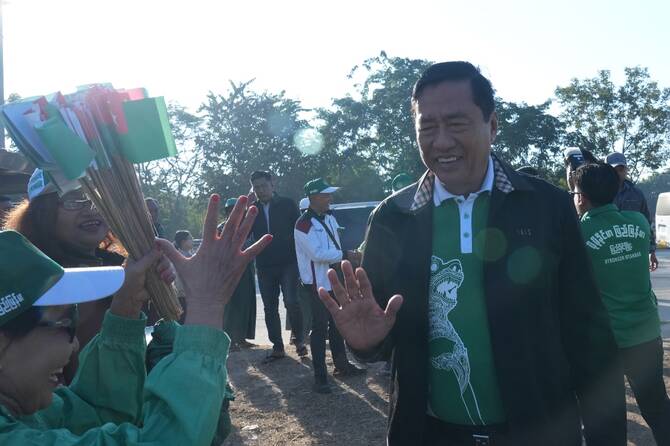
BANGKOK: Myanmar will hold the first phase of a general election on Sunday, its first vote in five years and an exercise that critics say will neither restore the country’s fragile democracy undone by a 2021 army takeover, nor end a devastating civil war triggered by the nation’s harsh military rule.
The military has framed the polls as a return to multi-party democracy, likely seeking to add a facade of legitimacy to its rule, which began after the army four years ago ousted the elected government of Aung San Suu Kyi.
The takeover triggered widespread popular opposition that has grown into a civil war. The fighting has complicated holding the polls in many contested areas.
Voting will be held in different parts of the country in three phases, with the second on Jan. 11 and the third on Jan. 25.
Human rights and opposition groups say the vote will be neither free nor fair and that power is likely to remain in the hands of military leader Senior Gen. Min Aung Hlaing.
Critics doubt a real transition to civilian rule
Richard Horsey, a Myanmar analyst for the International Crisis Group, noted that the vote is being run by the same military that was behind the 2021 coup.
“These elections are not credible at all,” he told The Associated Press. ”They do not include any of the political parties that did well in the last election or the election before.”
Horsey says the military’s strategy is for its favored Union Solidarity and Development Party to win in a landslide, shifting Myanmar from direct military rule to a government with a “civilian veneer” that perpetuates army control.
That would allow the military to claim that holding the election showed progress toward inclusiveness in the spirit of a peace proposal by the 11-member Association of Southeast Asian Nations, that calls for “constructive dialogue among all parties concerned” so they can “seek a peaceful solution in the interests of the people.”
It would also provide an excuse for neighbors like China, India and Thailand to continue their support, which they contend promotes stability in Myanmar.
Western nations have maintained sanctions against Myanmar’s ruling generals because of their anti-democratic actions and brutal war on their opponents.
The army seized power on Feb. 1, 2021, claiming the 2020 election — won in a landslide by Suu Kyi’s National League for Democracy — was illegitimate because of alleged large-scale voter registration irregularities. Independent observers, however, found no major problems.
On Sunday, ballots will be cast in 102 of the country’s 330 townships. Further rounds will follow on Jan. 11 and Jan. 25, leaving 65 townships where there would be no voting because of the ongoing conflict with ethnic guerrilla groups and resistance forces.
Though 57 parties have fielded candidates, most are posting candidates only in their own home states or regions. Six parties are competing nationwide and have a chance of winning enough seats to wield political power, but the rules make it likely the pro-military USDP will emerge in position to lead a new government.
In total, nearly 5,000 candidates are competing for more than 1,100 seats in the two chambers of the national legislature and in state and regional legislatures, though the actual number of seats that will be filled will be less where constituencies are not voting.
The Union Election Commission has yet to release the total number of eligible voters, but in 2020, there were more than 37 million.
Aung San Suu Kyi and her party are not participating
Myanmar’s 80-year-old former leader and her party are not taking part in the election. Suu Kyi is currently serving a 27-year prison term on charges widely seen as bogus and politically motivated. Her National League party was dissolved after refusing to officially register under the new military rules.
Other parties are also boycotting the vote or have declined to run under conditions they say are unfair. Opposition groups have also called for a boycott by voters.
Amael Vier, an analyst for the Asian Network for Free Elections, noted recently that Myanmar’s political parties that won 90 percent of the seats in 2020 no longer exist today.
An Election Protection Law with harsh penalties enacted this year put even more restrictions on political activity, effectively barring all public criticism of the polls. More than 200 people have been charged for leafleting or online activity over the past few months.
All this likely sets the stage for the military-backed Union Solidarity and Development Party to dominate the polls — and for 69-year-old Min Aung Hlaing to take over as president.
Repression and violence continue
The human cost of Myanmar’s conflict has been high. According to the independent Assistance Association for Political Prisoners, more than 22,000 people are currently detained for political offenses and over 7,600 civilians have been killed by security forces since the army seized power.
There are more than 3.6 million internally displaced people, most driven from their homes by warfare, marking a major humanitarian crisis.
“Myanmar is witnessing intensified violence, repression, and intimidation ahead of military-controlled elections,” the UN Human Rights Office said. It added that civilians are being threatened by both military authorities and armed opposition groups regarding participation.
Amnesty International researcher Joe Freeman said that many fear the election will only entrench the power of those responsible for years of unlawful killings.
Horsey, of the International Crisis Group, believes that after the polls, Myanmar is likely to see increased conflict as opponents attempt to prove the military still lacks popular legitimacy.


![]()

Myanmar will hold its first general election in 5 years as criticism of the military rule mounts
Short Url
https://arab.news/msk5x
Myanmar will hold its first general election in 5 years as criticism of the military rule mounts
- Voting will be held in different parts of the country in three phases, with the second on Jan. 11 and the third on Jan. 25


Latest updates


© 2026 SAUDI RESEARCH & PUBLISHING COMPANY, All Rights Reserved And subject to Terms of Use Agreement.