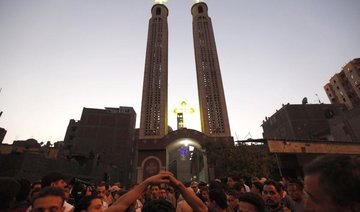
JEDDAH: Three women Egyptian police officers died in Sunday’s bombings of two Coptic Churches, the first females to die in the line of duty from the Egyptian police force.
Egyptian Interior Ministry said that Brig. Gen. Nagwa Al-Haggar, 53, died heroically when she rushed to the aid of her male colleagues to prevent a suicide bomber from entering Church of St. Mark’s in Alexandria. The attacker detonated his bomb, killing Al-Haggar and Major Emad Al-Rakaybi.
The two other female police sergeants, Asmaa Hussein and Omneya Roshdy, were among a total of seven police officers killed on Monday.
Sgt. Asmaa Mohamed, a colleague of Hussein and Roshdy, told CBC channel that one of her colleagues was planning to get married in a month, while the other left two daughters behind. “But, despite everything, we continue to be on duty— whether me or my colleagues,” Mohamed said.
Details on how the other two female officers died were not immediately available.
A security source said that Al-Haggar “is considered the first woman to be killed during duty in the female police force in the history of the Interior Ministry,” Egyptian media reported.
Due to the nature of Al-Haggar’s work, she never expected to become a victim of a terror attack.
For several years, she worked peacefully with almost no great risks in the Work Permits Department at the Security Directorate of Alexandria. She was then summoned to secure the Church of St. Mark in Alexandria on Sunday.
Al-Haggar was assigned to be in charge of inspecting people entering the church and to maintain the security of worshipers arriving for Palm Sunday services.
Al-Haggar was conducting her inspections when she observed Major Al-Rakaybi and other police officers struggling with a man who was attempted to break into the church. Al-Haggar ran to Al-Rakaybi to assist him when the terrorist detonated his bomb, killing all Al-Haggar, Al-Rakaybi and other officers.
Al-Haggar’s picture along with Al-Rakaybi were posted on the official Facebook page of the Egyptian Ministry of Interior with a caption: “When the terrorist was exposed by the security forces, he blew himself up with members of the designated security service outside the church, resulting in the martyrdom of a number of police officers from the Security Directorate of Alexandria.”
WATCH: Stopped from entering church, terrorist explodes bomb
Other male police officers killed in the attack were Essam Adeeb, Mohamed Ibrahim and Mohamed Hassan.
Al-Haggar was close to the fight and did not back down despite the danger that began to emerge in the place, according to Egyptian media.
Al-Haggar comes from a family of police officers — married to a major general and a mother of a captain. She graduated from the Police Academy in 1987.
Last year, Al-Haggar lost a son, Mahab Ezz, who was a student in the Police Academy. Mahab died of a heart attack.
Al-Haggar martyred shortly after marrying off her eldest son, Mahmoud Ezz, which aroused the sympathy of many Egyptians on social media.
Daesh has reportedly claimed responsibility for the twin attack.
Muslim extremists have increasingly targeted Egypt’s Coptic Christians, who are the largest ethno-religious minority in Egypt and consists roughly 10 percent of the country’s population.
Earlier this year, Daesh released a video footage vowing to liberate Cairo and bring explosives. “To my brothers in captivity: rejoice, you believers, do not falter or grieve,” the jihadist said in the video. “I swear to God we will very soon liberate Cairo and free you from captivity. We will come bearing explosives. I swear we will, so rejoice you believers.”