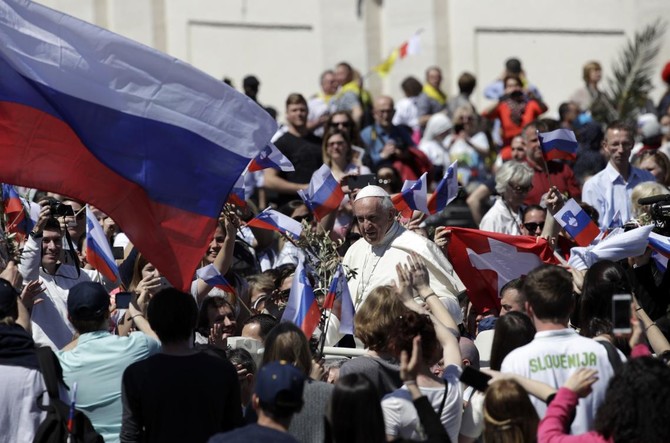
VATICAN CITY: Pope Francis on Sunday decried a deadly attack on a Coptic church in Egypt during Palm Sunday celebrations, just weeks before his planned visit to Cairo.
The pontiff expressed his “deep condolences” to the Coptic patriarch, Tawadros II, calling him “my brother,” to the Coptic church and “all of the dear Egyptian nation,” and said he was praying for the dead and injured in the attack that occurred just hours earlier as Francis himself was marking Palm Sunday in St. Peter’s Square.
The pontiff asked God “to convert the hearts of those who spread terror, violence and death, and also the hearts of those who make, and traffic in, weapons.”
The pope’s remarks on the church attack were handed to him on a piece of paper after he remembered the victims of the Stockholm attack Friday night.
The Palm Sunday celebrations in St. Peter’s Square were held under tight security, with streets surrounding St. Peter’s Square blocked to traffic and security search of the faithful entering the square.
The pope and cardinals in red robes led a solemn process clutching elaborately braided palm fronds as they walked through the throngs, followed by the papal blessing of palm fronds and olive branches.
The processions recalls the bittersweet nature of Holy Week, with the faithful clutching simple palm fronds and olive branches to commemorate Jesus’ triumphant entrance into Jerusalem only to be followed later by his death on a wooden cross.
In his homily, the pope remembered the suffering in the world today, citing those who “suffer from slave labor, from family tragedies, from diseases ... They suffer from wars and terrorism, from interests that are armed and ready to strike.”
After his traditional Sunday blessing, the pope circled the square in the pope mobile to greet the faithful.

Pope on Palm Sunday decries suffering from war, terrorism
UN’s top court opens Myanmar Rohingya genocide case
- The Gambia filed a case against Myanmar at the UN’s top court in 2019
- Verdict expected to impact Israel’s genocide case over war on Gaza
DHAKA: The International Court of Justice on Monday opened a landmark case accusing Myanmar of genocide against its mostly Muslim Rohingya minority.
The Gambia filed a case against Myanmar at the UN’s top court in 2019, two years after a military offensive forced hundreds of thousands of Rohingya from their homes into neighboring Bangladesh.
The hearings will last three weeks and conclude on Jan. 29.
“The ICJ must secure justice for the persecuted Rohingya. This process should not take much longer, as we all know that justice delayed is justice denied,” said Asma Begum, who has been living in the Kutupalong refugee camp in Bangladesh’s Cox’s Bazar district since 2017.
A mostly Muslim ethnic minority, the Rohingya have lived for centuries in Myanmar’s western Rakhine state but were stripped of their citizenship in the 1980s and have faced systemic persecution ever since.
In 2017 alone, some 750,000 of them fled military atrocities and crossed to Bangladesh, in what the UN has called a textbook case of ethnic cleansing by Myanmar.
Today, about 1.3 million Rohingya shelter in 33 camps in Cox’s Bazar, turning the coastal district into the world’s largest refugee settlement.
“We experienced horrific acts such as arson, killings and rape in 2017, and fled to Bangladesh,” Begum told Arab News.
“I believe the ICJ verdict will pave the way for our repatriation to our homeland. The world should not forget us.”
A UN fact-finding mission has concluded that the Myanmar 2017 offensive included “genocidal acts” — an accusation rejected by Myanmar, which said it was a “clearance operation” against militants.
Now, there is hope for justice and a new future for those who have been displaced for years.
“We also have the right to live with dignity. I want to return to my homeland and live the rest of my life in my ancestral land. My children will reconnect with their roots and be able to build their own future,” said Syed Ahmed, who fled Myanmar in 2017 and has since been raising his four children in the Kutupalong camp.
“Despite the delay, I am optimistic that the perpetrators will be held accountable through the ICJ verdict. It will set a strong precedent for the world.”
The Myanmar trial is the first genocide case in more than a decade to be taken up by the ICJ. The outcome will also impact the genocide case that Israel is facing over its war on Gaza.
“The momentum of this case at the ICJ will send a strong message to all those (places) around the world where crimes against humanity have been committed,” Nur Khan, a Bangladeshi lawyer and human rights activist, told Arab News.
“The ICJ will play a significant role in ensuring justice regarding accusations of genocide in other parts of the world, such as the genocide and crimes against humanity committed by Israel against the people of Gaza.”