Attacker among 4 dead in UK parliament 'terrorist' attack

1 / 6
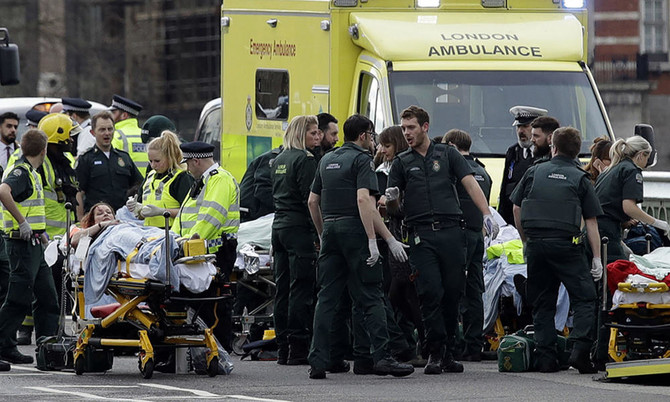
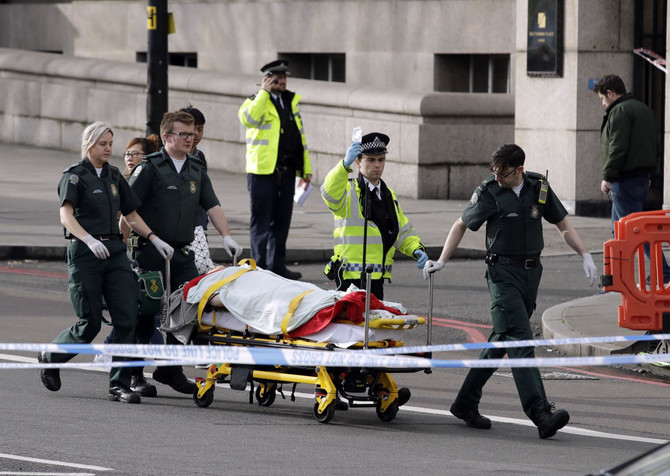
Emergency services staff provide medical attention close to the Houses of Parliament in London on Wednesday. (AP Photo/Matt Dunham)
2 / 6
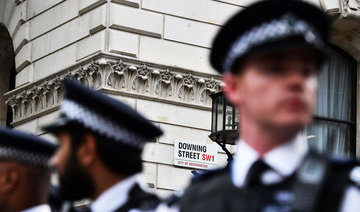
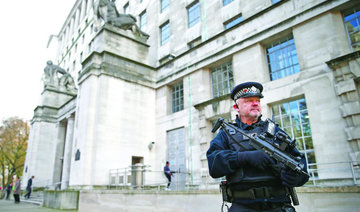
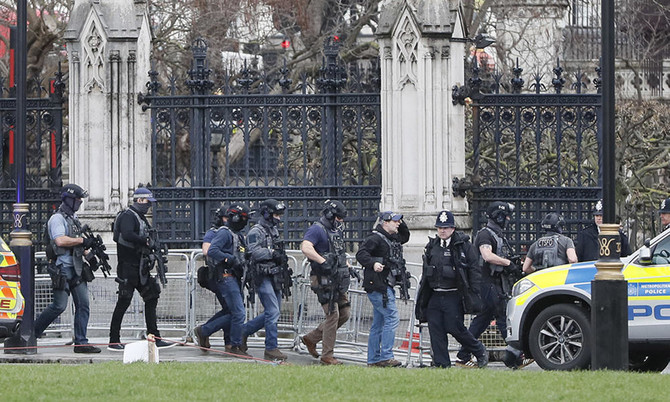
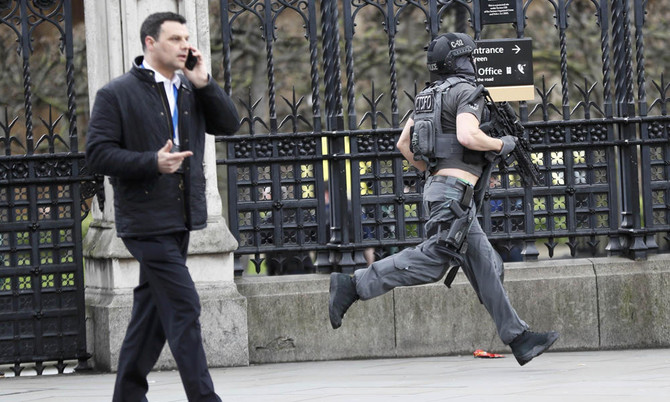
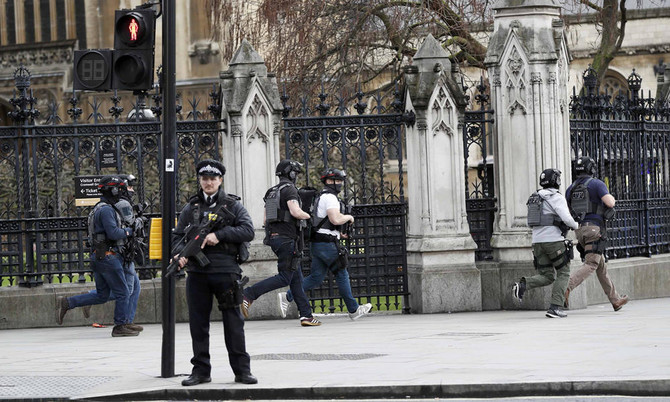
Armed police respond outside Parliament during an incident on Westminster Bridge in London on Wednesday. (REUTERS/Stefan Wermuth)
3 / 6
Emergency services staff provide medical attention close to the Houses of Parliament in London on Wednesday. (AP Photo/Matt Dunham)
4 / 6
Armed police officers enter the Houses of Parliament in London on Wednesday after the House of Commons sitting was suspended as witnesses reported sounds like gunfire outside. (AP Photo/Kirsty Wigglesworth)
5 / 6
Armed police respond outside Parliament during an incident on Westminster Bridge in London on Wednesday. (REUTERS/Stefan Wermuth)
6 / 6
Armed police respond outside Parliament during an incident on Westminster Bridge in London on Wednesday. (REUTERS/Stefan Wermuth)
Updated 24 March 2017
Follow

Attacker among 4 dead in UK parliament 'terrorist' attack

LONDON: Four people were killed and at least 20 injured in London on Wednesday after an attacker stabbed a policeman and a car plowed into pedestrians close to the British parliament, in what police called a terrorist incident.
The dead included the assailant and the policeman he stabbed, while the other two victims were among the pedestrians hit by the car as it tore along Westminster Bridge, which is right next to parliament.
“We’ve declared this as a terrorist incident and the counter-terrorism command are carrying out a full-scale investigation into the events today,” Mark Rowley, Britain’s most senior counter-terrorism officer, told reporters.
“The attack started when a car was driven over Westminster Bridge, hitting and injuring a number of members of the public, also including three police officers on their way back from a commendation ceremony.
“A car then crashed near to parliament and at least one man, armed with a knife continued the attack and tried to enter parliament.”
Witnesses who were inside parliament at the time heard loud bangs and shortly afterwards saw the knifeman and the stabbed policeman lying on the ground in a courtyard just outside, within the gated perimeter of the parliamentary estate.
Chris Doyle, director of the Council for Arab-British Understanding (Caabu), was inside the parliament building's Central Lobby on Wednesday afternoon when the incident happened.
He said that the parliament building was on lockdown and that there were "several hundred" people inside.
An announcement by officials said that there was a suspect vehicle outside the parliament that it was being dealt with by bomb squad units, Doyle said.
"It's calm now but there was panic earlier," Doyle told Arab News at 4 p.m. local time.
He said that a mass of people were trapped inside the building.
"Armed police are everywhere milling amongst politicians, the public and schoolchildren," he said.
Muddassar Ahmed, managing partner at Unitas Communications Ltd., and also an Arab News columnist, said he too was on lockdown inside the parliament building.
He was visiting an MP’s office in the building. After the alert was raised they were asked to evacuate the office but then told to return.
Police were carrying out “a door-to-door search” of the building, Ahmed told Arab News.
He said he was feeling “shaken” after about an hour on lockdown, with armed police still moving through the parliament building.
A Reuters photographer said he saw at least a dozen people injured on the bridge. His photographs showed people lying on the ground, some of them bleeding heavily and one under a bus.
A woman was pulled alive, but with serious injuries, from the Thames, the Port of London Authority said. The circumstances of her fall into the river were unclear.
Three French schoolchildren aged 15 or 16 were among those injured in the attack, French officials said.
The attack took place on the first anniversary of attacks by Islamist militants that killed 32 people in Brussels.

Bridge incident
On the bridge, witnesses said a vehicle struck several people, and photos showed a car plowed into railings.
The former Polish foreign minister Radoslaw Sikorski posted a video on Twitter that showed people lying injured on the bridge.
Sikorski, a senior fellow at Harvard Center for European Studies, says he saw at least five people lying on the ground after being “mown down” by a car.
The scene unfolded within clear sight of the London Eye, a large ferris wheel with viewing pods with views of the capital. Footage showed the pods full as viewers watched police and medical crews on the bridge.
The city was also on alert for the Thursday funeral of Martin McGuinness, former IRA commander.
The threat level for international terrorism in the UK was listed at severe. The city was also on alert for the Thursday funeral of Martin McGuinness, former IRA commander.

Parliament session suspended
“I just saw a car go out of control and just go into pedestrians on the bridge,” eyewitness Bernadette Kerrigan told Sky News. She was on a tour bus on the bridge at the time.
“As we were going across the bridge, we saw people lying on the floor, they were obviously injured. I saw about 10 people maybe. And then the emergency services started to arrive. Everyone was just running everywhere.”
The House of Commons, which was in session at the time, was immediately suspended and lawmakers were asked to stay inside.
Prime Minister Theresa May was safe after the incident, a spokesman for her office said. He declined to say where May was when the attack took place.
Journalist Quentin Letts of the Daily Mail newspaper told LBC radio that he had witnessed the stabbing of the policeman and the shooting of the assailant from his office in the parliament building.
“He (the assailant) ran in through the open gates ... He set about one of the policemen with what looked like a stick,” Letts said.
“The policeman fell over on the ground and it was quite horrible to watch and then having done that, he disengaged and ran toward the House of Commons entrance used by MPs (members of parliament) and got about 20 yards or so when two plain-clothed guys with guns shot him.”
Britain is on its second-highest alert level of “severe” meaning an attack by militants is considered highly likely.
In May 2013, two British Islamists stabbed to death soldier Lee Rigby on a street in southeast London.
In July 2005, four British Islamists killed 52 commuters and themselves in suicide bombings on the British capital’s transport system in what was London’s worst peacetime attack. (With Reuters)

US signs new health deals with 9 African countries that mirror Trump’s priorities

A pharmacist counts HIV medicine inside a clinic in Ha Lejone, Lesotho, July 16, 2025. (AP)
Updated 4 sec ago
Follow

US signs new health deals with 9 African countries that mirror Trump’s priorities

  • US aid cuts have crippled health systems across the developing world, including in Africa, where many countries relied on the funding for crucial programs, including those responding to outbreaks of disease
  • The agreements signed so far, with Kenya, Nigeria and Rwanda among others, are the first under the new global health framework, which makes aid dependent on negotiations between the recipient country and the US

JOHANNESBURG: The US government has signed health deals with at least nine African countries, part of its new approach to global health funding, with agreements that reflect the Trump administration’s interests and priorities and are geared toward providing less aid and more mutual benefits.
The agreements signed so far, with Kenya, Nigeria and Rwanda among others, are the first under the new global health framework, which makes aid dependent on negotiations between the recipient country and the US.
Some of the countries that have signed deals either have been hit by US aid cuts or have separate agreements with the Trump administration to accept and host third-country deportees, although officials have denied any linkage.
The Trump administration says the new “America First” global health funding agreements are meant to increase self-sufficiency and eliminate what it says are ideology and waste from international assistance. The deals replace a patchwork of previous health agreements under the now-dismantled United States Agency for International Development.
US aid cuts have crippled health systems across the developing world, including in Africa, where many countries relied on the funding for crucial programs, including those responding to outbreaks of disease.
The new approach to global health aligns with President Donald Trump’s pattern of dealing with other nations transactionally, using direct talks with foreign governments to promote his agenda abroad. It builds on his sharp turn from traditional US foreign assistance, which supporters say furthered American interests by stabilizing other countries and economies and building alliances.
A different strategy
The deals mark a sharp departure from how the US has provided health care funding over the years and mirrors the Trump administration’s interests.
South Africa, which has lost most of its US funding — including $400 million in annual support — due in part to its disputes with the US, has not signed a health deal, despite having one of the world’s highest HIV prevalence rates.
Nigeria, Africa’s most populous country, reached a deal but with an emphasis on Christian-based health facilities, although it has a slight majority Muslim population. Rwanda and Uganda, which each have deportation deals with the US, have announced the health pacts.
Cameroon, Eswatini, Lesotho, Liberia and Mozambique also are among those that have signed health deals with the US
According to the Center for Global Development, a Washington think tank, the deals “combine US funding reductions, ambitious co-financing expectations, and a shift toward direct government-to-government assistance.”
The deals represent a reduction in total US health spending for each country, the center said, with annual US financial support down 49 percent compared with 2024.
A faith-based deal in Nigeria, a lifeline for several others

Under its deal, Nigeria, a major beneficiary of USAID funds, would get support that has a “strong emphasis” on Christian faith-based health care providers.
The US provided approximately $2.3 billion in health assistance to Nigeria between 2021 and 2025, mostly through USAID, official data shows. The new five-year agreement will see US support at over $2 billion, while Nigeria is expected to raise $2.9 billion to boost its health care programs.
The agreement “was negotiated in connection with reforms the Nigerian government has made to prioritize protecting Christian populations from violence and includes significant dedicated funding to support Christian health care facilities,” the State Department said in a statement.
The department said “the president and secretary of state retain the right to pause or terminate any programs which do not align with the national interest,” urging Nigeria to ensure “that it combats extremist religious violence against vulnerable Christian populations.”
For several other countries, the new deals could be a lifeline after US aid cuts crippled their health care systems and left them racing to fill the gaps.
Under its deal, Mozambique will get US support of over $1.8 billion for HIV and malaria programs. Lesotho, one of the poorest countries in the world, clinched a deal worth over $232 million.
In the tiny kingdom of Eswatini, the US committed to provide up to $205 million to support public health data systems, disease surveillance and outbreak response, while the country agreed to increase domestic health expenditures by $37 million.
No deal for South Africa after disputes
South Africa is noticeably absent from the list of signatories following tensions with the Trump administration.
Trump has said he will cut all financial assistance to South Africa over his widely rejected claims that it is violently persecuting its Afrikaner white minority.
The dismantling of USAID resulted in the loss of over $436 million in yearly financing for HIV treatment and prevention in South Africa, putting the program and thousands of jobs in the health care industry at risk.
Health compacts with countries that signed deportation deals
At least four of the countries that have reached deals previously agreed to receive third-country deportees from the US, a controversial immigration policy that has been a trademark of the Trump administration.
The State Department has denied any linkage between the health care compacts and agreements regarding accepting third-country asylum seekers or third-country deportees from the United States. However, officials have said that political considerations unrelated to health issues may be part of the negotiations.
Rwanda, one of the countries with a deportation deal with the US, signed a $228 million health pact requiring the US to support it with $158 million.
Uganda, another such country, signed a health deal worth nearly $2.3 billion in which the US will provide up to $1.7 billion. Also Eswatini, which has started receiving flights with deported prisoners from the US