

Barrick Gold in talks with IFC, other agencies to raise $2 billion for Pakistan’s Reko Diq

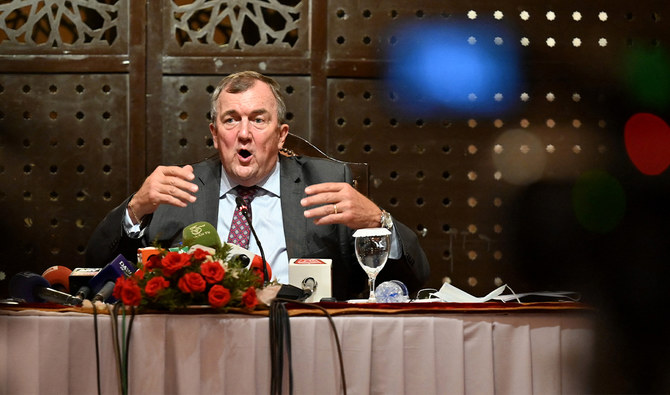
Mark Bristow, president and chief executive of Canadian gold and copper mining company Barrick Gold corporation, speaks to members of the media after his meeting with Pakistan’s minister of finance in Islamabad on July 18, 2022. (AFP/File)
Short Url
Updated 01 May 2024
Follow

Barrick Gold in talks with IFC, other agencies to raise $2 billion for Pakistan’s Reko Diq

  • Reko Diq in southwestern Pakistan is one of world’s biggest under-developed copper mines 
  • Barrick Gold CEO says mining company needs $2 billion for first phase of Reko Diq project

TORONTO: Barrick Gold is not interested in bidding for Anglo American, which last week received a $39 billion takeover offer from BHP, and is building its own copper portfolio, the Canadian miner’s CEO Mark Bristow said on Wednesday.

If BHP’s proposed acquisition of Anglo is successful, it would create one of the world’s biggest copper miners.

Analysts and investors expect rival bids to emerge after BHP’s offer was rejected last week by Anglo, which said it was opportunistic, significantly undervaluing the company and its future prospects.

“We are not interested in bidding for Anglo American, as we are building (copper assets) of our own,” Bristow told Reuters.

Bristow is betting on developing the Reko Diq copper project in Pakistan in which it holds a 50 percent stake, the first phase of which is expected to cost $5.5 billion.

Barrick is in talks with the International Finance Corporation and other agencies to raise at least $2 billion for the first phase of the project, Bristow added.

Reko Diq, one of the biggest yet-to-be-developed copper mines in the world, is also 50 percent owned by the government of Pakistan. Saudi Arabia is in talks to buy part of the stake from the Pakistan government.

In Mali, where Barrick has a gold mine, the military-led government was last year in talks with miners over a change to its mining law that could see it boost state and private Malian interests in new projects to 35 percent from up to 20 percent previously.

However, Bristow said that the company has received written assurances from the junta that there was no threat of its assets being nationalized.


Minister says Pakistan’s Hajj 2026 policy ‘effective,’ in line with Saudi guidelines

Updated 5 sec ago
Follow

Minister says Pakistan’s Hajj 2026 policy ‘effective,’ in line with Saudi guidelines

  • A large portion of the Pakistan’s private Hajj quota for 2025 remained unutilized due to delays by tour operators
  • While the government fulfilled its full allocation, private operators attributed the shortfall to technical issues

ISLAMABAD: Pakistan’s Minister for Religious Affairs Sardar Muhammad Yousaf has said the government formulated an “effective” Hajj Policy 2026 that is in accordance with guidelines issued by Saudi Arabia.

Pakistan approved the Hajj 2026 policy in July, under which the country has a quota of 179,210 pilgrims. Of which, around 120,000 seats have been allocated for the government scheme and the rest for private tour operators.

The government ensured digitization of Hajj services, electronic monitoring and complaint system, long and short duration Hajj packages, and prioritizing those who could not perform the pilgrimage under the private scheme last year.

Speaking to the state-run Radio Pakistan broadcaster, Yousaf said that the government is trying to expand the “Route to Makkah” facility to Lahore. The initiative allows pilgrims to complete travel formalities at their departure airports.

“Training for the 2026 Hajj is currently underway across the country, with mandatory sessions being conducted in various districts,” the minister was quoted as saying.

A large portion of the Pakistan’s private Hajj quota for 2025 remained unutilized due to delays by tour operators in meeting payment and registration deadlines, while the government fulfilled its full allocation of over 88,000 pilgrims.

Private operators had attributed the shortfall to technical issues, including payment processing problems and communication breakdowns.

Pakistan this month also requested Saudi Arabia to increase its Hajj quota in proportion to the country’s population of 240 million, Radio Pakistan reported.

“Pakistan has formally requested the Saudi government to increase its Hajj quota to 230,000, in proportion to the country’s population, to allow more people to undertake the pilgrimage,” Yousaf was quoted as saying.