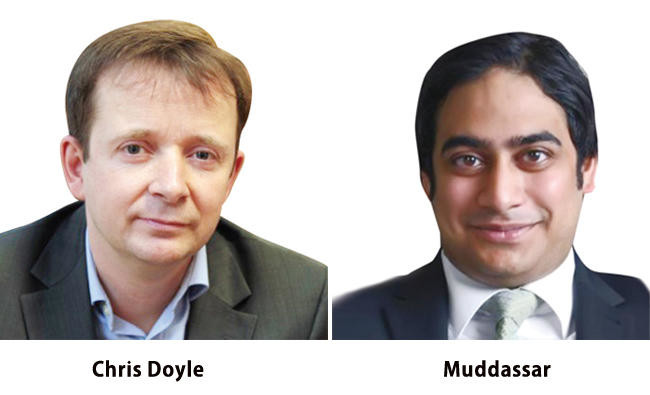
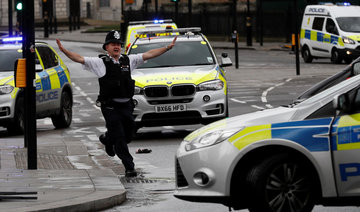
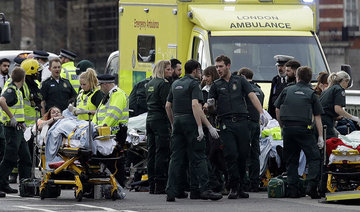
Arab News columnists Chris Doyle and Muddassar Ahmed were among hundreds trapped inside the Parliament building in London during the suspected terror attack.
Doyle, director of the Council for Arab-British Understanding (CAABU), was inside the building’s central lobby Wednesday afternoon when the attack took place. He said the building was on lockdown and there were “several hundred” people inside.
Officials annou-nced that there was a suspect vehicle outside Parliament that was being dealt with by bomb-squad units, Doyle said.
“It’s calm now but there was panic earlier,” he told Arab News at 4 p.m. local time, adding that a mass of people were trapped inside the building. “Armed police are everywhere milling among politicians, the public and schoolchildren.”
He tweeted from his handle @Doylech: “Bottles of water passed around by Parliamentary staff. People seated on the floor. Indescribable feeling of shock. People still scared. But seems police in control.”
In other tweets, he wrote: “Those in the dining room in Commons with us hid under tables. Terrified people as police were shouting to get out and go to Central Lobby. Coincidental or deliberate but the attack took place at around time of Division in Parliament. First vote of the week.”
Ahmed, managing partner at Unitas Communications Ltd., said he too was on lockdown inside the Parliament building on Wednesday afternoon.
He was visiting an MP’s office in the building. After the alert was raised they were asked to evacuate the office, but then told to return. Police were carrying out “a door-to-door search” of the building, Ahmed told Arab News.
He said he was feeling “shaken” after about an hour on lockdown, with armed police still moving through the building. “Missed the Westminster attack by minutes,” he wrote on his Twitter handle @unitascomms.

Two Arab News columnists recall Parliament building lockdown
UK govt bans pro-Palestinian march over alleged Iran support
- The UK government has banned an annual pro-Palestinian march planned for Sunday which London police claim is organized by a group “supportive of the Iranian regime“
LONDON: The UK government has banned an annual pro-Palestinian march planned for Sunday which London police claim is organized by a group “supportive of the Iranian regime.”
Interior minister Shabana Mahmood said late Tuesday she had approved the rare police request to prevent “serious public disorder” if the Al-Quds Day march and counter-protests had gone ahead.
It is the first time a protest march has been banned since 2012 but a static demonstration will be permitted, according to London’s Metropolitan police.
Mahmood said she was “satisfied” a ban was “necessary” due to “the scale of the protest and multiple counter-protests, in the context of the ongoing conflict in the Middle East.”
The minister added that she expected to see “the full force of the law applied to anyone spreading hatred and division.”
The Islamic Human Rights Commission (IHRC), an NGO which organizes the annual Al-Quds Day march, said it “strongly condemns” the decision, which it called “politically charged.”
“We are seeking legal advice and this decision will not go unchallenged,” it added, accusing the Met of having “brazenly abandoned their sworn principle of policing without fear or favor.”
It said the London force “unashamedly regurgitate Zionist talking points about the IHRC “without a shred of evidence.”
The group describes the day and march as an “international demonstration ... in support of Palestinians and all the oppressed around the world.”
- ‘Unique risks’ -
Al-Quds day, which takes its name from the Arabic for Jerusalem, originated in Iran in 1979 in support of the Palestinian people, and is now marked annually in various countries, notably in the Muslim world. It aims to protest Israel’s occupation of east Jerusalem.
But the Met’s Assistant Commissioner Ade Adelekan said it was “uniquely contentious having originated in Iran and in London is organized by the Islamic Human Rights Commission.”
He claimed that the organization was “supportive of the Iranian regime.”
“The threshold to ban a protest is high and we do not take this decision lightly,” Adelekan said.
He noted the Met has “a proven track record” of permitting free speech and protest rights at dozens of major pro-Palestinian and other demonstrations in recent years.
“But in our assessment this march raises unique risks and challenges,” he said.
“We must consider the likely high numbers of protesters and counter protesters coming together and the extreme tensions between different factions.
“We have taken into consideration the likely impact on protests of the volatile situation in the Middle East, with the Iranian regime attacking British allies and military bases overseas.”
The ban on the march and any associated counter-protest marches is valid for a month from Wednesday.
Interior minister Shabana Mahmood said late Tuesday she had approved the rare police request to prevent “serious public disorder” if the Al-Quds Day march and counter-protests had gone ahead.
It is the first time a protest march has been banned since 2012 but a static demonstration will be permitted, according to London’s Metropolitan police.
Mahmood said she was “satisfied” a ban was “necessary” due to “the scale of the protest and multiple counter-protests, in the context of the ongoing conflict in the Middle East.”
The minister added that she expected to see “the full force of the law applied to anyone spreading hatred and division.”
The Islamic Human Rights Commission (IHRC), an NGO which organizes the annual Al-Quds Day march, said it “strongly condemns” the decision, which it called “politically charged.”
“We are seeking legal advice and this decision will not go unchallenged,” it added, accusing the Met of having “brazenly abandoned their sworn principle of policing without fear or favor.”
It said the London force “unashamedly regurgitate Zionist talking points about the IHRC “without a shred of evidence.”
The group describes the day and march as an “international demonstration ... in support of Palestinians and all the oppressed around the world.”
- ‘Unique risks’ -
Al-Quds day, which takes its name from the Arabic for Jerusalem, originated in Iran in 1979 in support of the Palestinian people, and is now marked annually in various countries, notably in the Muslim world. It aims to protest Israel’s occupation of east Jerusalem.
But the Met’s Assistant Commissioner Ade Adelekan said it was “uniquely contentious having originated in Iran and in London is organized by the Islamic Human Rights Commission.”
He claimed that the organization was “supportive of the Iranian regime.”
“The threshold to ban a protest is high and we do not take this decision lightly,” Adelekan said.
He noted the Met has “a proven track record” of permitting free speech and protest rights at dozens of major pro-Palestinian and other demonstrations in recent years.
“But in our assessment this march raises unique risks and challenges,” he said.
“We must consider the likely high numbers of protesters and counter protesters coming together and the extreme tensions between different factions.
“We have taken into consideration the likely impact on protests of the volatile situation in the Middle East, with the Iranian regime attacking British allies and military bases overseas.”
The ban on the march and any associated counter-protest marches is valid for a month from Wednesday.
© 2026 SAUDI RESEARCH & PUBLISHING COMPANY, All Rights Reserved And subject to Terms of Use Agreement.