Minnesota man who regrets joining Daesh group faces sentencing on terrorism charge

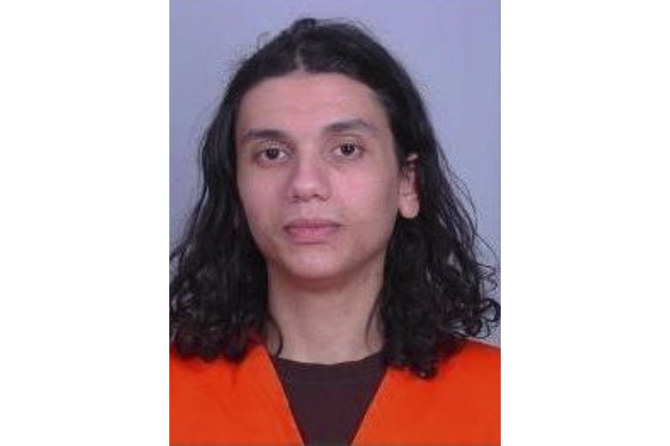
This image provided by the Sherburne County Jail in Elk River, Minn, shows Abelhamid Al-Madioum, a Minnesota man who once fought for Daesh in Syria. (AP)
Short Url
Updated 01 May 2024
Follow

Minnesota man who regrets joining Daesh group faces sentencing on terrorism charge

  • Federal prosecutors have recommended 12 years for Abelhamid Al-Madioum in recognition both of the seriousness of his crime and the help has he given the US
  • Al-Madioum was 18 in 2014 when Daesh recruited him

MINNEAPOLIS, USA: A Minnesota man who once fought for the Daesh group in Syria but now expresses remorse for joining a “death cult” and has been cooperating with federal authorities will learn Wednesday how much prison time he faces.
Federal prosecutors have recommended 12 years for Abelhamid Al-Madioum in recognition both of the seriousness of his crime and the help has he given the US and other governments. His attorney says seven years is enough and that Al-Madioum, 27, stopped believing in the group’s extremist ideology years ago.
Al-Madioum was 18 in 2014 when Daesh recruited him. The college student slipped away from his family on a visit to their native Morocco in 2015. Making his way to Syria, he became a soldier for Daesh, until he was maimed in an explosion in Iraq. Unable to fight, he used his computer skills to serve the group. He surrendered to US-backed rebels in 2019 and was imprisoned under harsh conditions.
Al-Madioum returned to the US in 2020 and pleaded guilty in 2021 to providing material support to a designated terrorist organization. According to court filings, he has been cooperating with US authorities and allied governments. The defense says he hopes to work in future counterterrorism and deradicalization efforts.
“The person who left was young, ignorant, and misguided,” Al-Madioum said in a letter to US District Judge Ann Montgomery, who will sentence him.
“I’ve been changed by life experience: by the treachery I endured as a member of Daesh, by becoming a father of four, a husband, an amputee, a prisoner of war, a malnourished supplicant, by seeing the pain and anguish and gnashing of teeth that terrorism causes, the humiliation, the tears, the shame,” he added. “I joined a death cult, and it was the biggest mistake of my life.”
Prosecutors acknowledge that Al-Madioum has provided useful assistance to US authorities in several national security investigations and prosecutions, that he accepted responsibility for his crime and pleaded guilty promptly on his return to the US But they say they factored his cooperation into their recommended sentence of 12 years instead of the statutory maximum of 20 years.
“The defendant did much more than harbor extremist beliefs,” prosecutors wrote in a sentencing memo. “He chose violent action by taking up arms for Daesh.”
A naturalized US citizen, Al-Madioum was among several Minnesotans suspected of leaving the US to join the Daesh group, along with thousands of fighters from other countries worldwide. Roughly three dozen people are known to have left Minnesota to join militant groups in Somalia or Syria. In 2016, nine Minnesota men were sentenced on federal charges of conspiring to join Daesh.
But Al-Madioum is one of the relatively few Americans who’ve been brought back to the US who actually fought for the group. According to a defense sentencing memo, he’s one of 11 adults as of 2023 to be formally repatriated to the US from the conflict in Syria and Iraq to face charges for terrorist-related crimes and alleged affiliations with Daesh. Others received sentences ranging from four years to life plus 70 years.
Al-Madioum grew up in the Minneapolis suburb of St. Louis Park in a loving and nonreligious family, the defense memo said. He joined Daesh because he wanted to help Muslims who he believed were being slaughtered by Syrian President Bashar Assad’s regime in that country’s civil war. Daesh recruiters persuaded him “to test his faith and become a real Muslim.”
But he was a fighter for less than two months before he lost his right arm below the elbow in the explosion that also left him with two badly broken legs and other severe injuries. He may still require amputation of one leg, the defense says.
While recuperating in 2016, he met his first wife Fatima, an Daesh widow who already had a son and bore him another in 2017. They lived in poverty and under constant airstrikes. He was unable to work, and his stipend from Daesh stopped in 2018. They lived in a makeshift tent, the defense says.
He married his second wife, Fozia, in 2018. She also was a Daesh widow and already had a 4-year-old daughter. They had separated by early 2019. He heard later she and their daughter together had died. The first wife also is dead, having been shot in front of Al-Madioum by either rebel forces or an Daesh fighter in 2019, the defense says.
The day after that shooting, he walked with his sons and surrendered to the Kurdish-led Syrian Democratic Forces, which held him under conditions the defense described as “heinous” for 18 months until the FBI returned him to the US
As for Al-Madioum’s children, the defense memo said they were eventually found in a Syrian orphanage and his parents will be their foster parents when they arrive in the US.


Putin says there are points he can’t agree to in the US proposal to end Russia’s war in Ukraine

Updated 7 min 44 sec ago
Follow

Putin says there are points he can’t agree to in the US proposal to end Russia’s war in Ukraine

  • He emphasized that Russia will fulfill the goals it set and take all of the eastern Donetsk region
  • “All this boils down to one thing: Either we take back these territories by force, or eventually Ukrainian troops withdraw,” he said

Russian President Vladimir Putin says some proposals in a US plan to end the war in Ukraine are unacceptable to the Kremlin, indicating in comments published Thursday that any deal is still some ways off.
US President Donald Trump has set in motion the most intense diplomatic push to stop the fighting since Russia launched the full-scale invasion of its neighbor nearly four years ago. But the effort has once again run into demands that are hard to reconcile, especially over whether Ukraine must give up land to Russia and how it can be kept safe from any future aggression by Moscow.
Trump’s special envoy, Steve Witkoff, and son-in-law Jared Kushner planned to meet later Thursday with the Ukrainian delegation led by Rustem Umerov following the Americans’ discussions with Putin at the Kremlin, but there was no immediate confirmation whether that meeting took place.
The meeting at the Shell Bay Club, a golf property developed by Witkoff in Hallandale Beach, was tentatively set to begin at 5 p.m. EST, according to an official familiar with the logistics. The official was not authorized to discuss the matter publicly because the meeting has not yet been formally announced and spoke on condition of anonymity.
Putin said his five-hour talks Tuesday with Witkoff and Kushner were “necessary” and “useful,” but also “difficult work,” and some proposals were unacceptable.
Speaking to the India Today television channel before he landed Thursday in New Delhi for a state visit, Putin said the American proposals discussed at the Kremlin meeting were based on earlier discussions between Russia and the US, including his meeting with Trump in Alaska in August, but also included new elements.
“We had to go through practically every point, which is why it took so much time,” he said. “It was a meaningful, highly specific and substantive conversation. Sometimes we said, ‘Yes, we can discuss this, but with that one we cannot agree.’“
Trump said Wednesday that Witkoff and Kushner came away from the marathon session confident that Putin wants to find an end to the war. “Their impression was very strongly that he’d like to make a deal,” he added.
Putin said the initial US 28-point peace proposal was trimmed to 27 points and split into four packages. He refused to elaborate on what Russia could accept or reject, and none of the other officials involved offered details of the talks.
The Russian leader praised Trump’s peace efforts, noting that “achieving consensus among conflicting parties is no easy task.”
“To say now what exactly doesn’t suit us or where we could possibly agree seems premature, since it might disrupt the very mode of operation that President Trump is trying to establish,” Putin said.
He emphasized that Russia will fulfill the goals it set and take all of the eastern Donetsk region. “All this boils down to one thing: Either we take back these territories by force, or eventually Ukrainian troops withdraw,” he said.
European leaders, left on the sidelines by Washington as US officials engage directly with Moscow and Kyiv, have accused Putin of feigning interest in Trump’s peace drive.
French President Emmanuel Macron met in Beijing with Chinese leader Xi Jinping, seeking to involve him in pressuring Russia toward a ceasefire. Xi, whose country has provided strong diplomatic support for Putin, did not say respond to France’s call, but said that “China supports all efforts that work toward peace.”
Russian barrages of civilian areas of Ukraine continued overnight into Thursday. A missile struck Kryvyi Rih on Wednesday night, wounding six people, including a 3-year-old girl, according to city administration head Oleksandr Vilkul.
The attack on Ukrainian President Volodymyr Zelensky’s hometown damaged more than 40 residential buildings, a school and domestic gas pipes, Vilkul said.
A 6-year-old girl died in the southern city of Kherson after Russian artillery shelling wounded her the previous day, regional military administration chief Oleksandr Prokudin wrote on Telegram.
The Kherson Thermal Power Plant, which provides heat for over 40,000 residents, shut down Thursday after Russia pounded it with drones and artillery for several days, he said.
Authorities planned emergency meetings to find alternate sources of heating, he said. Until then, tents were erected across the city where residents could warm up and charge electronic devices.
Russia also struck Odesa with drones, wounding six people, while civilian and energy infrastructure was damaged, said Oleh Kiper, head of the regional military administration.
Overall, Russia fired two ballistic missiles and 138 drones at Ukraine overnight, officials said.
Meanwhile, in the Russia-occupied part of the Kherson region, two men were killed by a Ukrainian drone strike on their vehicle Thursday, Moscow-installed regional leader Vladimir Saldo said. A 68-year-old woman was also wounded in the attack, he said.