


Pet dogs and strays suffer in Asia heatwave

Dogs get treated for heat burns at a pet clinic in Kolkata on April 30, 2024. (AFP)
Short Url
Updated 01 May 2024
Follow

Pet dogs and strays suffer in Asia heatwave

  • Increasing number of animals suffer nosebleeds, severe skin rashes in Kolkata in heatwave
  • Experts say climate change makes heatwaves more frequent, longer and more intense 

Kolkata: Soaring temperatures across Kolkata have brought life in much of the Indian megacity to a standstill, but veterinarian Partha Das cannot recall a time when he was more busy.

His clinic has been swamped by distressed members of the public carrying in beloved pets suffering nosebleeds, severe skin rashes and lapses into unconsciousness in a relentless heatwave suffocating much of South and Southeastern Asia over the past week.

“Many pets are also hospitalized for three or four consecutive days, and they are taking a long time to get back to normal,” the 57-year-old told AFP from his surgery.

“We are getting several heatstroke cases in a day. It’s unprecedented.”
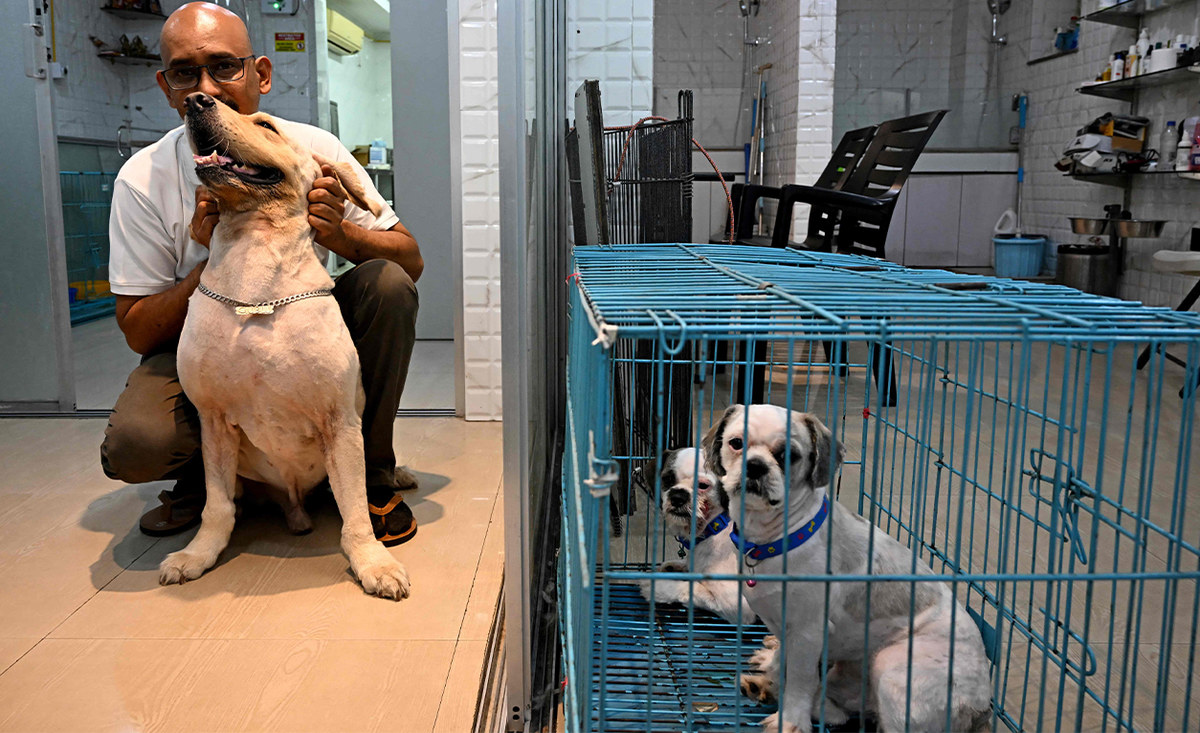


Dogs sit in a cage as they wait to be treated for heat burns, at a pet clinic in Kolkata on April 30, 2024. (AFP)

Kolkata has sweltered through days of punishing heat, peaking at 43 degrees Celsius for the hottest single April day since 1954, according to the city’s weather bureau.

Streets of the normally bustling colonial-era capital have been almost deserted in the afternoons as its 15 million people do what they can to stay out of the sun.

But even cats and dogs lucky enough to have an owner have been susceptible to falling ill, with Das saying the heat had triggered a surge in dehydration-related illnesses in pets from around the city.

Teacher Sriparna Bose said her two cats had become sullen and withdrawn in a way she hadn’t seen before when the heatwave hit.

“They are refusing food,” she said. “They hide in dark, cold corners of the room and won’t come out.”

The situation is worse for the 70,000 stray dogs estimated to live on city streets by municipal authorities, which have no owner but are often fed and tended to by nearby residents.

Many are spending the day taking refuge from the sun under parked cars, while a lucky few are hosed down by sympathetic humans to help them cool off.

“They are finding it difficult to stand on their soft paws because the roads are so hot,” said Gurshaan Kohli of Humanimal Foundation, a local animal welfare charity for stray animals.
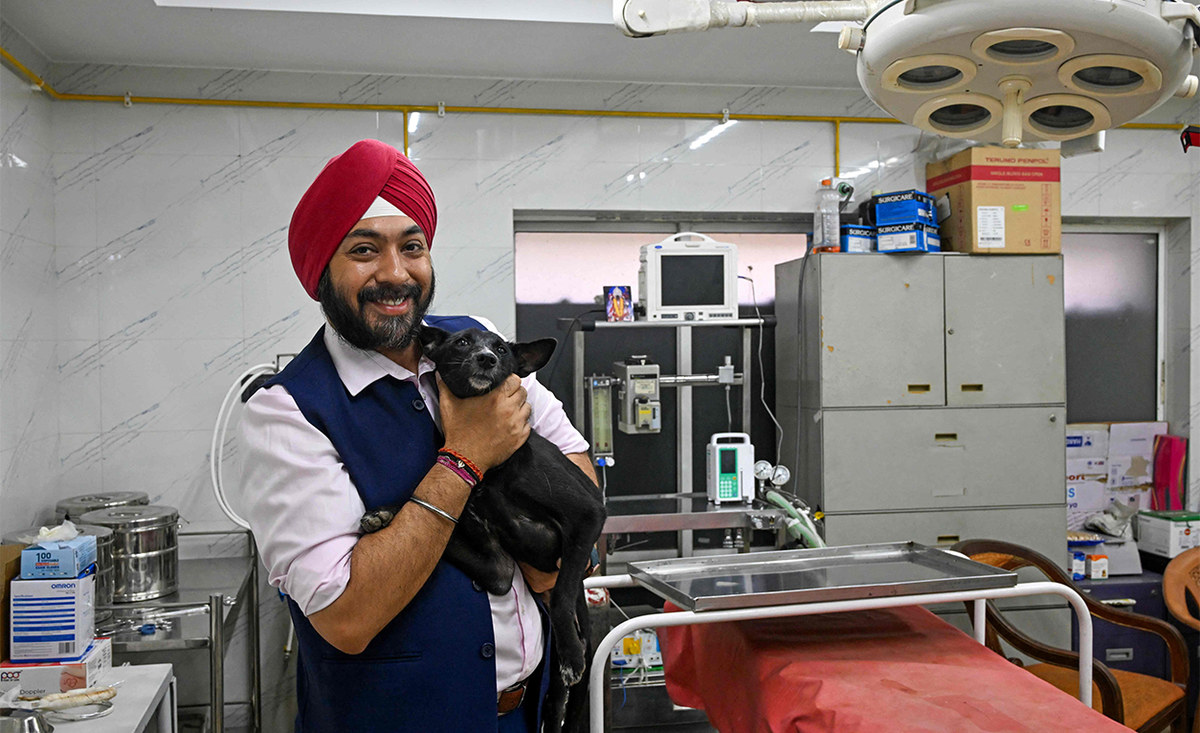


Gurshaan Kohli of Humanimal Foundation poses for a photograph with a wounded stray dog at a veterinary clinic in Kolkata on April 30, 2024. (AFP)

“Scores of dogs and cats have died” even though he and his colleagues had rushed them to clinics for treatment, he added.

Large swathes of South and Southeast Asia are struggling through a heatwave that has broken temperature records and forced millions of children to stay home as schools close across the region.

Experts say climate change makes heatwaves more frequent, longer and more intense, while the El Nino phenomenon is also driving this year’s exceptionally warm weather.

The heat has taken its toll on animals across the continent.

“They are eating less, and they are reluctant to move,” Henna Pekko of Rescue PAWS, which operates an animal shelter near Thailand’s capital Bangkok, told AFP.

With temperatures in Thailand exceeding 40 degrees Celsius over the past week, Pekko said her charity had taken to bringing its rescues to the ocean to cool down with a swim, while older dogs were being kept indoors.

“We are definitely taking extra precautions because of this weather,” she told AFP, adding that the stress on animals from the heat was the worst she had experienced in the kingdom.

“Last year was bad. This year was worse.”


New ‘superfood’ transforms livelihoods in India’s rural east

A farmer harvests makhana, or lotus seeds, in Kapchhahi village in India’s eastern state of Bihar. (Mahesh Mukhia)
Updated 5 sec ago
Follow

New ‘superfood’ transforms livelihoods in India’s rural east

  • Known as fox nut or lotus seed, makhana is rich in protein, dietary fiber, minerals
  • Most of the world’s makhana production is in Bihar, one of India’s poorest states

BIHAR: Wading through knee-deep, stagnant water, Mahesh Mukhia plunges his hands into the mud, pulling up handfuls of sludge that he and others toss into a large, partially submerged basket.

After a while, they shake the basket to drain away the water and debris. What remains is makhana — round black seeds that have lately gained popularity as India’s new superfood.

A regional Indian snack, also known as fox nut or lotus seed, makhana is the edible seed of the prickly waterlily. The plant grows in freshwater ponds and wetlands in southern and eastern Asia.

After makhana seeds are handpicked from pond beds, cleaned, and sun-dried, they are roasted at high heat so their hard black shells crack open and release the white, popcorn-like puffed kernels, which are eaten as snacks or used in dishes.

It has long been known for its nutritional value — high in plant-based protein and dietary fiber, the seeds are also rich in minerals and gluten-free — which over the past few years have helped it gain global attention and are transforming farmlands in Bihar, one of India’s poorest states.

“Earlier, people were not researching it but now, after research, makhana’s nutritional values have been highlighted. Now this is a superfood. That’s why demand is growing everywhere,” said Mahesh Mukhia, a farmer in Kapchhahi village in Bihar’s Darbhanga district, whose family has been harvesting the seeds for generations.

“The difference is that my forefathers did farming in a traditional way, but we’ve learnt to do it in a scientific way,” Mukhia told Arab News.

“There is Bhola Paswan Shastri Agricultural College in the neighboring Purnea district. I went there for training. After I started practicing farming the way I learnt, the yield increased by more than 30 percent.”

Makhana farming is highly labor-intensive, starting with the cultivation of water lilies in shallow ponds. The plants require constant monitoring as they are sensitive to water levels and pests.

Harvesting takes place between August and October. Workers pluck the seeds by hand and then dry them under the sun for several days before they can be processed.

The processing and roasting of makhana also require significant effort. The dried seeds are first de-shelled by manually cracking them, followed by multiple rounds of roasting to make them crisp.

Whole families are involved in the production, which has been expanding since 2020, when the state government introduced the Makhana Development Scheme.

Besides training in farming and processing, growers who cultivate fox nut receive $820 per hectare.

“The rate has also gone up. The makhana that we used to sell at 200-300 ($2-$3) rupees per kg is now selling at 1,000 ($12) or 1,500 rupees per kg,” Mukhia said.

“Makhana farmers are now making a profit. Those who are growing makhana are earning well, those who are popping it are also doing well, and those involved in trading are making profits too. We are getting good demand from everywhere. I just received an order for 25 tonnes recently.”

Bihar currently produces over 85 percent of India’s makhana and accounts for most of the world’s production, according to Ministry of Commerce and Industry estimates.

According to reports by the Indian Brand Equity Foundation and the Agricultural and Processed Food Products Export Development Authority, India accounts for roughly 85 to 90 percent of the world’s production.

Farmland where the crop is grown has increased many times over the past decade and can now be compared to the area covering half of New York City.

More than 600,000 people are involved in the makhana industry in Bihar, according to Niraj Kumar Jha, Darbhanga district’s horticulture officer.

“Earlier, we were cultivating 5,000 hectares in the Kosi and Mithlanchal regions. But now it has expanded to 35,000 hectares, and with many supportive schemes, farmers are increasingly encouraged to grow makhana,” he said.

“We are strengthening our marketing channels. We’ll reach the metro cities as well as world markets ... We can see that makhana is growing very popular, not only in India.”