France charges Daesh official’s ex-wife with crimes against humanity

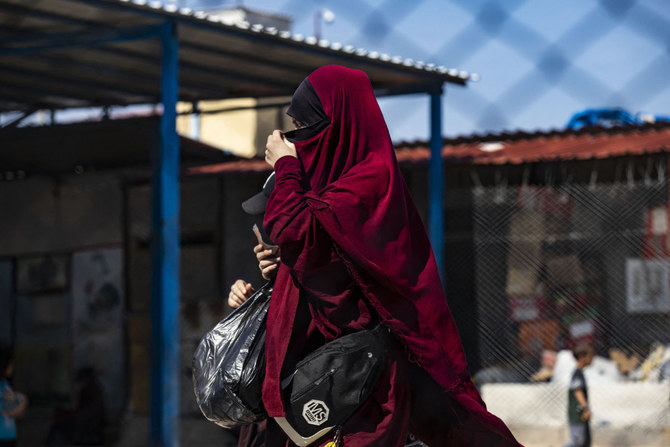
A woman hides walks past a fence at Camp Roj, where relatives of people suspected of belonging to the Daesh (IS) group are held, in the countryside near al-Malikiyah (Derik) in Syria's northeastern Hasakah province on October 8, 2023. (AFP/File)
Short Url
Updated 28 April 2024
Follow

France charges Daesh official’s ex-wife with crimes against humanity

  • The woman identified only as Sonia M. was accused by a Yazidi woman of raping her twice and knowing that her husband was raping her, Le Parisien reported
  • The Yazidi woman was 16 when she was taken captive by Daesh militants and forced into slavery by top Daesh official Abdelnasser Benyoucef

PARIS: France has charged the ex-wife of a top Daesh official with crimes against humanity on suspicion of enslaving a teenage Yazidi girl in Syria, French media reported.

A woman identified as Sonia M., the former wife of the jihadist group’s head of external operations Abdelnasser Benyoucef, was charged on March 14, Le Parisien said Saturday.
The Yazidi woman, who was 16 when she was forced into slavery by Benyoucef, accused Sonia M. of raping her twice and knowing that her husband was raping her, the report said.
The woman, now 25, said she was held for more than a month in 2015 in Syria, where she was not allowed to eat, drink or shower without Sonia M.’s permission.
Sonia M. denied the allegations against her in a March 14 interview with French investigators, saying “only one rape” had been committed by her former husband.
The teenager “left her room freely, ate what she wanted, went to the toilet when she needed to,” she said in her interview, seen by AFP.
Sonia M.’s lawyer Nabil Boudi slammed the charges as “opportunistic accusations,” saying that prosecutors were seeking “to make her responsible for the most serious crimes, because the courts have not managed to apprehend the real perpetrators.”
An arrest warrant has been issued for Benyoucef, according to a source close to the investigation.
France launched an investigation in 2016 into genocide, crimes against humanity and war crimes committed against ethnic and religious minorities in Iraq and Syria since 2012.
The probe has focused on crimes suffered by members of the Yazidi and Christian communities as well as members of the Sheitat tribe, according to France’s PNAT anti-terror unit.
“The aim is to document these crimes and identify the French perpetrators who belong to the Islamic State organization,” PNAT told AFP.


Eritrea withdraws from regional bloc as UN expresses concern over tensions with Ethiopia

Updated 1 sec ago
Follow

Eritrea withdraws from regional bloc as UN expresses concern over tensions with Ethiopia

NAIROBI: Eritrea on Friday withdrew from the Intergovernmental Authority on Development, accusing the East African regional bloc of nations of acting against the country’s interests.
At the same time, the United Nations expressed concern over renewed tensions between Eritrea and neighboring Ethiopia, which signed a peace agreement 25 years ago.
Eritrea’s foreign ministry said in a statement Friday it was withdrawing “from an organization that has forfeited its legal mandate and authority; offering no discernible strategic benefit to all its constituencies and failing to contribute substantively to the stability of the region.”
Eritrea quit IGAD in 2003 and rejoined two years ago, but said Friday that the bloc had failed to contribute to regional stability. IGAD responded by saying Eritrea had not participated in regional activities since it rejoined.
In addition to Eritrea and Ethiopia, IGAD includes Djibouti, Kenya, Somalia, South Sudan, Sudan and Uganda. The organization works on regional policies concerning trade, customs, transport, communications, agriculture, natural resources and the environment, according to its website.
Eritrea and Ethiopia have in recent months accused each other of interference, sparking concerns over the possibility of a return to hostilities.
Ethiopia said it wants to peacefully gain Red Sea access through Eritrea, which it relied on heavily for trade before the secession. Ethiopian Prime Minister Abiy Ahmed said in September it was a “mistake” to lose access to the sea when Eritrea gained independence in 1993 by seceding from Ethiopia to form a separate nation. Abiy’s rhetoric has been seen as provocative by Eritrea.
The office of UN Secretary-General Antonio Guterres on Friday urged the two countries to “recommit to the vision of lasting peace and the respect for sovereignty and territorial integrity.”
The UN cited the Algiers Agreement signed in 2000, which ended nearly three decades of border war between Eritrea and Ethiopia. The UN called for a recommitment to the agreement, which it described as a “crucial framework” for peace.
Eritrea accused Ethiopia in June of having a “long-brewing war agenda” aimed at seizing its Red Sea ports. Ethiopia recently claimed Eritrea was “actively preparing to wage war against it,” as well as supporting Ethiopian rebel groups.