Minnesota man who regrets joining Daesh group faces sentencing on terrorism charge

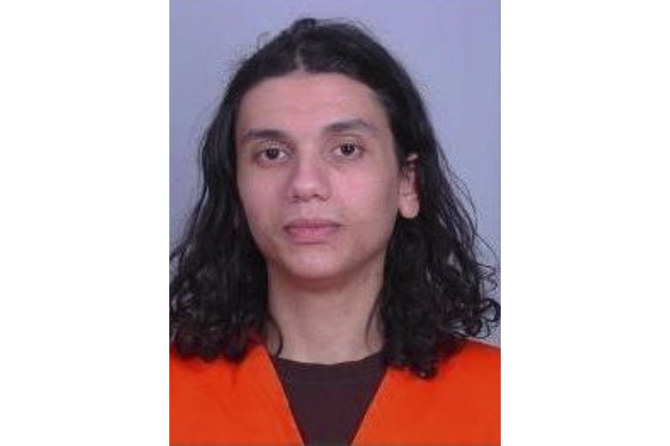
This image provided by the Sherburne County Jail in Elk River, Minn, shows Abelhamid Al-Madioum, a Minnesota man who once fought for Daesh in Syria. (AP)
Short Url
Updated 01 May 2024
Follow

Minnesota man who regrets joining Daesh group faces sentencing on terrorism charge

  • Federal prosecutors have recommended 12 years for Abelhamid Al-Madioum in recognition both of the seriousness of his crime and the help has he given the US
  • Al-Madioum was 18 in 2014 when Daesh recruited him

MINNEAPOLIS, USA: A Minnesota man who once fought for the Daesh group in Syria but now expresses remorse for joining a “death cult” and has been cooperating with federal authorities will learn Wednesday how much prison time he faces.
Federal prosecutors have recommended 12 years for Abelhamid Al-Madioum in recognition both of the seriousness of his crime and the help has he given the US and other governments. His attorney says seven years is enough and that Al-Madioum, 27, stopped believing in the group’s extremist ideology years ago.
Al-Madioum was 18 in 2014 when Daesh recruited him. The college student slipped away from his family on a visit to their native Morocco in 2015. Making his way to Syria, he became a soldier for Daesh, until he was maimed in an explosion in Iraq. Unable to fight, he used his computer skills to serve the group. He surrendered to US-backed rebels in 2019 and was imprisoned under harsh conditions.
Al-Madioum returned to the US in 2020 and pleaded guilty in 2021 to providing material support to a designated terrorist organization. According to court filings, he has been cooperating with US authorities and allied governments. The defense says he hopes to work in future counterterrorism and deradicalization efforts.
“The person who left was young, ignorant, and misguided,” Al-Madioum said in a letter to US District Judge Ann Montgomery, who will sentence him.
“I’ve been changed by life experience: by the treachery I endured as a member of Daesh, by becoming a father of four, a husband, an amputee, a prisoner of war, a malnourished supplicant, by seeing the pain and anguish and gnashing of teeth that terrorism causes, the humiliation, the tears, the shame,” he added. “I joined a death cult, and it was the biggest mistake of my life.”
Prosecutors acknowledge that Al-Madioum has provided useful assistance to US authorities in several national security investigations and prosecutions, that he accepted responsibility for his crime and pleaded guilty promptly on his return to the US But they say they factored his cooperation into their recommended sentence of 12 years instead of the statutory maximum of 20 years.
“The defendant did much more than harbor extremist beliefs,” prosecutors wrote in a sentencing memo. “He chose violent action by taking up arms for Daesh.”
A naturalized US citizen, Al-Madioum was among several Minnesotans suspected of leaving the US to join the Daesh group, along with thousands of fighters from other countries worldwide. Roughly three dozen people are known to have left Minnesota to join militant groups in Somalia or Syria. In 2016, nine Minnesota men were sentenced on federal charges of conspiring to join Daesh.
But Al-Madioum is one of the relatively few Americans who’ve been brought back to the US who actually fought for the group. According to a defense sentencing memo, he’s one of 11 adults as of 2023 to be formally repatriated to the US from the conflict in Syria and Iraq to face charges for terrorist-related crimes and alleged affiliations with Daesh. Others received sentences ranging from four years to life plus 70 years.
Al-Madioum grew up in the Minneapolis suburb of St. Louis Park in a loving and nonreligious family, the defense memo said. He joined Daesh because he wanted to help Muslims who he believed were being slaughtered by Syrian President Bashar Assad’s regime in that country’s civil war. Daesh recruiters persuaded him “to test his faith and become a real Muslim.”
But he was a fighter for less than two months before he lost his right arm below the elbow in the explosion that also left him with two badly broken legs and other severe injuries. He may still require amputation of one leg, the defense says.
While recuperating in 2016, he met his first wife Fatima, an Daesh widow who already had a son and bore him another in 2017. They lived in poverty and under constant airstrikes. He was unable to work, and his stipend from Daesh stopped in 2018. They lived in a makeshift tent, the defense says.
He married his second wife, Fozia, in 2018. She also was a Daesh widow and already had a 4-year-old daughter. They had separated by early 2019. He heard later she and their daughter together had died. The first wife also is dead, having been shot in front of Al-Madioum by either rebel forces or an Daesh fighter in 2019, the defense says.
The day after that shooting, he walked with his sons and surrendered to the Kurdish-led Syrian Democratic Forces, which held him under conditions the defense described as “heinous” for 18 months until the FBI returned him to the US
As for Al-Madioum’s children, the defense memo said they were eventually found in a Syrian orphanage and his parents will be their foster parents when they arrive in the US.


Judge bars federal prosecutors from seeking the death penalty against Luigi Mangione

Updated 3 sec ago
Follow

Judge bars federal prosecutors from seeking the death penalty against Luigi Mangione

  • Judge Margaret Garnett’s Friday ruling foiled the Trump administration’s bid to see Mangione executed
  • Garnett dismissed a federal murder charge against Mangione, finding it technically flawed. She left in place stalking charges that could carry a life sentence
NEW YORK: Federal prosecutors can’t seek the death penalty against Luigi Mangione in the killing of UnitedHealthcare CEO Brian Thompson, a federal judge ruled Friday, foiling the Trump administration’s bid to see him executed for what it called a “premeditated, cold-blooded assassination that shocked America.”
Judge Margaret Garnett dismissed a federal murder charge that had enabled prosecutors to seek capital punishment, finding it technically flawed. She wrote that she did so to “foreclose the death penalty as an available punishment to be considered by the jury” as it weighs whether to convict Mangione.
Garnett also dismissed a gun charge but left in place stalking charges that carry a maximum punishment of life in prison. To seek the death penalty, prosecutors needed to show that Mangione killed Thompson while committing another “crime of violence.” Stalking doesn’t fit that definition, Garnett wrote in her opinion, citing case law and legal precedents.
In a win for prosecutors, Garnett ruled they can use evidence collected from his backpack during his arrest, including a 9mm handgun and a notebook in which authorities say Mangione described his intent to “wack” an insurance executive. Mangione’s lawyers had sought to exclude those items, arguing the search was illegal because police hadn’t yet obtained a warrant.
During a hearing Friday, Garnett gave prosecutors 30 days to update her on whether they’ll appeal her death penalty decision. A spokesperson for the US attorney’s office in Manhattan, which is prosecuting the federal case, declined to comment.
Garnett acknowledged that the decision “may strike the average person — and indeed many lawyers and judges — as tortured and strange, and the result may seem contrary to our intuitions about the criminal law.” But, she said, it reflected her “committed effort to faithfully apply the dictates of the Supreme Court to the charges in this case. The law must be the Court’s only concern.”
Mangione, 27, appeared relaxed as he sat with his lawyers during the scheduled hearing, which took place about an hour after Garnett issued her written ruling. Prosecutors retained their right to appeal but said they were ready to proceed to trial.
Outside court afterward, Mangione attorney Karen Friedman Agnifilo said her client and his defense team were relieved by the “incredible decision.”
Jury selection in the federal case is set for Sept. 8, followed by opening statements and testimony on Oct. 13. The state trial’s date hasn’t been set. On Wednesday, the Manhattan district attorney’s office urged the judge in that case to schedule a July 1 trial date.
“That case is none of my concern,” Garnett said, adding that she would proceed as if the federal case is the only case unless she hears formally from parties involved in the state case. She also said the federal case will be paused if the government appeals her death penalty ruling.
Thompson, 50, was killed on Dec. 4, 2024, as he walked to a midtown Manhattan hotel for UnitedHealth Group’s annual investor conference. Surveillance video showed a masked gunman shooting him from behind. Police say “delay,” “deny” and “depose” were written on the ammunition, mimicking a phrase used by critics to describe how insurers avoid paying claims.
Mangione, an Ivy League graduate from a wealthy Maryland family, was arrested five days later at a McDonald’s in Altoona, Pennsylvania, about 230 miles (about 370 kilometers) west of Manhattan.
Following through on Trump’s campaign promise to vigorously pursue capital punishment, Attorney General Pam Bondi ordered Manhattan federal prosecutors last April to seek the death penalty against Mangione.
It was the first time the Justice Department sought the death penalty in President Donald Trump’s second term. He returned to office a year ago with a vow to resume federal executions after they were halted under his predecessor, President Joe Biden.
Garnett, a Biden appointee and former Manhattan federal prosecutor, ruled after hearing oral arguments earlier this month.
Besides seeking to have the death penalty rejected on the grounds Garnett cited, Mangione’s lawyers argued that Bondi’s announcement flouted long-established Justice Department protocols and was “based on politics, not merit.”
They said her remarks, followed by posts to her Instagram account and a TV appearance, “indelibly prejudiced” the grand jury process resulting in his indictment weeks later.
Prosecutors urged Garnett to keep the death penalty on the table, arguing that the charges were legally sound and Bondi’s remarks weren’t prejudicial, as “pretrial publicity, even when intense, is not itself a constitutional defect.”
Prosecutors argued that careful questioning of prospective jurors would alleviate the defense’s concerns about their knowledge of the case and ensure Mangione’s rights are respected at trial.
“What the defendant recasts as a constitutional crisis is merely a repackaging of arguments” rejected in previous cases, prosecutors said. “None warrants dismissal of the indictment or categorical preclusion of a congressionally authorized punishment.”