- Envoy says recent killing of a young disabled man by Israeli forces set off protests across Syria on a scale unseen since 2011
- UN warns of a hard winter ahead, as 200,000 people lack proper shelter, and explosive remnants of war kill 19 children in space of a month
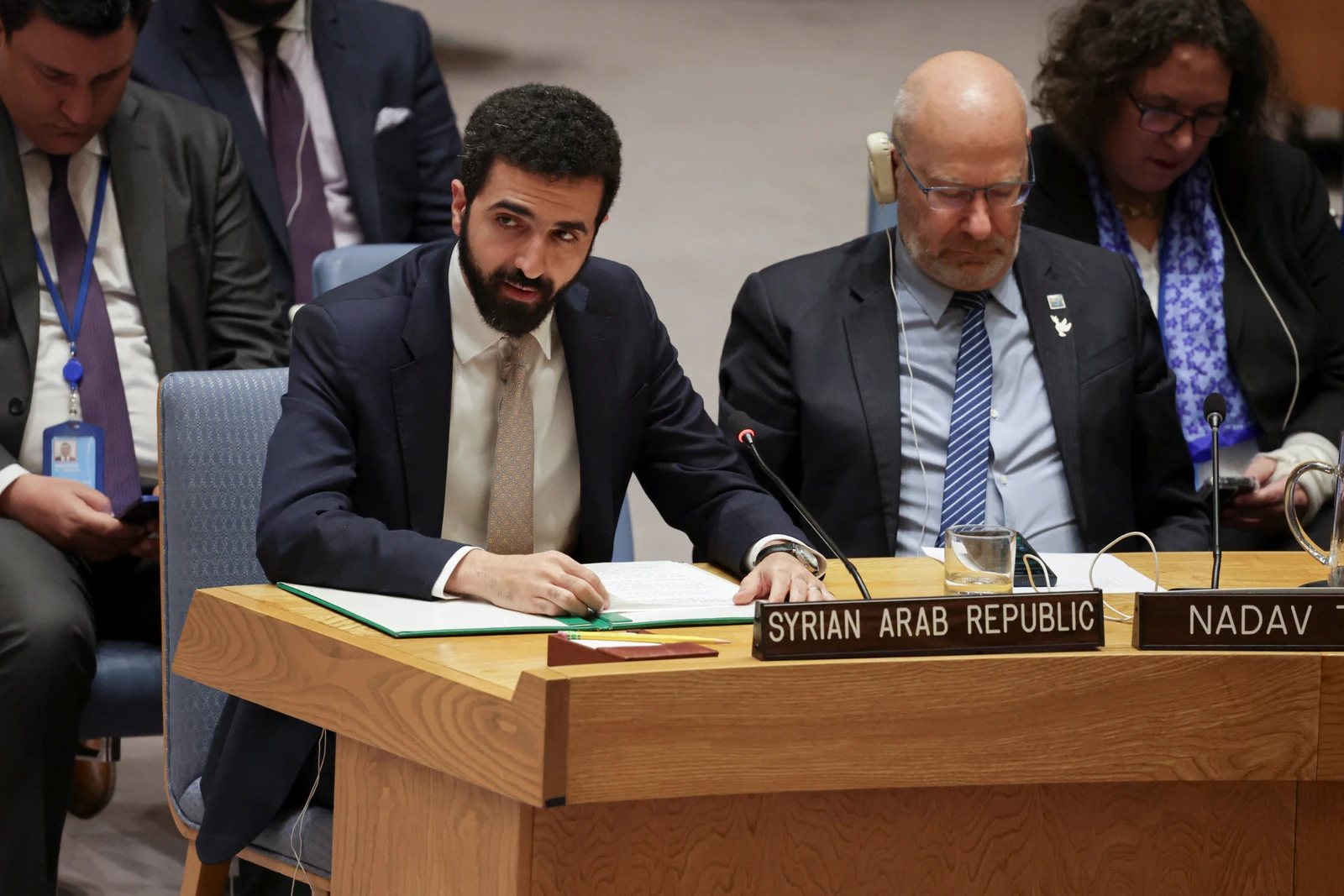
NEW YORK CITY: Syria’s ambassador to the UN told the Security Council on Monday that Israel’s “hostile policies” had brought Syrians back onto the streets in numbers not seen since the protests in 2011 that marked the start of the civil war.
The recent killing of a young man with a disability by Israeli forces had set off demonstrations “from the north to the south” of the country, he added.
“I would never have imagined seeing, after 2011, massive protests filling Syrian cities and governorates,” Ibrahim Olabi said. He put the demonstrations down “shelling, killing and enforced disappearance, destruction of properties, and land clearance” carried out by Israel.
He told the 15-member council: “Syrians and the entire world have had enough of Israel’s attacks and baseless pretexts and attempts to justify them.”
Damascus was tired of the actions of the Israeli occupation that were “curtailing efforts to stabilize Syria due to the political games and ambitions of its leaders,” he said.
“It is high time for these illusions to be dissipated and for a return to international law and legitimacy. It is high time for the region to breathe a sigh of relief.”
Olabi thanked council members for “standing beside Syria in the face of Israeli aggression,” and expressed gratitude to US President Donald Trump for his mediation efforts.
The UN’s deputy special envoy for Syria, Claudio Cordone, speaking from Damascus, said Israeli military activities “continued relentlessly, in violation of Syria’s sovereignty and territorial integrity.” He cited as evidence of this incursions, temporary checkpoints, detentions, shelling, land clearances, and damage to farm and water infrastructure.
He added that Israeli activity near Al-Mantara Dam in Quneitra and in Wadi Al-Ruqqad threatened access to water and farmland in the Yarmouk basin.
Cordone repeated a call by the UN secretary-general, Antonio Guterres, for an end to violations of the 1974 Disengagement of Forces Agreement between Israel and Syria, full respect for Syria’s sovereignty, and for the cases of Syrians detained in Israel to be resolved.
Israeli authorities moved troops into the UN-patrolled buffer zone along the Golan Heights after Syria’s former president, Bashar Assad, was overthrown by opposition forces on Dec. 8, 2024, marking the end of the civil war. They said the 1974 agreement had collapsed, and Israeli forces have since carried out hundreds of strikes against Syrian military sites.
In July 2025, during sectarian clashes in Sweida, Israel struck the Defense Ministry in Damascus. Since then, US-mediated talks between Syria and Israel about a security arrangement have stalled several times.
Cordone said Sweida was still stuck in a “tense security and political stalemate.” The Syrian government had sent additional forces to the area “amid reports of continued Israeli support to local armed actors,” he added.
Traffic along the Sweida-Damascus road has been cut off at times, he said, and fighting in the city has resulted in civilian casualties.
Mohamed Yahya, the UN’s assistant secretary-general for humanitarian affairs, said that although the humanitarian situation was improving in some ways, it remained fragile. Nearly 4 million Syrians displaced during their country’s civil war have returned home voluntarily since December 2024. That includes 60,000 internally displaced people and 18,000 refugees who have returned since the Security Council last met to discuss Syria, in October.
“Yet returns do not mean humanitarian needs have ended,” Yahya said. “For many families, return marks the beginning of a new struggle.”
More than 730,000 people are still living in camps, and Yahya said explosive ordnance was the biggest obstacle to safe returns. Since the council’s last meeting, at least 30 people had been killed by war remnants, 19 of them children, he added, and more than 80 injured, including 35 children.
“In short, the situation is not improving,” Yahya said, describing the toll of such incidents on families as “unacceptable.”
The approaching winter was another major concern. An estimated 2.4 million people will need additional help, but the UN’s plan to reach the 970,000 most at risk is only 40 percent funded.
“Time is running out,” Yahya said, with nearly 200,000 displaced people and returnees living in damaged shelters that offer little protection from the cold.
Recent flash floods have made things worse. They washed away key bridges, destroyed nearly 5,000 acres of crops and affected more than 2,000 families in eastern Syria alone. Floodwaters had also swept explosive ordnance into areas previously considered relatively safe.
In addition, the virus that causes polio was recently found in two children in Deir Ezzor, and authorities have since vaccinated more than 34,000 children.
Cordone said the World Bank estimated it would cost about $216 billion just to rebuild damaged physical assets in Syria.
He welcomed the formal submission of a draft transitional justice law to the interim People’s Assembly and said it was critical that “the justice the law will aim to deliver will not be selective justice,” and would apply in all cases, whoever the perpetrators or victims might be.
He also said there needed to be clarity on the process and timeline for the introduction of a permanent constitution and elections. “Time is ticking,” he said.
Olabi also talked about Syria’s return to the world stage after years of isolation under the Assad regime. He highlighted recent visits to Damascus by the prime minister of Iraq and Jordan’s foreign minister, the restoration of direct flights to European capitals, and Syria’s reconnection to global electronic-payment networks.
He added that Syria had climbed 36 places on the 2026 World Press Freedom Index, and cited recent court cases and convictions related to the violence along the coast last year as proof of an independent judiciary.
“The war has ended in Syria; however, its repercussions still reverberate across the country,” Olabi said as he appealed for international help with de-mining efforts.
“Syria today is yet another test to the international community, as it is teeming with promising opportunities. How will political support (be) transformed into a partnership to protect what was achieved by Syrian men and women?”