- As winter deepens hardships facing displaced families, Jehad Jarbou raises her son and makes art in a daily struggle to survive
- Nearly 1m people in enclave live in flood-prone areas, including about 400,000 in locations WHO classifies as ‘extremely high risk’
LONDON: Jehad Jarbou survived beneath the rubble of her family’s home in northern Gaza with her mother and younger brother after an Israeli strike hit the house in November 2023. Her father and eldest brother were killed.
The strike also destroyed her art supplies and about eight years of work.
“I didn’t just lose members of my family, I lost my home, my memories and my artistic archive,” the 27-year-old told Arab News. “All my artwork and art supplies were destroyed under the rubble.”
Surviving the strike began a journey of repeated displacement that brought neither safety nor shelter. Jarbou recalled walking in tears as she left northern Gaza, looking back toward the place where her home had stood, “not knowing where my mother, my younger brother and I would go.”
Now she shares a tent in Gaza City with her husband, their baby son, Adam, her mother and younger brother. Food and clean water are scarce and privacy is nonexistent.
Yet she continues to make art from what remains: her body, her memories and the life unfolding around her.
“Sometimes I feel that I make art out of life itself … out of fear, the tent, the rubble, my body, my child and the small things that make me feel that hope still exists.”
As winter approaches, protecting that fragile life is becoming harder.
Heavy rains have flooded makeshift camps across Gaza, soaking bedding, ruining belongings and damaging shelters already worn by repeated displacement.
More than 26,000 households have been affected by flooding since Nov. 6, according to UN figures. More than 6,000 family shelters were destroyed and another 17,400 damaged.
The downpours have also compounded dangers beyond the camps. Damaged buildings have collapsed, while floodwaters can expose unexploded ordnance buried beneath debris or carry it elsewhere, threatening residents and aid workers.
Nearly 1 million people live in flood-prone areas, including about 400,000 in locations the World Health Organization classifies as “extremely high risk.”
For families with little means to repair their shelters, the effects of the rain linger long after a storm passes.
One displaced woman in central Gaza told Arab News on Sunday that her family’s bedding remained wet for several days after the flooding on Nov. 6, forcing them to sleep in it in the cold.
One night, she said, she urinated involuntarily and did not realize it until hours later. Her name is being withheld to protect her privacy.
She said tents deteriorated and needed replacing every month or two, but Israeli restrictions had made replacements scarce and extremely costly. Her family could not afford repairs or a tarpaulin to reinforce their shelter.
The storms have intensified international pressure on Israel to allow more aid and shelter materials into Gaza.
“Families exposed to freezing rains and children dying from hypothermia, this is the reality in Gaza,” Hadja Lahbib, the European commissioner for equality and crisis management, said on Monday.
At a meeting of EU foreign ministers in Brussels, Irish Foreign Minister Helen McEntee urged stronger action to open aid corridors, saying food and lifesaving supplies were waiting at the border while children in Gaza were dying from cold and hunger.
Australia, Canada, Italy and Britain issued a joint appeal on Sunday for “immediate, rapid and unimpeded humanitarian access throughout Gaza,” saying that 150,000 tents and other essential supplies were being held at the border.
They also called for Israel to admit relief and recovery materials classified as “dual-use” — items with potential civilian and military applications.
Philippe Lazzarini, former UN under-secretary-general, said that restrictions on aid reflected a deliberate policy.
“Aid restriction is the outcome of a deliberate policy to keep Palestinians in Gaza in sub-humane living conditions,” he said on X.
“People in Gaza need more than words of concerns and condemnation; they need to see an improvement and a future they continue to be deprived of despite a so-called ceasefire.”
The appeals come amid renewed scrutiny of aid deliveries under the ceasefire agreement that took effect in October 2025.
The Israeli newspaper Haaretz reported on Sunday that humanitarian aid and commercial deliveries had fallen well short of Israel’s commitments for most of the preceding eight months. The agreement called for 4,200 trucks to enter Gaza each week, or about 18,200 a month.
But since March, deliveries had averaged roughly half that monthly target, the report said, citing Israeli data obtained from the US-established Civil-Military Coordination Center in Kiryat Gat.
COGAT, the Israeli military body responsible for coordinating civilian affairs in the Palestinian territories, disputed the figures. It said that the data presented were inaccurate and that Israel was meeting its humanitarian commitments “and beyond them.”
For Jarbou, the shortages are measured in more immediate terms, including milk for Adam, food for herself and clean water for the family.
At one point during her displacement, she said, the family lived in a tent on the street, surrounded by insects and rats.
“Sometimes the food that reached us was contaminated or contained insects and worms, but we had no choice but to eat it to stay alive,” she said. “The water was unclean and there were no suitable containers to store it in, making daily life even harder.”
The family still has no regular electricity or suitable place to bathe. There have been periods without milk for Adam and times when Jarbou has gone hungry.
“Sleep itself has become a battle,” she said. “I do not feel safe and I do not feel that life can be normal.
“Sometimes I wish there were a magic door through which I could take my family from death to life and from fear to safety.”
Jarbou grew up in the Al-Saftawi area of northern Gaza, where, she said, war shaped her life from childhood. She studied fine arts and began working professionally about eight years ago, eventually concentrating on conceptual photography.
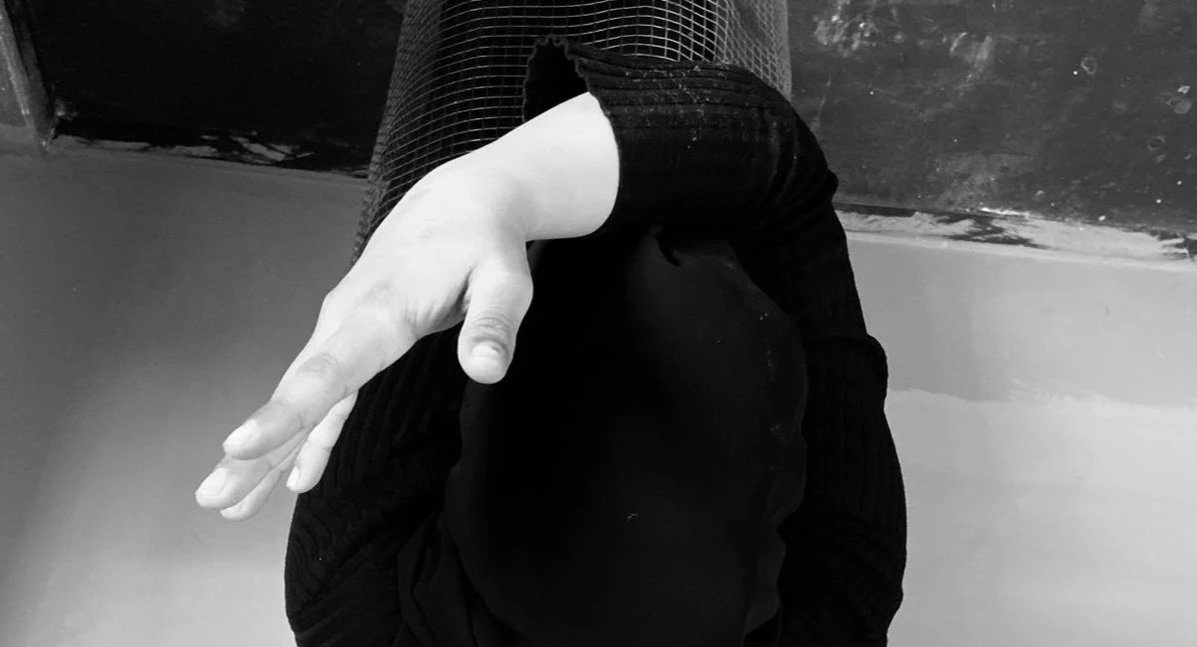
Her work explores women’s freedom, fear, pain and survival during war. Using her body as “a tool, a witness and a memory,” she turns personal experiences into photographs and installations.
Her books, including “Here Is My Life,” “They Walked Upon Their Hearts” and “Perhaps the Night,” explore memory and Palestinian experiences of war. She has also taken part in exhibitions and collaborative projects.
Now, the tent, the rubble and the demands of caring for Adam have become part of the record she is trying to preserve. The circumstances that constrain her work also shape its subjects.
She hopes to study filmmaking to gain “stronger tools” for telling Gaza’s stories through images, video and art.
For now, creating and surviving remain inseparable.
“Every day I search for life,” Jarbou said. “I am still searching for true survival.”