- A report in the Washington Post says Iran used Starlink to help carry out attacks on US forces in the Middle East
- Investigators have also traced European purchases to Hezbollah and German components to Houthi weapons
LONDON: In January, ordinary Iranians used Starlink to show the world what their security forces were doing to protesters. By early March, according to the Washington Post, Iran’s armed forces were using the same American satellite network to launch attacks on US troops in the Middle East.
For Arab Gulf states that have come under Iranian and Houthi fire, the reversal of Starlink application has a familiar ring. Investigators have found German components in Houthi weapons, traced an order placed in Europe to a Hezbollah drone that struck a retirement home in Israel, and identified American electronics in Iranian drones recovered in Ukraine.
A chipmaker can do little about one of its products once it turns up in a missile. Elon Musk’s SpaceX can still cut service to a Starlink dish. Washington had already asked it to disconnect equipment that Hezbollah in Lebanon and the Houthis in Yemen were suspected of using. But could the company tell who was using its service in Iran?
Four people familiar with Iranian military operations reportedly confirmed Tehran’s use of Starlink to the Washington Post for its Nov. 28 report. The US and Israel had begun bombing Iran on Feb. 28. One person described a classified summer update for US Defense Secretary Pete Hegseth. According to that source, Iran used the service to communicate with its forces and oversee drone operations as the US targeted its usual communications systems.
That account has drawn attention to the Iranian drone strike that killed six US Army reservists at the Kuwaiti port of Shuaiba on March 1. Within hours, SpaceX began requiring some customers using Starlink aboard aircraft to provide additional proof of identity, according to notices and pilots cited by the Post. The Telegraph led its follow-up with the possibility that Iran had used Starlink in the deadly attack.
Whether the drone that hit Shuaiba relied on Starlink remains unknown. US Central Command declined to answer the Post’s questions about the strike. The Pentagon, which has yet to publish its findings, told Reuters it was unaware of the classified report described to the Post.
Neither SpaceX nor Iran’s Foreign Ministry immediately responded to Reuters. CNBC and other publications attributed the report of Iranian military use to the Post.
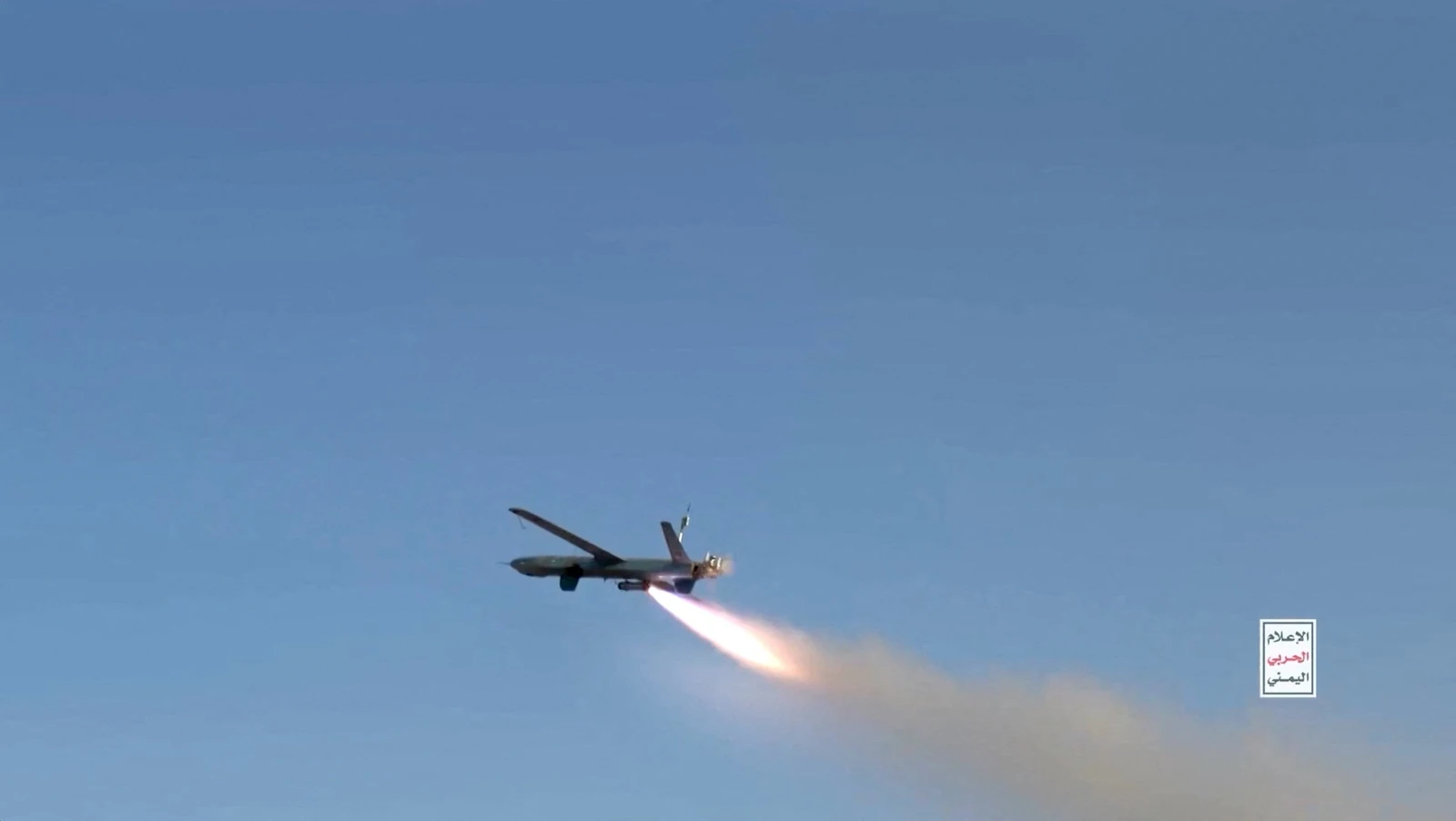
Wolf-Christian Paes, a former UN arms investigator, has traced parts in Houthi weapons back to Europe via China. “I have tracked some German components, specifically, in these weapon systems,” he told Arab News in October. Paes, who served on the UN Panel of Experts on Yemen, said the Houthis had gone from relying almost entirely on missiles shipped from Iran to making some with very little Iranian content.
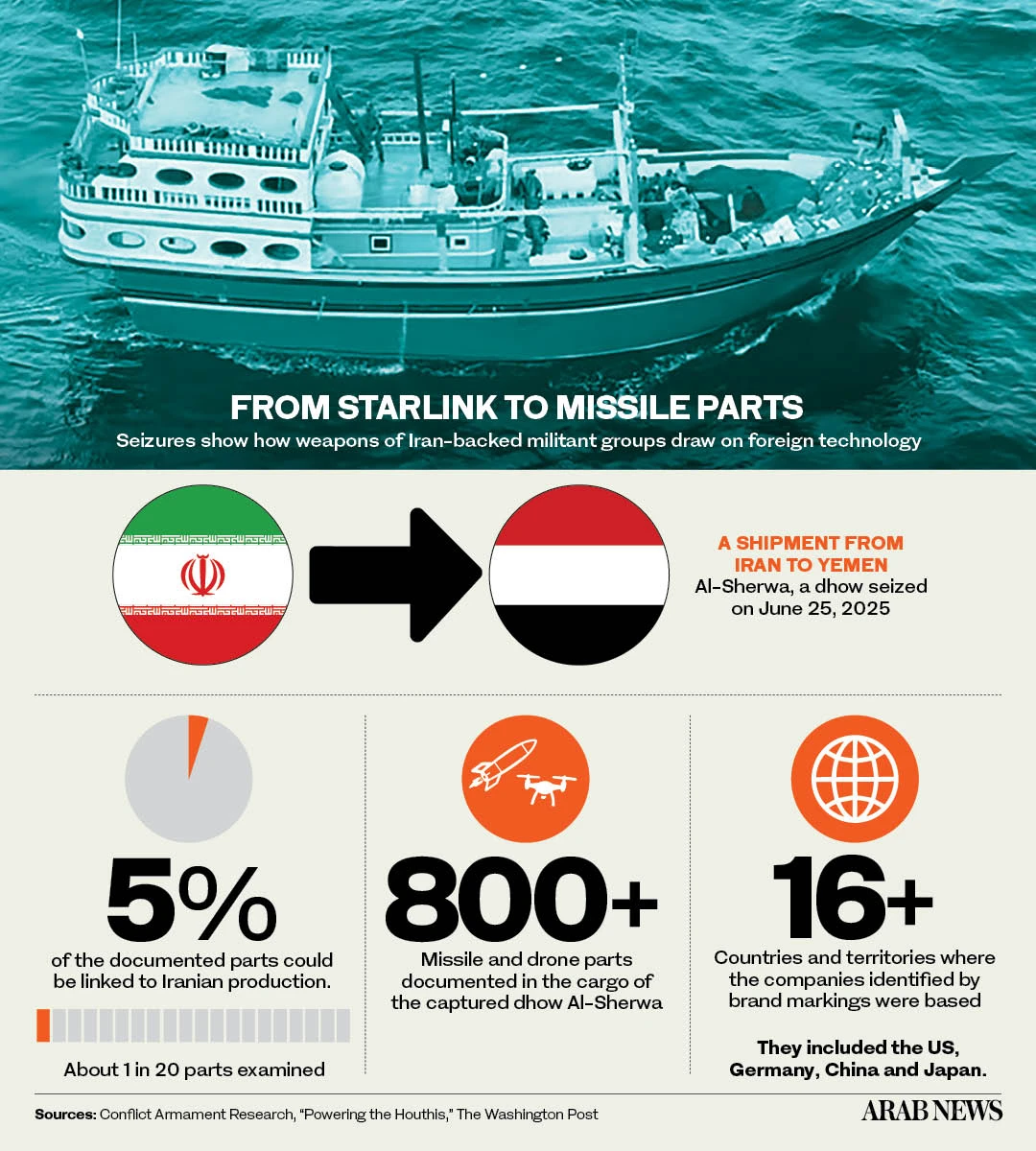
An arms shipment seized on its way from Iran to Yemen in June 2025 offered a rare inventory. Investigators from Conflict Armament Research examined hundreds of missile and drone components. Only about 5 percent of the parts they documented were made in Iran. The markings pointed to companies headquartered in at least 16 countries and territories.
In 2021, Paes and the rest of the UN panel inspected the debris of a ballistic missile used in an attack on Riyadh in 2020. It was identified as a Burkan-2H, a weapon with a range of about 1,000 km and a warhead payload of 250 kg. The panel found “artisanal welding” marks that suggested sections of the missile body had been assembled and welded in Yemen.
“The Houthis went through stages,” Paes told Arab News. “They moved to manufacturing certain ballistic missiles, and now the new development is that they are making longer-range ballistic missiles with very little Iranian content.”
In Paes’ assessment, even if Tehran agreed to stop supplying the Houthis, the group could still build missiles. The companies that made the parts face a problem: Their records may identify the customer who bought a shipment years earlier, but it can take a separate investigation to learn where the goods went next.
Hezbollah’s purchases in Europe show what it takes to establish a link to a particular attack. In October 2024, a drone from Lebanon exploded at a retirement home in Herzliya, north of Tel Aviv. No injuries were reported. In March this year, a court in Celle, Germany, found that the wreckage contained parts ordered by a Hezbollah buyer who had operated in Spain and Germany. His convictions included aiding attempted murder.
American investigators faced a similar question after a January 2024 attack on a US outpost in Jordan known as Tower 22. Militants backed by Iran’s Islamic Revolutionary Guard Corps killed three American soldiers and wounded more than 40. Investigators identified the drone from its remains as an Iranian Shahed and traced its navigation system to an Iranian company that supplied the Revolutionary Guard, according to US court documents.
In July, a federal jury in Boston convicted Mahdi Sadeghi, a Massachusetts engineer, of conspiring to export American electronics to that company in breach of sanctions. Prosecutors said the US manufacturer had been unaware that its products would end up in Iran.
The judge had barred prosecutors from presenting evidence of the Jordan attack at his trial. The verdict established the illegal export scheme but could not establish whether a part supplied by the engineer had been inside the drone that killed the soldiers.
Russia’s use of Iranian drones against Ukraine gave investigators a much broader body of evidence. Conflict Armament Research documented more than 500 components in Iranian weapons recovered there, many bearing the brands of US companies.
Matthew Olsen, then a senior US Justice Department official, visited a forensic center in Kyiv where examiners kept a downed Iranian Shahed. Describing their efforts to trace the parts to their makers, Olsen said in a speech in Berlin: “Far too often, the answer is the United States or a European ally.”
Washington had tried to get ahead of the problem with Starlink. In October, former US officials told Reuters that the Biden administration had asked SpaceX to act after intelligence officials raised concerns about Hezbollah’s access in 2023 and the Houthis’ in 2024. Two former officials said some terminals were switched off. The officials did not identify a specific strike by either group in which Starlink had played a part.
Musk explained the rules on X on March 1 in response to a post about US attack drones. Using a commercial Starlink terminal for a weapon violated its terms, he said. “This applies to all users and is shut down when discovered.”
In April, Starlink paused a program that let distributors sell through other dealers, acknowledging that it knew too little about who its customers were.
SpaceX also had questions about its US military customer. The Washington Post reported that the Pentagon flew drones using Starshield, the company’s military service, on a plan intended for equipment on the ground. Musk and the Pentagon disputed Reuters’ reporting on the price of those flights when it appeared in May.
In Iran, tracing every dish to a named user would work against a stated US aim. The Wall Street Journal reported in February that the Trump administration had secretly sent about 6,000 Starlink kits into the country after the January crackdown. There is no public evidence linking that shipment to the equipment the Iranian military reportedly used.
That does not mean Starlink kits have not been used by US adversaries. In an interview with Bloomberg News on May 9, 2024, John Plumb, a former US assistant secretary of defense for space policy, said: “I am certain Russia will continue to try and find ways to exploit Starlink and other commercial communications systems.”
The families of the six reservists killed at Shuaiba in Kuwait still await a public account of what happened. Across Saudi Arabia — from frontline border towns in Jazan and Najran to major cities enduring near-daily Houthi drone and missile fire — there is compelling reason to care what investigators find in the Shuaiba wreckage.
A manufacturer in Europe may have the best record of who bought a part. Gulf authorities may have the only evidence of where it landed. What both presumably want to know is whether the customer who placed that order is still buying.