- Tensions rise after Ukraine says its naval drones sank a Russian warship docked in Benghazi
- Strikes draw attention to Russian foothold on NATO’s southern flank in the Mediterranean Sea
The distance from the Libyan port of Benghazi to the front line in war-torn Ukraine is more than 2,400 kilometers. But dramatic strikes on two Russian ships in the Mediterranean on Sunday served as a reminder that in the age of drone warfare, the front line is wherever combatants decide it is.
Ukraine’s security service, the SBU, said seven domestically made naval drones had been launched from a mothership in an operation the president, Volodymyr Zelensky, described as “exemplary.”
Ukraine said the drones hit the dry-cargo ship MV Angara, which it believed Russia was using to transport weapons, and sank the corvette Merkury, one of the Russian Navy’s newest warships, in the eastern Libyan port of Benghazi.
It was not the first time Ukraine had targeted Russian-linked vessels in the region. In December 2025, a Ukrainian security official said aerial drones hit and damaged the Qendil, a sanctioned oil tanker linked to Russia. Ship-tracking data later placed it off the coast of Libya.
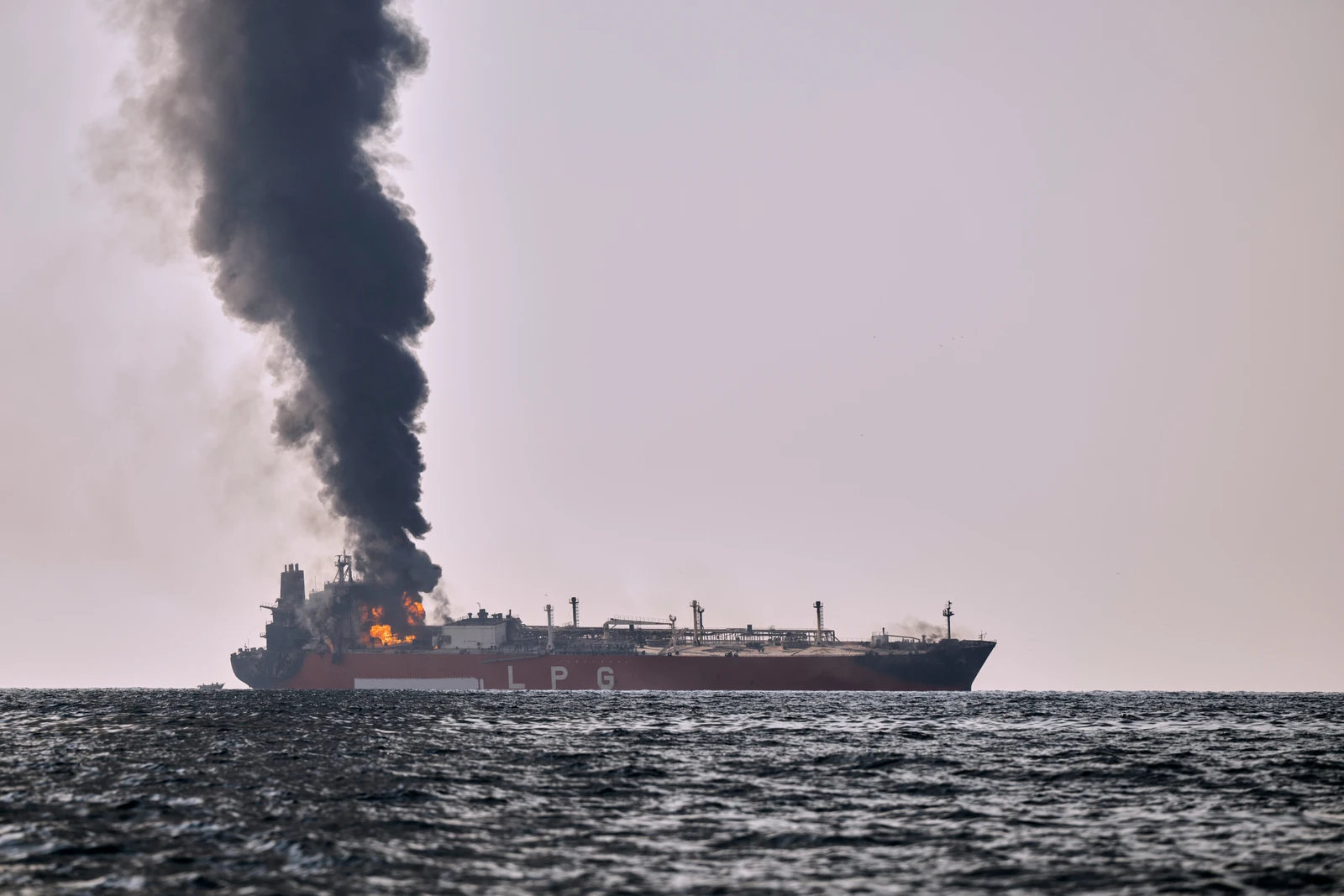
In March, the Russian tanker Arctic Metagaz, which was carrying liquefied natural gas, caught fire in the Mediterranean. Moscow blamed Ukrainian naval drones. The tanker drifted for weeks before Libya’s coast guard began towing it.
The attacks show how the war in Ukraine is spreading beyond that country’s borders, raising fears that Libya was becoming a new battleground for foreign powers.
Addressing the NATO Parliamentary Assembly in Berlin by video on Monday, Zelensky said Russia could feel Ukraine’s response, from the oil refineries of western Siberia “to the coast of Libya, where its warships are sinking.”
Western Libya is controlled by an internationally recognized government in Tripoli. The east of the country, where Benghazi is located, is controlled by forces loyal to military commander Khalifa Haftar, who has ties to Russia.
The eastern authorities said the Merkury had docked at Benghazi to refuel and take on supplies under a cooperation agreement with Russia.
The operation was the latest long-range assault by Kyiv’s forces, and followed an attack last week on the Kerch Bridge linking Russia to occupied Crimea.
Dmitry Peskov, spokesperson for the Kremlin, declined to comment directly on Sunday’s strikes and referred questions to the Russian Defense Ministry.
He issued a warning to Ukraine: “These actions result in highly painful consequences for the Kyiv regime. I would like to recall a statement made by Putin in Shenzhen, in which he affirmed that this practice, this course of action by our military will continue.”
Libya’s government in Tripoli condemned the Ukrainian operation and said it would not accept being drawn into the war.
Responding to Zelensky’s remarks, the Libyan Foreign Ministry said: “The continuation of the war between Russia and Ukraine gives neither side the right to conduct military operations on Libyan territory or in its territorial waters.”
Foreign forces would not be allowed to use Libyan ports or civilian infrastructure for military purposes, it added.
The Tripoli government also said it was alarmed by “risks posed by involving civilian ports and facilities in activities linked to external conflicts.”
The UN Support Mission in Libya expressed “serious concern” over the attacks and called for “an immediate, independent and transparent investigation.”
In a message posted on social media platform X, it added: “Libya cannot afford, and must not become, a battleground for foreign conflicts.”
The strikes underscored the ways in which the rival governments in Libya had left the country exposed to competition among outside powers. Whether Ukraine intends to open a new front in the Mediterranean or Africa remained unclear.
“Ukrainians are bringing war to Libya and the Sahel. It’s not a risk, it has happened,” Karim Mezran, director of the North Africa Initiative at the Atlantic Council’s Rafik Hariri Center, told Arab News.
“There are lots of Ukrainian special troops, or irregular troops, not tied to the Ukrainian government acting among some of the militias in Libya. And now they came out in the open.”
He said widening the fight to Russian assets in Africa made little strategic sense for Ukraine, which was already stretched and risked retaliation. The aim, he suggested, was to dismantle the economic empire Russia had built in Libya.
That empire included oil and gas projects, mines, infrastructure and reconstruction contracts, he explained, as well as an arrangement under which Moscow relied on Haftar’s eastern-based Libyan National Army for access to airfields, ports and operational hubs.
Moscow had long backed Haftar and used eastern Libya as a staging post for its presence in North Africa and the Sahel. The location offered access to oil, military facilities and a deep-water Mediterranean port on NATO’s southern flank.
In April, a report by the Associated Press cited Libyan officials as saying that Ukrainian drone specialists were operating at military sites in Misrata, Tripoli and Zawiya in western Libya.
In September, Libyan authorities denied a CNN report that they had allowed Ukraine to use a military base to launch drones against Russia’s “shadow fleet” in the Mediterranean. The report linked those operations to the attack on the Arctic Metagaz.
“They have places with hangars where they have put these drones,” Mezran said, adding that Ukrainians themselves had named two bases.
He said the attack on Sunday would be “the first of many” that he warned could further destabilize a country already split between Haftar’s forces in the east and the internationally recognized Government of National Unity in Tripoli.
“Because the Russians are in the game in the Sahel, then there will be spillover against Haftar’s men,” Mezran said, suggesting that Ukraine might be providing military support to militias opposed to Haftar.
The attacks carried political weight and could strain Moscow’s alliance with Haftar, he added, and the incident “exposed the whole Russian structure, the money, the alliances with Haftar. In communication terms, it’s a masterpiece. Now the Russians have to reevaluate the relationship.”
An open confrontation between Russia and Ukraine on Libyan soil appeared unlikely. A more plausible risk was that Libya would become an arena for indirect competition as both sides looked for ways to raise the cost of a largely stalled war and strengthen their positions in any future talks.
The strikes on the Russian vessels on Sunday, far from the front line, could fit that pattern, though Ukraine has not said so. The consequences could be significant for Moscow, which uses eastern Libya’s ports and airfields as a foothold on Europe’s southern flank.
They could also complicate matters for Haftar, who is involved in a US-led push to unify the rival administrations in Libya. That effort was already struggling before the strikes and Mezran doubted it would succeed.
“I think the Boulos plan is dead,” he said. “I don’t believe the Libyans will ever go for it anyway.”
Libya has been divided since the NATO-backed uprising that toppled and killed Muammar Qaddafi in 2011. A civil war followed and a UN-brokered ceasefire halted the main fighting in October 2020.
Now the country is split between the internationally recognized Government of National Unity, led by Prime Minister Abdul Hamid Dbeibah, and the eastern administration aligned with Haftar’s Libyan National Army.
The US-led initiative, spearheaded by Massad Boulos, senior adviser to US President Donald Trump on Arab and African affairs, aims to unify Libya’s rival administrations and pave the way for national elections.
According to diplomatic briefings, Dbeibah would remain as prime minister under the proposal, which would also give Haftar’s son, Saddam Haftar, a role on a presidential executive council. Critics have described the framework as a “forced marriage” that could entrench the power of the two families.
The UN is pursuing a parallel plan, presented in August 2025 and welcomed by the Security Council in Resolution 2835. Its political road map aims to unify state institutions and pave the way for presidential and parliamentary elections through broad Libyan participation.
The effort gained momentum with an agreement in August 2026 on steps to reconstitute the electoral commission and resolve disputes over election rules. Implementation has been held up by disagreements over appointments, however.
“This is a game of ignorance,” Mezran said. “I don’t know who to listen to anymore.”
He recalled a conversation with Hanna Serwaa Tetteh, the UN’s special representative for Libya, who, he said, told him: “I cannot do anything. I need the Security Council. And the Security Council doesn’t support me.”
Mezran said Tetteh was ready to pursue broader talks and added: “We need a dialogue, a quick dialogue.” What the country required, he added, was “a moment of inclusion. Otherwise, they will keep going to war.”