- Urdu-language drama spans three generations, reunites Fawad Khan and Mahira Khan, whose series Humsafar aired in India
- Indian film workers’ association has asked Prime Minister Narendra Modi to block the series ahead of its Dec. 4 premiere
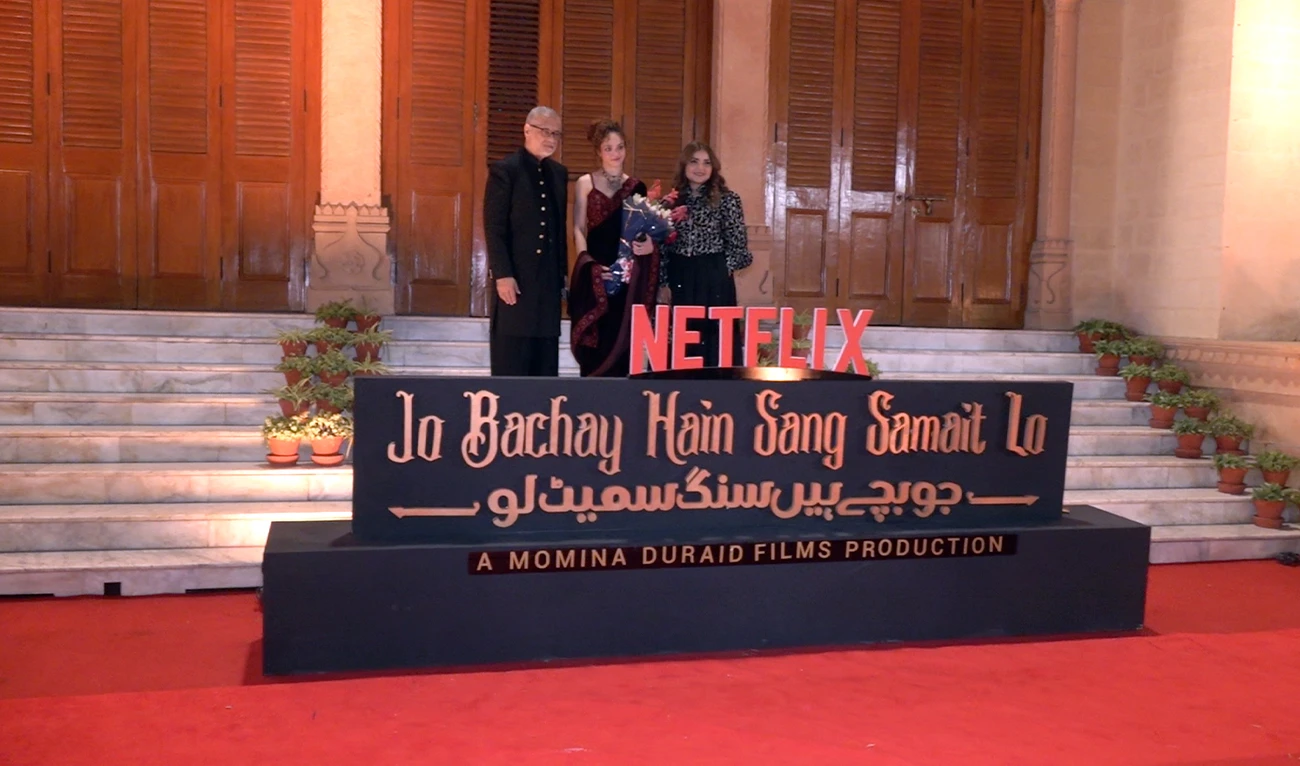
KARACHI: At Karachi’s Mohatta Palace this week, some of Pakistan’s best-known actors gathered to unveil the trailer for the country’s first Netflix series.
Across the border, an Indian film workers’ association was asking Prime Minister Narendra Modi to keep the series off screens in India.
Jo Bachay Hain Sang Samait Lo, titled All the Love Our Hearts Carry internationally, is a collaboration between Netflix’s Middle East and North Africa division and Pakistan’s Momina Duraid Productions. Its first part is set to premiere on Dec. 4.
Pakistani dramas have traveled across borders for years, including through Netflix, which has previously carried shows made for domestic television. This production gives a Pakistani team a direct collaboration with the streamer and a global launch for an Urdu-language drama. It also reunites Fawad Khan and Mahira Khan, whose hit television series Humsafar aired in India in 2014.
That history gives the dispute over the series’ availability in India particular weight. The title appeared on Netflix’s Indian website but the company has yet to confirm whether subscribers there will be able to watch it.
“Some of the [Pakistani] serials such as Humsafar, Zindagi Gulzar Hai, Shehr-e-Zaat and others, as well as some films, have had a run on Netflix earlier as well. But this is the first collaboration. So in a way, it kind of puts the best foot forward of both the producer and the platform,” Fawad Khan told Arab News at the Karachi launch on Tuesday.
SIX LOVE STORIES
Created and directed by Momina Duraid, the series adapts Pakistani novelist Farhat Ishtiaq’s 2013 book of the same name. It follows six love stories across three generations and was filmed mainly in Pakistan, with scenes shot in Rome and the United Kingdom. The project had been in the works for almost eight years by the time the trailer and music were unveiled in Karachi.
“This particular series is a Pakistani brand but it could only be possible because Netflix MENA took it under its wing. You need a global platform to believe in you. They believed in us and I hope we can live up to their expectations,” Duraid told Arab News.
“It’s time that the world knows about Pakistani culture and who we are as Pakistanis. It can only happen through our content that goes in the world because the world judges you by the content they see. It’s extremely important that Pakistan should go more on global platforms.”
Fawad Khan plays a man whose love interest, Victoria, is played by Sanam Saeed. Khan said the role gave him room to show his character’s emotional range.
“Mehmood loves, hates, gets angry [and] gets happy. You’ll get to see all these faces,” said Khan.
Saeed described Victoria as a woman of mixed heritage living in Italy.
“That in itself was a shock for me to be able to be like ‘Okay, I’m a half foreigner’. I live in Italy and I just have to embody this girl. I hope it clicks with people,” she said.
“It’s about time, this had to happen. We are very grateful that it happened in our lifetime and we could be a part of it. So that’s exciting.”
Hania Aamir, whose drama Kabhi Main Kabhi Tum drew viewers beyond Pakistan, said she hoped audiences would have some sympathy for the choices her character makes.
“[My character is an] extremely strong-willed girl. She goes to extreme lengths for love, whatever version she has of it in her brain. I really enjoyed her so if everyone could have some empathy for her, they’d understand what she is doing in life,” Aamir told Arab News on the red carpet.
The cast also includes Ahad Raza Mir, Iqra Aziz, Maya Ali, Bilal Ashraf, Ahmed Ali Akber and Dubai-based Aamina Sheikh, who plays Sadia.
Sheikh said she had seen interest in Pakistani dramas among viewers of different nationalities during her five years in the United Arab Emirates.
“They know there is a lot of good drama storytelling coming from this region,” said Sheikh.
For Sheikh, the release is a chance for viewers abroad to recognize Pakistani storytelling on its own terms:
“We need to visually and in this medium create our own identity globally because we are, most of the time, confused with the entire South Asian region whether it comes to Indian content, Bangla content [or] Sri Lankan content. A lot of people outside of South Asia don’t know how to distinguish what is Pakistani. If we can create that identity on a global scale there is nothing like it.”
UNCERTAIN AUDIENCE IN INDIA
The All Indian Cine Workers Association asked Modi to ensure the series “is not released or streamed in India on 4 December 2026 or on any other date.”
The letter, signed by association president Suresh Shyamlal Gupta, also called for a permanent law barring Pakistani productions and artists from Indian television, cinemas and streaming services.
The association cited a May 2025 advisory from India’s information ministry asking streaming services to stop carrying content originating in Pakistan. The ministry cited national security after gunmen killed 26 people in Pahalgam in Indian-administered Kashmir. India blamed Pakistan, which denied involvement. The nuclear-armed neighbors fought for four days in May before agreeing to a ceasefire.
Cultural exchanges have repeatedly narrowed during crises between the two countries, which were created with the partition of British India in 1947 and have fought multiple wars.
Pakistan announced a ban on Indian films in its cinemas in 2019 after New Delhi revoked Indian-administered Kashmir’s special status. In 2024, a planned Indian release of the Pakistani film The Legend of Maula Jatt, also starring Fawad Khan and Mahira Khan, was called off amid political opposition. The 2025 crisis brought further restrictions on travel and blocked access in India to YouTube channels run by Pakistani broadcasters including HUM TV and ARY Digital.
A block in India would keep Netflix subscribers there from watching the series while leaving the rollout elsewhere unaffected. Netflix told shareholders in October that viewing hours in India rose 24 percent from a year earlier in the third quarter, when it recorded its biggest quarterly increase in paid memberships in the country. The company does not disclose its India subscriber count, so the size of the potential audience is unknown.
The audience for Pakistani dramas in India was visible last weekend, when dozens of people turned up at a New Delhi café to watch an episode of the Pakistani Urdu-language television drama Dar-e-Nijaat, more than triple the turnout the organizer had planned for. Organizers stopped taking reservations after the surge in interest, and some viewers brought their parents. Fans have also held watch parties for the ARY Digital series in Bengaluru and Hyderabad, according to Indian media.
On Tuesday, Netflix marketing executive June Sauvaget addressed the launch in a recorded message.
“I want to thank all of them for the heart they’ve poured into playing these characters and bringing them to life. We cannot wait for the audience around the world to experience ‘Jo Bachay Hain Sang Samait Lo’ on Netflix.”