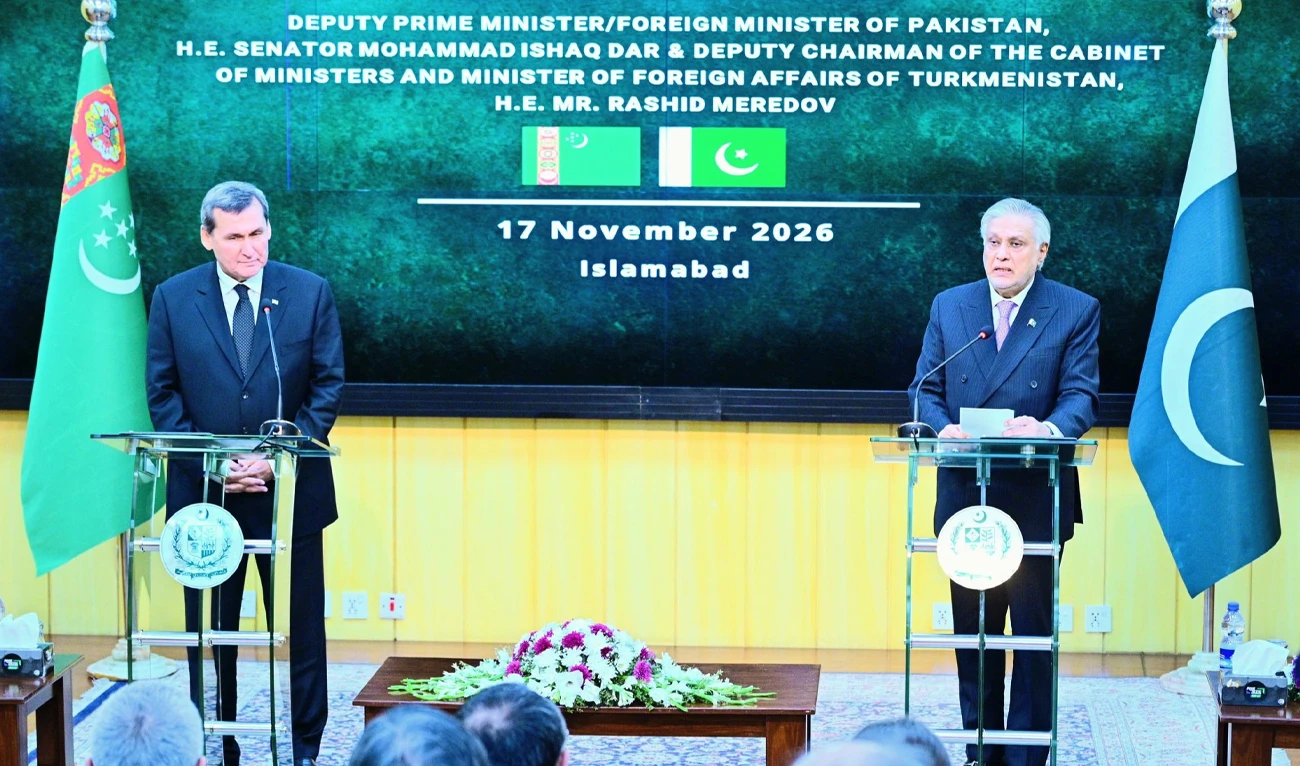
- The documents were signed after the sixth session of the Pakistan-Turkmenistan Joint Intergovernmental Commission in Islamabad
- Pakistan is working to strengthen energy, trade and economic ties with landlocked Central Asian states, touting itself as key transit hub
ISLAMABAD: Pakistan and Turkmenistan on Tuesday signed three agreements aimed at expanding bilateral cooperation in connectivity, trade and tourism, with both sides reaffirming their commitment to advancing regional energy and transport projects, including the long-delayed Turkmenistan-Afghanistan-Pakistan-India (TAPI) gas pipeline.
The documents were signed after the sixth session of the Pakistan-Turkmenistan Joint Intergovernmental Commission (IGC) on Economic Cooperation in Islamabad, co-chaired by Pakistan’s Deputy Prime Minister and Foreign Minister Ishaq Dar and Turkmen Foreign Minister Rashid Meredov.
The development comes at a time when Pakistan is working to strengthen its energy, trade and economic ties with landlocked Central Asian states, touting itself as a key trade and transit hub that can help connect with global markets through its strategic location.
The agreements signed on Tuesday included a protocol of the sixth IGC session, a cooperation program between the two foreign ministries for 2026-2030, and a memorandum of understanding on tourism cooperation between the two countries.
“We discussed ways to advance work on a bilateral transit trade framework and explore commercially viable transport links... I reiterated Pakistan’s readiness to explore practical arrangements for the use of our ports, including Karachi and Gwadar, and Turkmenistan cargo,” Dar said at a joint presser with his Turkmen counterpart.
“We also exchanged views on cooperation in the energy sector, including Turkmenistan-Afghanistan-Pakistan-India TAPI gas project pipeline. We recognized the importance of continued engagement among the participating countries on the technical and commercial aspects of the project.”
Both sides discussed the proposed Turkmenistan-Afghanistan-Pakistan electricity transmission project and the associated fiber-optic communications link, including the need for further assessment for their technical and commercial viability, according to Dar.
Beyond connectivity and energy, Dar said both countries explored opportunities to deepen cooperation in agriculture, industry, tourism, culture, higher education, information technology, health and financial services.
“We look forward to building on today’s discussions through sustained engagement and practical cooperation for the benefit of our two countries and our peoples,” Dar said.
Turkmen FM Meredov described the signing of the three agreements as “a very shining example” of the two countries’ effective cooperation under the Joint Intergovernmental Commission. He said additional agreements under discussion were expected to be finalized before a planned state visit by Turkmenistan’s leadership to Pakistan next year.
“We agreed that other documents which we discuss with our Pakistani colleagues will be prepared, will be finalized before the state visits which we are planning to arrange during the next year in Islamabad,” he said.
Dar thanked the Turkmen delegation for what he described as constructive engagement during the commission’s meetings and said both countries were committed to translating their discussions into practical cooperation.
Pakistan earlier proposed direct flights between Islamabad and Ashgabat to help revive trade with Turkmenistan, which fell 56 percent year on year in the first nine months of 2026, the Pakistani commerce ministry said Tuesday.
Bilateral trade stood at about $15 million between January and September, according to Turkmen Trade Minister Dortguly Suleymanov, who attributed the decline mainly to lower textile exports. Trade exceeded $36 million in 2025, down nearly 23 percent from 2024. Direct cargo flights could give Pakistani exporters a faster route for goods with a short shelf life.
“Jam Kamal Khan proposed exploring direct flights between Islamabad and Ashgabat, along with chartered cargo services for perishable agricultural and food products,” the commerce ministry said in its statement.