- Pakistan, which has a population of over 260 million, ranks among the countries most vulnerable to climate change
- The crises pose challenges with regards to economic planning, employment , education, health care, housing and food
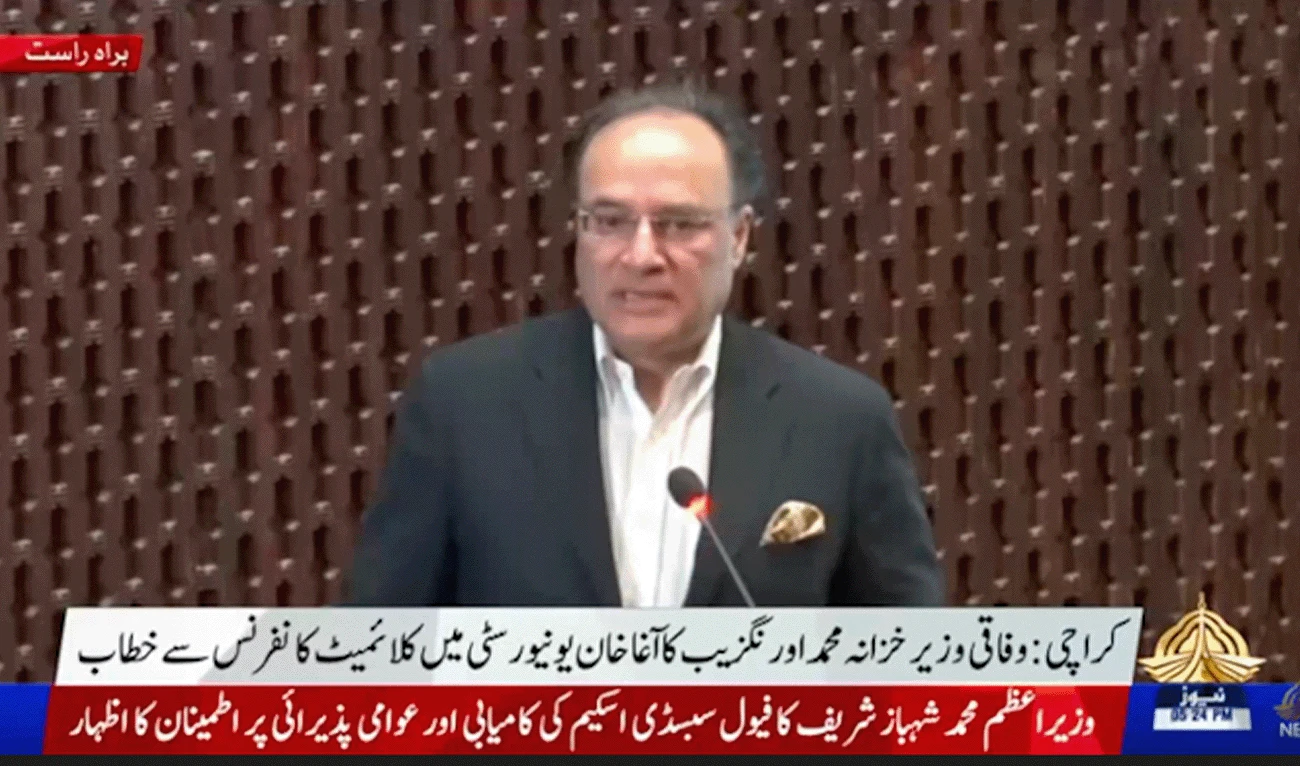
ISLAMABAD: Pakistan’s Finance Minister Muhammad Aurangzeb on Sunday called for an urgent, coordinated national response to the country’s rapidly growing population and worsening climate challenges, saying the two issues were increasingly interconnected and threatened the country’s development.
Pakistan is among the countries most vulnerable to climate change despite contributing less than one percent of global greenhouse gas emissions. The country has experienced increasingly frequent extreme weather events, including devastating floods, heatwaves and glacial lake outburst floods in its northern regions.
The annual population growth rate of the country of over 260 million presents significant challenges with regards to economic planning, employment generation, education, health care, housing, food, environment and infrastructure development.
Speaking at an event in Karachi, Aurangzeb said the country’s population was growing at 2.55 percent annually and child stunting and learning poverty were one of several issues associated with it, mentioning floods glacial melt and other climate phenomena that were exacerbating the situation.
“These simply exacerbate the discussion around health, education and everything else that is coming along. I think there is a reason why both of these need to be addressed, and addressed urgently by the whole of the government,” he said.
“And when I say whole of the government, it’s not only about the federal government. The provincial governments, we all have to work together.”
The statement came days after a survey by Pew Research Center, a Washington-based nonpartisan research organization, projected Pakistan to overtake Indonesia as the country with the world’s largest Muslim population by 2070, with the number of Muslims in the South Asian nation more than doubling to 461 million.
The findings are part of a global demographic study, which projects that Muslims will surpass Christians as the world’s largest religious group by 2035. The study examined population trends across 201 countries and territories, taking into account birth and death rates, migration and changes in religious affiliation.
The study said Muslims were the world’s fastest-growing major religious group, with their global population expected to increase by 80 percent between 2020 and 2070, compared with 11 percent growth among non-Muslims.
Pakistan’s share of the global Muslim population is expected to rise from about 11 percent to nearly 13 percent over the same period, while Muslims are projected to account for almost 97 percent of its population, little changed from 2020. The research also projected that Pakistan would have the world’s fourth-largest Hindu population by 2070, although Hindus would account for only about 2 percent of its population.