- The NSC expresses concern over the ‘undiplomatic language’ used by the foreign official mentioned in the diplomatic cable
- Pakistan’s information minister calls the opposition’s no-trust motion part of the ‘conspiracy’ hatched abroad
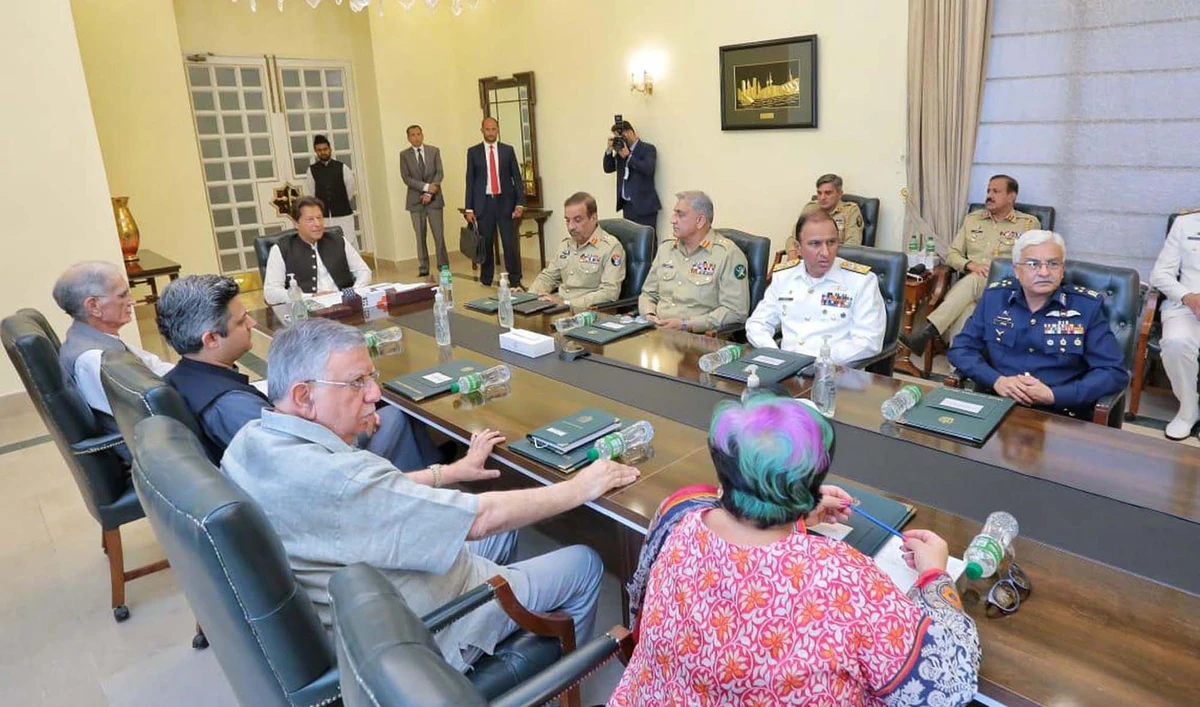
ISLAMABAD: Pakistan’s National Security Committee (NSC) on Thursday expressed concern over the language used by a foreign official in a document which Prime Minister Imran Khan recently described as evidence of a “foreign-funded conspiracy” against his administration while agreeing to issue a demarche to the country in question.
According to details shared by Prime Minister’s Office in a string of social media posts, Pakistan’s national security advisor briefed the committee over the content of a diplomatic cable generated by the country’s ambassador after meeting a senior official of a foreign state.
“The Committee expressed grave concern at the communication, terming the language used by the foreign official as undiplomatic,” the PM Office said in a Twitter post. “The Committee concluded that the communication amounted to blatant interference in the internal affairs of Pakistan by the country in question, which was unacceptable under any circumstances.”
It added that the NSC “decided that Pakistan will issue a strong demarche to the country in question both in Islamabad and in the country’s capital through proper channel in keeping with diplomatic norms.”
The diplomatic cable was first mentioned by the prime minister in a rally of his party workers and supporters in Islamabad on Sunday where he described it as a “threatening letter” by a foreign power. However, he did not specify which country or personality had written it, though the revelation generated a great deal of political debate around the issue.
Pakistan’s information minister Chaudhry Fawad Hussain told the media earlier in the day the no-confidence movement against the prime minister was part of the same foreign conspiracy against the government.
He said Pakistan was an independent and sovereign country, and there was no issue if a government was changed through constitutional means. However, he added that the no-trust motion was not “organic” since it was originally conceived by a foreign power.
“I have been told that we called some parliamentary leaders to show them the evidence and then we did the same to the opposition leaders,” he said. “However, their continuous boycott indicates that some of the opposition leaders are completely involved in this conspiracy. They are taking dictation from foreign powers.”
Hussain also accused former prime minister Nawaz Sharif of holding meetings with Indian and Israeli officials in London, adding some members of the media community were also involved in the ongoing conspiracy against the government.
“This conspiracy began in Nawaz Sharif’s apartment in London and is now coming to an end over here,” he added.
Addressing the media on the occasion, Pakistan’s energy minister Hammad Azhar said four things became clear after looking at the diplomatic cable.
“First, there has been an effort to change the government in Pakistan from a foreign power,” he maintained. “Second, the method [no-confidence motion] that the foreign government said would be adopted [against the Pakistani government] has actually been used.”
“Third, that foreign power is also very confident that if the government is changed in Pakistan, it will also change the country’s foreign policy,” he continued, adding: “Fourth, it considers Prime Minister Imran Khan as the architect of the country’s independent foreign policy.”
He concurred with Hussain’s assessment that the opposition’s no-confidence motion was part of the international conspiracy for “regime change” in Pakistan.