

RIYADH: Saudi Arabia’s relationship with France is often discussed in the language of diplomacy, investment and geopolitics, but it is now increasing being preceded by lighter conversations over a plate of warm prawns and French pastry at a table with friends.
Crown Prince Mohammed bin Salman is on an official visit to France for discussions on issues affecting the region and world, but the growing presence of French restaurants and chefs in Saudi Arabia offers another lens through which to view the relationship between the two countries.
French influence is increasingly visible in Riyadh’s restaurants, AlUla’s dining experiences and seasonal pop-ups, reflecting broader Saudi-French ties in culture, tourism and investment.
Food has become one of the most accessible expressions of that relationship.
The Kingdom’s rapidly changing culinary landscape has created space for established Parisian institutions, internationally renowned chefs and smaller French entrepreneurs to build a presence in Saudi Arabia.
Some arrive with decades of history behind them. Others are testing the market through temporary concepts, food trucks and seasonal appearances.
One of the clearest examples is LPM, formerly La Petite Maison, which opened in Riyadh.
Executive Chef Raphael Duntoye told Arab News during the restaurant’s soft launch that the decision to expand into the Saudi Arabia market was driven by demand for the restaurant’s established identity rather than a desire to reinvent it.
“The Saudi market wanted LPM for what it is, the signature menu and recipes, which we have been consistent about for the last 13 years,” Duntoye said. “So we decided to deliver just that for now, and do it greatly.”
Riyadh is LPM’s sixth location after London, Dubai, Miami, Abu Dhabi and Hong Kong. The restaurant serves more than 70 dishes influenced by French and Italian cooking, including Escargots de Bourgogne, warm prawns with olive oil and its popular cheesecake.
But the restaurant’s Saudi story began before its permanent presence in the capital.
LPM first appeared in the Kingdom as a pop-up during the 2019 Diriyah Season, offering diners an early introduction to the concept before establishing a more permanent presence in Riyadh.
That trajectory, from temporary attraction to permanent fixture, has become increasingly familiar in Saudi Arabia’s dining scene. Other French culinary names have followed a similar path.
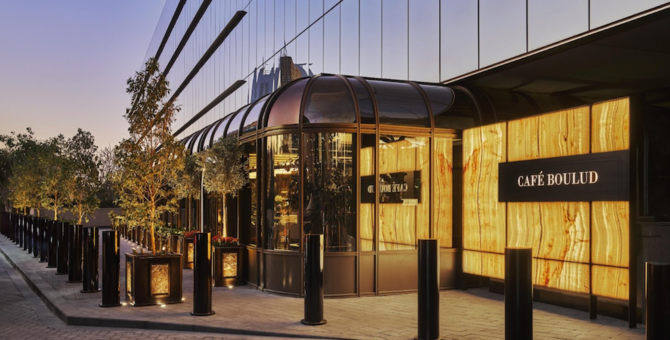
Parisian institution Les Deux Magots entered the Saudi market as a pop-up before opening in Via Riyadh, while chef Daniel Boulud has brought his interpretation of French cuisine to the Kingdom through seasonal dining showcases.
L’ami Dave in Mansard is another addition to Riyadh’s growing French dining scene, bringing a French-inspired concept to one of the capital’s expanding lifestyle destinations.
Together, the restaurants reflect a shift in the way international cuisine is entering Saudi Arabia. Rather than being confined to hotels or traditional fine-dining districts, French concepts are appearing across Riyadh’s increasingly diverse neighborhoods and entertainment destinations.
But perhaps the most interesting development is taking place outside the capital.
In AlUla, French culinary expertise is being combined directly with Saudi ingredients, landscapes and traditions.
Ducasse in AlUla, created by renowned French chef Alain Ducasse, offers an experience built around French techniques and produce sourced from the Kingdom. The concept uses ingredients including dates, citrus, vegetables, flowers, spices and Red Sea fish.
About 80 percent of its products are sourced locally, according to Dining Room Director Michel Lang.
The menu includes young camel prepared using French techniques, blue crab with burnt lemon and fennel, and desserts incorporating ingredients such as tahini.
Lang told Arab News that the young camel dish reflects the restaurant’s approach of combining Saudi ingredients with French techniques.
That distinction is important.
The story is no longer simply about French cuisine being imported into Saudi Arabia. It is increasingly about French culinary traditions being adapted to the Kingdom and, in turn, being shaped by what is available locally.
A French chef working in AlUla is not cooking in the same context as one working in Paris. The surrounding landscape, local produce and Saudi culinary traditions become part of the experience.
For Ducasse, even the setting is inseparable from the food. Located near the heritage site of Jabal Ikmah, the restaurant places French culinary techniques within an oasis landscape shaped by thousands of years of Saudi history.
The result is a form of cultural exchange that happens through ingredients as much as through recipes.
A French technique can be applied to a Saudi ingredient. A traditional French dessert can incorporate tahini. Red Sea fish can become part of a menu inspired by Mediterranean cooking.
The direction of influence is therefore becoming less one-sided.
Saudi Arabia is not simply becoming a market for French restaurants. Its ingredients, landscapes, diners and cultural identity are becoming part of what French culinary brands present in the Kingdom.
The French presence also extends well beyond luxury restaurants and internationally recognized chefs.
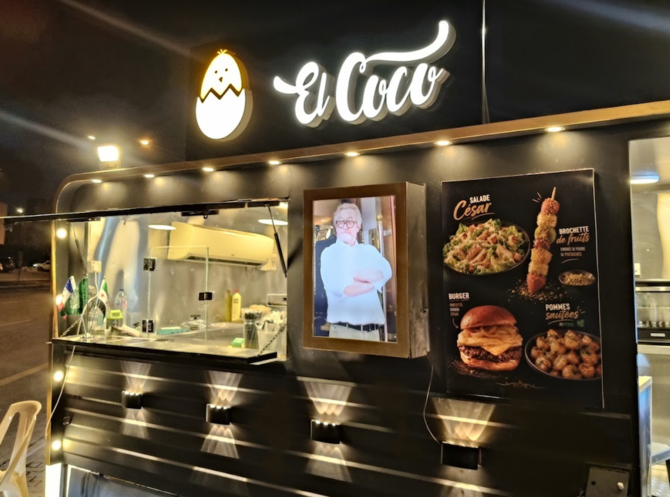
In Al-Izdihar, a French chef and his wife operate El Coco, a temporary food truck serving burgers and potatoes. The concept is more casual than the fine-dining restaurants associated with chefs like Ducasse, but the couple has bigger ambitions: to eventually open their own restaurant in Riyadh.
El Coco represents a smaller and more informal side of the Saudi-French culinary exchange.
There are no elaborate tasting menus or desert resorts. Instead, there is a French couple, a food truck and a plan to build a more permanent business in the Saudi capital.
Its appeal lies partly in its simplicity. Familiar street-food staples are being served through the perspective of French entrepreneurs who have chosen Riyadh as a place to build their future.
That makes El Coco part of a broader story unfolding across the Kingdom.
Saudi Arabia’s expanding restaurant, tourism and entertainment sectors are attracting not only established international brands, but also independent chefs, couples and small business owners who see opportunities in a market that is developing quickly.
From haute cuisine in AlUla to burgers served from a food truck in Riyadh, the scale of the French culinary presence varies dramatically.
But the businesses share an underlying trend.
French culture is becoming increasingly embedded in Saudi Arabia’s everyday consumer landscape.
For restaurant operators, the attraction is commercial. For diners, it can be cultural. For the two countries, food offers an unusually informal form of diplomacy.
Saudi Arabia and France have spent years broadening their relationship beyond traditional political cooperation, with ties spanning culture, tourism, trade and major Vision 2030 projects.
France has also been closely involved in several of the Kingdom’s major development and cultural initiatives, including projects connected to AlUla and other emerging destinations.
Against that backdrop, a French restaurant opening in Riyadh may appear to be a small development. But cultural relationships are often built through ordinary experiences.
A diner discovering a French dish in Riyadh, a Saudi ingredient appearing on a menu created by a French chef, or a Parisian cafe finding a new audience in the Kingdom can all become part of a much larger exchange.
The transformation can also be seen in the journey of the restaurants themselves.
Pop-ups that once tested whether Saudi audiences would embrace a particular concept can evolve into permanent establishments. Temporary food trucks can become stepping stones toward restaurants. International chefs can begin working with local producers and ingredients.
The result is a culinary landscape that is increasingly difficult to describe simply as “French food in Saudi Arabia.” It is becoming something more collaborative.
French techniques meet Saudi ingredients. Parisian concepts meet Riyadh diners. International culinary reputations meet a young and rapidly changing consumer market. And that may be the most telling part of Saudi Arabia’s French food boom.
It is no longer simply about bringing France to Saudi Arabia.
It is about French chefs, restaurateurs and entrepreneurs coming to the Kingdom, finding an audience and increasingly deciding to build something here.
Diplomacy may happen across conference tables. But cultural relationships are often built around dining tables. And in Saudi Arabia, those tables are increasingly French, while the ingredients, audiences and stories around them are becoming distinctly Saudi.