

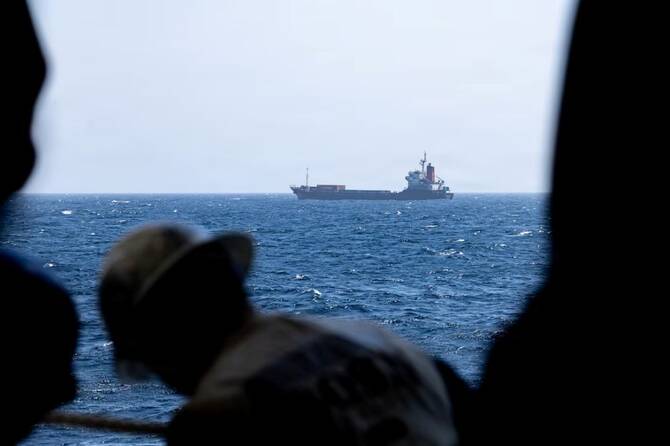

NEW DELHI: India’s maritime regulator has barred ship owners, managers and recruitment agencies from sending Indian nationals to work on vessels transiting the Strait of Hormuz following a rise in deadly attacks by US and Iranian forces.
Ten civilian ships staffed by Indian seafarers — MT Settebello, MT Celestial, MT Marivex, MT Jalveer, GFS Galaxy, Sky Light, Safe Sea, MT Safesea Vishnu, MT Mombasa and MT Al-Bahiyah — have been targeted by US and Iranian forces since the beginning of the US-Israeli war on Iran on Feb. 28.
The first attack took place on March 1, when the Sky Light oil tanker was hit while anchored about five nautical miles north of the Omani coastline.
It has not been conclusively established whether the ship was hit by Iranian or US forces, but two Indian sailors, including the ship’s captain, were killed. Since then, at least another six Indians were killed in similar attacks.
On Tuesday, an Indian sailor on a UAE-operated tanker, MT Mombasa, was killed by an Iranian missile. On Wednesday, an engineer missing after an attack on GFS Galaxy on July 12 was confirmed dead.
The escalation in attacks over the past few days has “increased the risks faced by seafarers and commercial ships operating in the conflict-affected area significantly,” India’s Directorate General of Shipping said in a notification to ship owners, managers and recruitment companies on Wednesday evening.
“Ship owners, ship managers and RPS companies are directed to avoid deploying Indian seafarers on vessels undertaking voyages involving passage through the Strait of Hormuz until further orders.”
At least 15,000 Indians still remain stranded in the maritime passage aboard various civilian ships operated by companies from different countries.
While the DGMA limits their deployment by entities registered in India, those do not constitute the bulk of ship operators in the area. Most of the vessels in the strait do not operate under the Indian flag.
“We have limited access when it comes to the vessels which are registered in foreign countries or the beneficial owner belongs to a foreign country ... we are only a labor-supplying country,” said Manoj Yadav, secretary-general of the Forward Seamen’s Union of India, a labor union representing sailors working aboard commercial vessels.
“The decision on sailing vessels through the Hormuz or not is totally dependent on the beneficial owner, or the charterer or the technical management, not on the recruitment and placement services who are recruiting Indian seafarers.”
While the ban set by the Indian regulator will prevent some sailors from being deployed to the conflict zone, it has no effect on those who are already there. The union has been pleading with the Indian government to intervene at the UN level instead.
“Almost every week, there are attacks, and the casualties reported,” Yadav told Arab News.
“We wrote a letter to our honorable prime minister requesting them to register a protest in the UN over the murder of Indian seafarers ... it is high time that the Indian government intervened on a direct basis with Iran and the US.”


