AI is revolutionizing cinematography — but can we trust it?

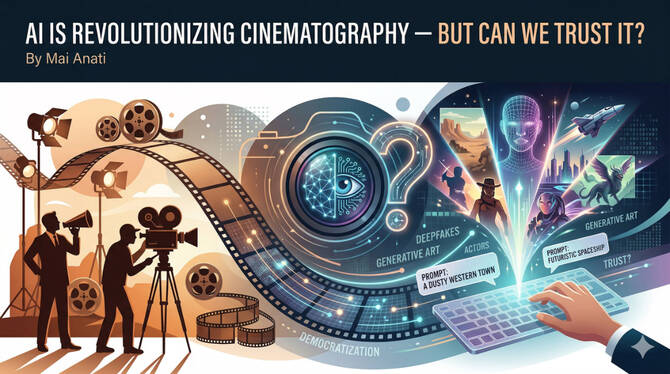
https://arab.news/rn5ez
Artificial intelligence is rapidly integrating into nearly every aspect of modern life, yet few fields are feeling its impact as dramatically as the film industry.
For more than a century, great films have been the product of massive collaborative effort.
From scouting locations and building sets to coordinating actors, lighting, and sound, filmmaking has always been an intensely human endeavor.
On a set, with cameras rolling and a director shouting “action,” every member of the cast and crew moves in careful synchrony.
The late filmmaker Samuel Fuller once described filmmaking as “a battleground — love, hate, action, violence, death — in one word: emotion.”
It is precisely this emotional and often chaotic energy that has long defined cinema. However, with the arrival of AI-powered cinematography, that vibrant atmosphere is changing.
From prompts to production
The industry is currently undergoing a profound technological shift. AI-driven visual design platforms such as DALL-E, Midjourney, and OpenAI’s Sora are transforming the early stages of filmmaking.
Tasks that once required weeks of work — such as concept art, character design, and visual style development — can now be generated within minutes through simple text prompts.
This transformation extends far beyond pre-production. During filming and post-production, AI tools are increasingly capable of generating entire scenes, environments, and complex actions based on creative direction.
Filmmakers can now refine outputs and combine digital elements without ever picking up a traditional camera.
In conventional filmmaking, editing involves cutting and enhancing existing footage.
AI alters this process entirely. Instead of relying solely on recorded material, generative models trained on vast datasets can synthesize scenes, characters, and animations from scratch.
The rise of the virtual performer
The implications of these tools are significant. AI systems can transform a written prompt into complete visuals and movement automatically, accelerating creative experimentation and lowering production costs.
This democratization allows beginners to create high-quality video content without the need for expensive cameras, actors, or advanced editing skills.
Another major development is the emergence of virtual actors and AI-driven computer-generated imagery.
Using deep learning, filmmakers can digitally alter an actor’s appearance — making them appear decades younger or older with remarkable realism.
Many of these effects rely on Generative Adversarial Networks, which analyze thousands of facial expressions to recreate convincing human features.
Deepfake technology has taken this even further, allowing filmmakers to replace faces, resurrect historical figures, or create digital performers that are almost indistinguishable from real people.
Can a machine write a masterpiece?
Artificial intelligence has even entered the writers’ room. Using Natural Language Processing, AI tools can analyze patterns in successful screenplays to estimate audience engagement or generate dialogue that imitates a specific writer’s style.
Yet, despite these advances, AI still struggles with the essentials of the craft: originality, emotional depth, and the subtle nuance that human writers bring to storytelling.
This raises a fundamental question: Is AI-generated work truly authentic?
Cinema has always been a blend of art and technology. Masterpieces such as 2001: A Space Odyssey, The Matrix Revolutions, and Titanic demonstrate how technology can expand storytelling possibilities.
But could AI produce a film with the emotional weight of The Godfather, Cast Away, or Saving Private Ryan?
For now, the answer is likely no. These films rely on deeply human performances and emotional nuances delivered by actors like Tom Hanks, Marlon Brando, and Al Pacino — qualities that machines cannot yet replicate.
A collaborative future
However, technology evolves quickly. As audiences grow familiar with AI-generated content, the possibility of a machine-assisted cinematic classic no longer seems far-fetched.
The future of filmmaking may not be a battle between humans and machines, but a collaboration— one where artificial intelligence expands the toolkit of storytelling while human creativity continues to give cinema its soul.
• Mai Anati is managing editor at The Jordan Times.