
RIYADH: Global markets and energy prices reacted to the US-led attack on Iran on Monday, as the Middle East aviation sector continued to be impacted.
Oil prices surged by as much as 13 percent before paring back after shipping in the crucial Strait of Hormuz was disrupted by retaliatory Iranian attacks.
One of the most dramatic developments came when QatarEnergy announced it was halting liquified natural gas production following an Iranian drone attack on its facilities in Ras Laffan and Mesaieed Industrial Cities.
The decision sent gas prices soaring almost 50 percent in Europe.
Here is how the day unfolded (all times are Saudi)
6.02 p.m. Saudi stock exchange stable
The Kingdom’s benchmark index maintained stability on Monday, as it edged up by 0.13 percent to close at 10,488.91. The total trading turnover of the main market stood at SR7.22 billion, with 74 of the listed stocks advancing and 189 declining.
Saudi Arabia’s parallel market Nomu edged down by 0.29 percent to close at 22,532.90. The MSCI Tadawul Index advanced by 0.30 percent to 1,422.97.
Aramco’s share price increased by 1.63 percent to SR26.22 ($6.99), compared to the previous close of SR25.80.
4:40 p.m. - Kuwait bans food exports

Getty
Kuwait has announced a ban on food exports for a month. Minister of Commerce and Industry Osama Boodai made the decision "in order to protect consumers and enhance market stability," reported the country's official news agency.
In 2024, Kuwait exported around $394.03 million in food including dairy products, fruits and vegetables, cereal and cocoa, according to the UN database on international trade.
4:32 p.m. - Europe gas prices soar
After QatarEnergy announced it was halting LNG production (see below), the price of gas in Europe soared by almost 50 percent.
Europe has increased imports of LNG over the past few years as it seeks to phase out Russian gas following Russia’s invasion of Ukraine.
Around 20 percent of the world’s LNG transits through the Strait of Hormuz and a prolonged suspension or full closure would increase global competition for other sources of the gas, driving up prices internationally.
“Disruptions to LNG flows would reignite competition between Asia and Europe for available cargoes,” said Massimo Di Odoardo, vice president, gas and LNG research at Wood Mackenzie.
2:56 p.m. - QatarEnergy halts LNG production

Ras Laffan Industrial City. QatarEnergy
QatarEnergy announced that it has halted liquefied natural gas production and related products after military attacks targeted its facilities in Ras Laffan and Mesaieed Industrial Cities.
The company said it will continue to provide updates to stakeholders as more information becomes available.
1:40 p.m. - Emergency surcharges being rolled out amid supply chain disruption

Getty
Global supply chains are facing continued disruption, with shipping firms and airlines suspending routes, rerouting traffic, and imposing emergency surcharges across the Middle East.
As traffic slowed through the Strait of Hormuz and airspace restrictions spread across Gulf hubs, logistics providers halted new container bookings and adjusted operations, driving longer transit times, higher freight costs, and greater uncertainty for cargo owners worldwide.
Ship-tracking data cited by Reuters showed a maritime standstill taking shape near the Hormuz chokepoint, with roughly 150 crude and liquefied natural gas tankers anchored in open waters beyond the strait and additional vessels stationary on both sides, clustered near the coasts of Iraq, Saudi Arabia, and Kuwait, as well as the UAE and Qatar.
Hapag-Lloyd and CMA CGM are among those to have introduced surcharges in light of the military activity.
1:08 p.m. - Global markets down

Getty
Equities across Asia fell in early Monday trading as investors moved into safe-haven assets amid fears of prolonged conflict and supply disruptions in the Middle East.
Japan’s Nikkei 225 and South Korea’s Kospi declined by 2.7 percent and 4.3 percent, respectively.
Indian benchmark indices extended losses, with the BSE Sensex falling 1.90 percent and the NSE Nifty 50 dropping 1.88 percent as of 11:30 a.m. Saudi time.
Pakistan’s stock market dropped as much as 9.6 percent — the worst fall of its kind on record — according to Reuters.
12:50 p.m. - Oil gains surges pare slightly

Shutterstock
Oil prices have fallen back slightly since a 13 percent surge. Brent crude futures rose stood at $78.60, up 7.86 percent , by 9:42 a.m. GMT.
US West Texas Intermediate crude climbed to an intraday high of $75.33, up over 12 percent and the highest since June, before dropping back to $71.84 — a rise of 7.19 percent.
12.35 p.m. - Lebabon airspace remains open
Lebanon’s Middle East Airlines is still operating its flight to Riyadh and other destinations, remaining the country’s only active carrier. Lebanon’s airspace stayed open after Israeli strikes hit Beirut in the early hours of March 2 in response to Hezbollah targeting Haifa. Another strike hit Beirut at 12noon; the airport remains intact.
12:14 p.m. - Aviation impacted for 3rd day
Airlines and airport operators across the Middle East extended flight suspensions for a third consecutive day after US and Israeli strikes on Iran triggered widespread airspace closures, disrupting global travel routes.
Major Gulf hubs halted operations as authorities kept sections of regional airspace closed, forcing carriers to cancel thousands of flights and reroute long-haul services linking Europe, Asia and Australia.
Emirates said in a statement that, due to multiple regional airspace closures, it has temporarily suspended all operations to and from Dubai until 3:00 p.m. UAE time on March 3.
Hamad International Airport said flights remain suspended and will resume once the Civil Aviation Authority announces the reopening of Qatari airspace. The airport advised passengers not to travel to the airport and to contact their airlines for updates.
12noon - Muted opens from regional markets

File
Saudi Arabia’s Tadawul All Share Index showed signs of resilience on March 2, buoyed by gains in Saudi Aramco, even as the Middle East region continues to grapple with escalating tensions.
As of 11:50 a.m., Saudi time, the Kingdom’s benchmark index maintained stability, seeing only a marginal decline of 0.74 percent to 10,398.64.
Aramco’s share price increased by 1.16 percent to SR26.10 ($6.95), compared to the previous close of SR25.80.
The Dubai Financial Market and Abu Dhabi Securities Exchange is closed today and tomorrow.
Boursa Kuwait declined by 2.25 percent, while Bahrain’s benchmark and Muscat Qatar Stock Exchange edged down by 1.53 percent and 3.26 percent, as of 11:00 a.m. Saudi time.
11:26 a.m. - Emirates continues Dubai flight suspension

Shutterstock
“Due to multiple regional airspace closures, Emirates has temporarily suspended all operations to and from Dubai, up until 1500hrs UAE time on Tuesday, 3 March,” a statement on the airline’s website reads.
It added that the situation remains dynamic and is assessed continuously. We urge all customers to review the latest operational updates on emirates.com and check their email for any notifications about changes or cancelations to their flights before traveling to the airport’s
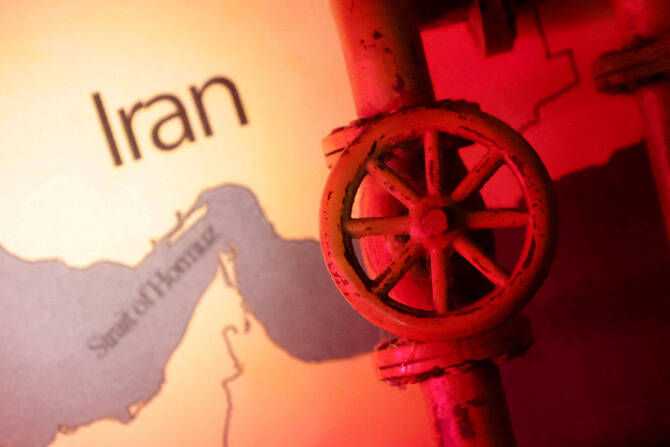
11:20 a.m. - Why the Strait of Hormuz is so vital for global energy

The Strait of Hormuz remains one of the most critical arteries of the global energy system, carrying about 20 million barrels of oil per day — roughly one-fifth of global consumption — along with a significant share of the world’s liquefied natural gas exports.
The 33 km-wide waterway links the Persian Gulf to the Gulf of Oman and serves as the primary export route for Saudi Arabia, the UAE, Iraq, Kuwait and Qatar.
At its narrowest shipping point, transit lanes are only about two miles wide in each direction, concentrating tanker flows through a confined corridor.
Markets have demonstrated their sensitivity to geopolitical risk in the area, with Brent crude recently rising sharply in a single session despite no physical disruption to shipments.
Asia is particularly exposed: about 84 percent of crude transiting the strait is destined for Asian buyers, including China, India, Japan and South Korea.
Three alternative routes offer limited mitigation. Saudi Arabia’s East-West Pipeline to the Red Sea, the UAE’s Abu Dhabi Crude Oil Pipeline to Fujairah, and Iraq’s northern export route to Turkey together provide only partial rerouting capacity.
Combined, they cannot replace the full volume that normally passes through Hormuz, underscoring its central role in global energy security and price stability
10:50 a.m. - Aramco shares up

Getty
The share price of Saudi energy firm Aramco rose 1.71 percent after the market opening in Riyadh this morning. The increase comes after the company's shares closed up 3.37 percent on Sunday.
10:00 a.m. - FedEx suspends some services
Global transportation company Fedex says due to recent developments in the Middle East, customers may experience service delays.
9:05 a.m. - Oil prices up 13%
Brent crude futures rose to as much as $82.37 a barrel, the highest since January 2025, before retreating to be up $5.41, or 7.4 percent, to $78.28 by 09:05 am Saudi time.
US West Texas Intermediate crude climbed to an intraday high of $75.33, up over 12 percent and the highest since June, though it later pared gains and was up $4.74, or 7.1 percent, at $71.76.