History can teach us how to make Gaza ceasefire work

https://arab.news/2w84e
The US-sponsored ceasefire for Gaza was approved by the UN Security Council three months ago, yet the killing has not stopped. Since the truce supposedly began in October, at least 586 Palestinians have been killed and more than 1,000 have been injured. In Gaza, the “peace” looks remarkably like the war that preceded it, with civilians still caught in the crossfire and a humanitarian catastrophe deepening by the day. If Thursday’s Board of Peace meeting is to be anything more than a symbolic gesture, members must work on moving from a sham truce to a genuine cessation of hostilities.
One way to find a solution is to look at previous ceasefires that actually worked. History shows us that a ceasefire is not merely a pause in shooting; it is a technically complex agreement that requires specific pillars to remain standing. The most successful ceasefires share two key ingredients: robust, neutral monitoring with clear, reciprocal obligations and a parallel political process that can give people hope. When those elements are absent, as they are today, the stronger party inevitably dictates the terms on the ground and the agreement collapses at the hands of a powerful occupier that is not genuinely interested in a cessation of violence.
The monitoring vacuum in Gaza is perhaps the greatest catalyst for failure. Israel has barred foreign journalists and international observers from the Strip. The International Stabilization Force envisioned in US President Donald Trump’s 20-point plan remains a phantom. Without boots on the ground from neutral parties — the kind of monitors that stabilized the Sinai after 1979 or the Balkans in the 1990s — a ceasefire is just a piece of paper. Israel has even vetoed the inclusion of Turkish and Qatari troops, insisting instead on a force that will do what its own military could not: the total and immediate disarmament of Hamas. To make this ceasefire work, the US must end the Israeli veto on monitors and deploy a multinational force with a clear mandate to verify violations and report them directly to the UNSC.
The International Stabilization Force envisioned in Trump’s 20-point plan remains a phantom
Daoud Kuttab
Beyond monitoring, a ceasefire needs a functioning civilian alternative to the chaos of war. For weeks, 14 Palestinian men and one woman have been waiting in Egypt for Israeli permission to enter Gaza. This National Committee for the Administration of Gaza is composed of non-Hamas technocrats, chosen by the US team in coordination with all parties. Yet they remain stranded while Israel reportedly objects to trivialities like the committee’s logo.
By preventing a vetted civilian government from taking root, the status quo ensures that Hamas remains the only governing power in Gaza, which in turn justifies continued Israeli military operations. A firm decision is needed: the committee must be seated in Gaza immediately, with the full backing of the international community, to manage reconstruction and restore basic services.
Furthermore, a ceasefire only holds when it is linked to a credible political horizon. Previous successful truces were never an end result; they were the first phase of a larger political settlement. The promise of “Palestinian self-determination” cannot remain a footnote in the 20-point plan. While Washington’s focus has drifted toward Iran in recent weeks, the reality is that the toxicity of the Middle East cannot be drained so long as Gaza is left to fester. The Board of Peace must reestablish a “credible pathway to statehood,” as recognized by the UN, and give the Palestinian people a reason to invest in the calm.
Previous successful truces were never an end result; they were the first phase of a larger political settlement
Daoud Kuttab
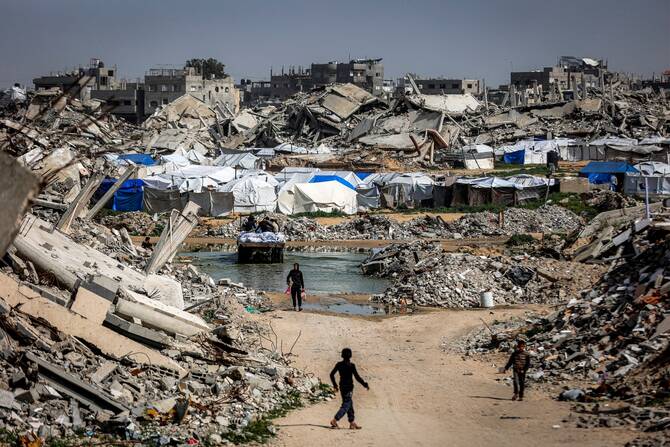
Finally, we must address the humanitarian death by a thousand cuts that undermines the truce. Israel has refused to allow prefabricated homes for those in tents and has restricted the entry of the heavy equipment needed to recover the thousands of bodies still trapped under the rubble. A ceasefire that secures the release of Israelis but leaves the Palestinian population to freeze and starve is not a peace plan. True success requires the full lifting of the siege and unconditional entry of aid, as required by international humanitarian law.
Thursday’s summit is the last chance to prove that the current peace framework is a roadmap, not a headstone. The 15 technocrats in Egypt are ready. The reconstruction funds are pledged. All that is missing is the political will to enforce the basic requirements of the truce. We must learn from the past: peace is not kept by silence but by the active presence of monitors, the empowerment of civilian leaders and the promise of a future beyond war, occupation, siege and attempts at displacement.
- Daoud Kuttab is an award-winning Palestinian journalist and former Ferris Professor of Journalism at Princeton University. He is the author of “State of Palestine Now: Practical and Logical Arguments for the Best Way to Bring Peace to the Middle East.” X: @daoudkuttab