

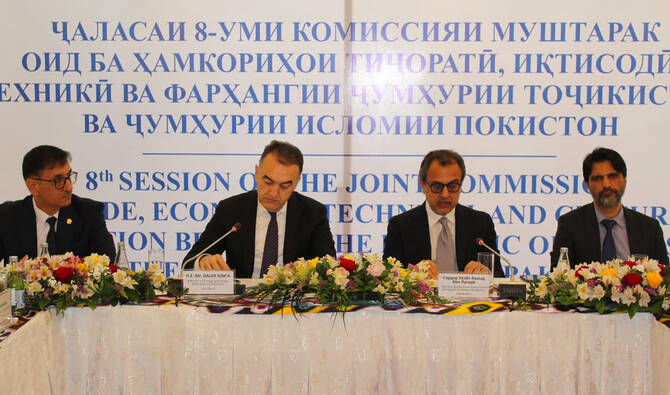

ISLAMABAD: Pakistan and Tajikistan agreed on a three-year roadmap to increase bilateral trade between them to $200 million, state media reported on Thursday, reaffirming their resolve to deepen cooperation in trade, agriculture, energy, tourism and connectivity.
Pakistan has recently sought increased cooperation with Central Asian states, including Tajikistan, in logistics, energy and agriculture, as its deals with frequent border closures due to strained ties with Afghanistan.
The two sides agreed on the roadmap during the eighth session of the Joint Commission on Trade, Economic and Scientific-Technical Cooperation held in Dushanbe between the two sides. The two-day meeting was held from June 2-3 and was co-chaired by Tajikistan’s Minister of Energy and Water Resources Jum’a Daler Shofaqir, and Pakistan’s Power Minister Sardar Awais Ahmad Khan Leghari.
“Pakistan and Tajikistan have agreed on a comprehensive roadmap to boost bilateral trade to $200 million over the next three years,” state-run Associated Press of Pakistan (APP) reported on Thursday.
Pakistan and Tajikistan enjoy cordial relations but their bilateral trade has failed to cross $100 million in 2023. Pakistan exported goods worth $48.94 million to Tajikistan in 2023, while it imported goods worth $3.8 million from the country in the same year.
The two sides also agreed to expand cooperation in energy, agriculture, information technology, health, education and tourism during the meeting.
Both delegations underscored the importance of strengthening trade and investment ties through enhanced business-to-business engagement, participation in trade exhibitions, exchange of trade information and closer collaboration between chambers of commerce, it added.
“The parties agreed to organize trade delegations, B2B meetings and online business interactions to unlock new commercial opportunities,” state media said.
The two countries expressed satisfaction over progress on the CASA-1000 regional electricity transmission project, stressing the need for the timely completion of the remaining work.
Both countries reaffirmed their participation in the CASA-1000 Joint Working Group meeting scheduled for June 2026 in Istanbul.
The CASA-1000 project, launched in 2016, aims to allow Tajikistan and Kyrgyzstan, former Soviet republics with an extensive network of hydroelectric power plants, to sell excess energy to Pakistan and Afghanistan in the summer months.
The project, initially meant to allow the export of electricity to Afghanistan and Pakistan by 2020, has been stalled for years by turmoil in Afghanistan.
“The two sides also reaffirmed their participation in the CASA-1000 Joint Working Group meeting scheduled for this month in Istanbul,” APP said.


