France’s new model for relations with Africa

https://arab.news/gfwrx
Emmanuel Macron is France’s first president who did not live through or experience the country’s colonialist past. He stated early in his first mandate a will to shift Paris’ African strategy and to break away from this past, recognizing historical mistakes and building a new relationship. This shift in strategy was not merely the result of a deep self-reflection but also a necessity to adapt to global geopolitical changes in order to stay relevant. It is a way to manage France’s decline in influence and capacity to impact African files. Thanks to stronger direct engagement from China, Russia and the US, or even India, the Francafrique has been pushed over. And it is difficult to define a new way or what comes next.
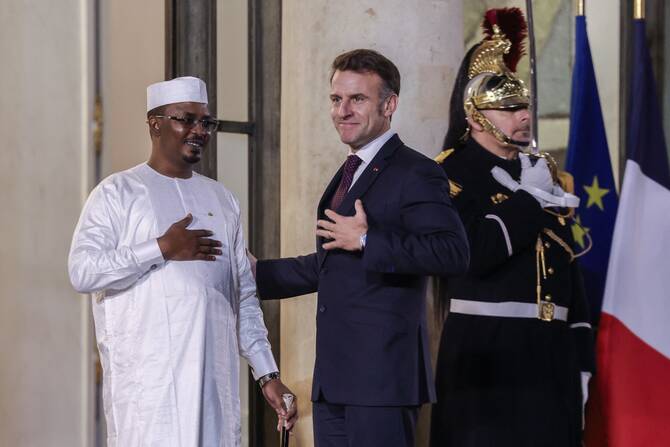
This is why last week’s visit of Chadian President Mahamat Idriss Deby to Paris has raised the question of whether a new path is starting to emerge. This visit came following a severe rupture in relations. The positive language from both parties, referring to it as a “friendship” visit, intended to redefine the parameters of Franco-Chadian cooperation. We are yet to see the outcome but could this be a case study for France’s new African policy?
This visit came after Chad abruptly terminated its defense agreement with France in November 2024. Relations had rapidly deteriorated and the French military was forced to quickly withdraw. The Chadian decision clearly blindsided Paris. It was also a source of increased tensions beyond the closure of the French military base itself, as this was also happening elsewhere in Africa. It is worth noting that, while the two countries’ military collaboration broke down, diplomatic relations were never officially cut off.
Perhaps Chad has started to notice that Paris can still be a valid partner and that Macron’s approach is genuine
Khaled Abou Zahr
Indeed, Chad is not the only country to have stopped military collaboration with France. If we focus on the Sahel region, Operation Barkhane came to an end in 2022 and thousands of French troops withdrew after France was militarily driven out of other important nations like Mali, Burkina Faso and Niger. This happened in various forms, abruptly or in good order, depending on the country. These withdrawals came in the wake of coups, as well as growing anti-French sentiment.
Moreover, claims were made that, despite long-term deployments, France had failed to provide security, as the threat of insurgents continued to increase. Perhaps Chad has started to notice that Paris can still be a valid partner and that Macron’s approach of turning a new page is genuine, or it could be a simple, pragmatic give-and-take situation.
France needs to show that it can build anew, while there is little doubt that N’djamena needs economic support, which Moscow has not been able to provide lately. It is nevertheless important to remove the tensions of what looks like a bad breakup. This is a prerequisite in order to start afresh. One must also understand that France’s package for African countries was and still can be a mix of military, intelligence, economy and soft power, as well as international access.
With its capacity for infrastructure building and development, France can be a valid partner supporting Africa’s new leaderships to deliver change for their citizens. However, something France will have to give up — especially in the face of stronger Russian and Chinese execution — is the habit of giving lessons. A more pragmatic approach is needed, as such an attitude of disdain will not work.
In the same way, French judicial investigations into the alleged misappropriation of public funds could also be a blockage in bilateral relations. Although these actions should have reassured the new African leaders, it has actually added to the tensions as it is seen as a sword above their heads and a means of leverage, especially in the CFA franc environment.
Something France will have to give up — especially in the face of stronger Russian and Chinese execution — is the habit of giving lessons
Khaled Abou Zahr
It is easy to understand that these labels portray Paris as an unsafe and unreliable economic partner. Whether all these actions are justified or not, they have created an atmosphere of preemptive distrust between France and African heads of state. This contributed to the freezing of relations with Chad, as in 2024 French prosecutors launched an inquiry into allegations that Deby embezzled public funds.
Deby’s warm visit to the Elysee Palace perhaps offers a new opportunity, especially as Chad stated that the meeting helped in clarifying misunderstandings and finding an end to their disagreements. It is also clear that Chad is in search of, or in need of, economic cooperation, especially in the areas of energy, digital technology, agriculture, livestock, education and culture. Moreover, Paris can help Chad by supporting it in front of international financial organizations like the World Bank and the International Monetary Fund. This is something N’djamena cannot disregard.
Another positive is that Macron has given a clear signal of a will to have African countries take more agency within the decision-making process of their region and to be real stakeholders in building its security and stability. This is clear in the important stance both presidents took for the establishment of a humanitarian truce in Sudan and conditions that would facilitate the resolution of its civil war.
There is no doubt that what is happening in Sudan and relations with neighboring Niger could lead to increased internal divisions and instability in Chad. Hence, Deby needs the backing of strong allies such as France for international reach as well as intelligence support. This provides an opportunity for both countries, as Paris can reposition itself in the face of Russian competition. It is still too early to judge, but this could be an example of how France can reestablish its relations with African nations.
- Khaled Abou Zahr is the founder of SpaceQuest Ventures, a space-focused investment platform. He is CEO of EurabiaMedia and editor of Al-Watan Al-Arabi.