

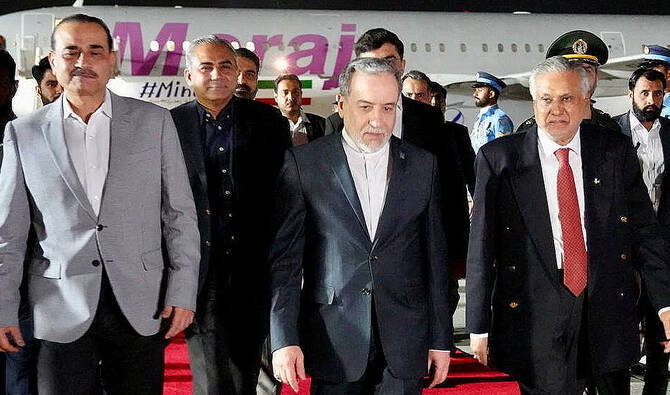

ISLAMABAD: Iran’s Foreign Minister Seyed Abbas Araghchi is set to return to Islamabad for a “few hours” tonight after concluding his visit to Oman, Iranian state media and diplomatic sources said on Sunday, hours after President Donald Trump canceled a US delegation’s planned visit to Pakistan for peace talks.
Araghchi arrived in Islamabad on Friday to discuss Tehran’s tensions with Washington after the Israeli-US strikes against Iran in February triggered a war between the three sides that lasted for more than a month.
The Iranian foreign minister concluded meetings with Pakistani officials without a breakthrough and left for Oman on Saturday night. Trump announced on Saturday that a US delegation comprising Steve Witkoff and Jared Kushner, who were
due to arrive in Islamabad for talks with Iran, would not travel to Islamabad as Tehran’s revised peace offer was “not enough.”
Araghchi is set to visit Pakistan again after concluding his trip to Oman and before traveling to Russia, Iran’s state-run Islamic Republic News Agency (IRNA) reported, citing the Iranian foreign ministry.
“Yes, Iran foreign minister is coming to Islamabad for a few hours’ stopover,” an Iranian diplomatic official, who requested anonymity, told Arab News on Sunday evening.
“His next destination is Moscow.”
IRNA said part of Araghchi’s delegation returned to Tehran after talks with Pakistani officials in Islamabad on Saturday night. The Iranian delegation had arrived in Tehran to seek guidance on issues related to ending the war, IRNA said, adding that it is expected to rejoin Araghchi in Islamabad on Sunday night.
Iran’s foreign minister had announced on Friday he was traveling to Islamabad, Muscat and Moscow as part of a diplomatic trip aimed at strengthening coordination with these countries.
Separately, Pakistan’s top political and military leadership was continuing to mediate between the US and Iran, with indirect ceasefire talks “still alive” despite mounting tensions between the sides, two Pakistani officials told AP on Sunday.
ISLAMABAD EASES RESTRCTIONS
Meanwhile, Islamabad limped back to normalcy as authorities removed roadblocks at roads surrounding the “Red Zone” area, which houses key government buildings and institutions.
Islamabad’s deputy commissioner announced on Saturday that heavy and public transports have been allowed to enter the capital and all bus terminals, except for the one in Faizabad, have been reopened.
Major parks in the city and hiking trails were also opened after remaining closed for days in anticipation of the arrival of foreign delegations.
Islamabad Police said in a separate statement that a large-scale combing and search operation was underway in various areas of the city.
It said hundreds of people, households, and vehicles are being checked during the ongoing operation.
“Twenty-four suspicious individuals and 27 motorcycles were shifted to the relevant police stations for further verification,” the statement added.
Araghchi met Pakistan PM Shehbaz Sharif and Chief of Defense Forces Field Marshal Asim Munir during his trip to Islamabad. He described the trip as a “very fruitful” one.
Washington and Tehran remain at an impasse, with Iran effectively restricting traffic through the Strait of Hormuz— a key artery for global energy shipments— while the US maintains curbs on Iranian oil exports.
Pakistan has positioned itself as a key mediator during the war, leveraging the close ties its leadership has forged with Trump’s administration and its cordial relations with neighboring Iran.


