

Ethiopian civilians ‘caught in the crossfire’ of Amhara conflict

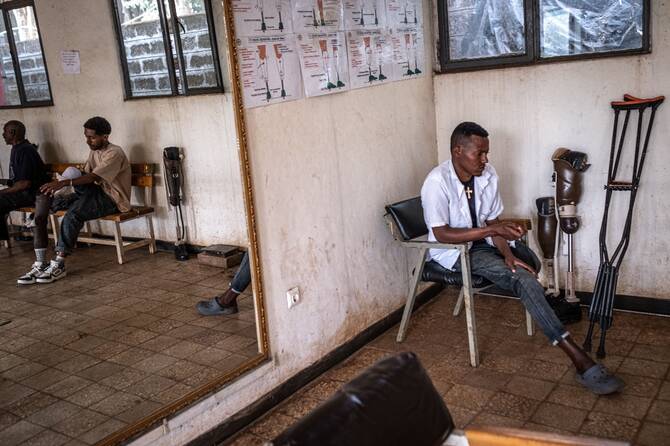
Belete Melke, a farmer who was caught in crossfire during the last rainy season in an area about six hours from Bahir Dar, waits for his turn to begin physiotherapy in Amhara, Ethiopia. (AFP)
Short Url
Updated 19 December 2025
Follow

Ethiopian civilians ‘caught in the crossfire’ of Amhara conflict

  • No death toll, which is nonetheless high, has ever been made public

BAHIR DAR: A few months ago, farmer Belete Melke was sheltering from a heavy downpour in a remote village in Ethiopia’s Amhara region when suddenly gunfire erupted around him.
“We were caught in the crossfire,” he told AFP, after being struck by a stray bullet.
Northern Amhara is Ethiopia’s second most populated region with roughly 23 million inhabitants, and has endured nearly three years of conflict between the federal army and the “Fano,” Amhara’s self-defense militias.
There is scant public information about the conflict, which sprawls across an area that foreign embassies advise their citizens to avoid thanks to the fighting and risks of kidnapping. And no death toll, which is nonetheless high, has ever been made public.
After Belete was wounded, he traveled to capital Addis Ababa for treatment.
“In Addis, they told me that my vein had been cut and (my leg) would no longer function,” he told AFP.
“I cried in anguish, and then they amputated my leg.”
The present conflict stems from the 2020-2022 Tigray War, which killed more than 600,000 people, according to the African Union.
The Fano, like many in Amhara, felt betrayed by the November 2022 peace deal after their support to the government against the neighboring Tigrayan forces.
It came to a head in April 2023, when an attempt by the federal government to disarm the Fano and Amhara forces ignited the conflict.
And a year-long regional state of emergency imposed by the government has failed to stop the fighting.
“I can’t understand this war,” said Belete, who does not know which side wounded him.
“When you meet the Fanos, they say they are fighting for our country, Ethiopia.
“And when you meet the National Defense Forces, they say they are fighting for our country, Ethiopia.”

- Civilians on the frontline -
Whoever is fighting, civilians are the ones on the front lines.
UNICEF estimates roughly 4.5 million children are out of school in Amhara, and Doctors Without Borders puts the number of displaced at over 600,000 people.
“Federal forces roughly control the cities while Fano controls the countryside,” a security source told AFP, speaking on condition of anonymity.
Both sides are regularly accused of abuses against civilians.
The Fano are alleged to carry out kidnappings for ransom, while federal forces have been accused of conducting drone strikes.
At a federal medical center in Amhara’s capital Bahir Dar, Yoseph Debasu sways as he grips parallel bars, re-learning how to walk with his prosthesis.
Despite his frustration, the 19-year-old is grateful for his care at the institution, which is supported by International Committee for the Red Cross.
After leaving school because of the war, Yoseph’s family in Merawi, a town roughly 30 kilometers (18 miles) from Bahir Dar, bought him a tuk-tuk so he was able to begin earning.
But as the conflict spread, he ran over an improvised explosive device (IED) in a contested area. It destroyed both his vehicle and his leg.
While doctors attempted to save it, the swelling grew too much, he told AFP, and “it had to be amputated.”
Still, he said that having the prosthesis was amazing, “like I am born again.”

- Uncertain future -
In another room at the rehabilitation center, orthopaedic technician Bashawgize Getie, 33, gently polishes a prosthesis.
Bashawgize has worked at the center for almost a decade, and said the Tigrayan conflict had already heaped pressure on their facilities.
“Now with this new conflict added on top of it, the number of patients is increasing,” he told AFP.
“We are struggling to accommodate them,” he said.
There are also worries that many of the wounded cannot reach the facility as roadblocks prevent access.
And Red Cross officials worry the situation could deteriorate.
“We can see that the forces are building on their capacity,” said ICRC’s Sabrina Denuncq in Bahir Dar, a reference to both the Fano and other armed groups.
While the conflict has subsided enough in Merawi town for Yoseph to return to school, he remains fearful.
“When one side comes and tells us to go to school, we go. Then the other side comes and tells us to stop, and fighting starts again,” he explained.
“That is our situation.”


8 in 10 British Muslims face ‘financial faith penalty’ when seeking home finance, survey finds

Updated 04 February 2026
Follow

8 in 10 British Muslims face ‘financial faith penalty’ when seeking home finance, survey finds

  • Restricted choices plague potential buyers

LONDON: Eight in 10 British Muslims say their home finance choices are restricted because of their faith, according to a new national survey that highlighted what researchers describe as a growing “financial faith penalty” in the UK housing market.

The report, published by Islamic home finance fintech firm Offa, found that 80 percent of Muslim respondents believe their religious beliefs limit their access to suitable home finance, while those who do use Islamic products often face slower decisions, heavier paperwork and poorer customer experiences than in the conventional mortgage market.

Based on surveys of 1,000 British Muslims conducted by Muslim Census, and 2,000 non-Muslims carried out by OnePoll, the research calls on providers, brokers and policymakers to modernize Islamic home finance and improve access to Sharia-compliant products.

Among the 24.3 percent of British Muslims who have used Islamic home finance, just 5 percent said they had received a same-day decision.

Some 62 percent waited up to two weeks, while 33 percent waited more than 15 days, including 16 percent who waited over a month.

Long decision times were cited as the biggest challenge by 28 percent of respondents, followed by excessive paperwork (22.6 percent) and poor customer service (18.9 percent).

Islamic home finance differs from conventional mortgages by avoiding interest and steering investment away from sectors considered harmful to society, including gambling, alcohol, tobacco, arms trading and animal testing.

Sagheer Malik, chief commercial officer and managing director of home finance at Offa, said the findings showed British Muslims were being underserved by outdated systems.

Malik said: “Property is the asset class of choice for many of the UK’s 3.87 million Muslims, both as a route to generational wealth and as a long-term financial foundation, yet our insightful research report reveals that British Muslims are being underserved and deterred by slow, outdated and opaque Islamic home finance provision.

“This is not a niche concern. It goes to the heart of financial fairness and inclusion in modern Britain.”

He added that Muslims deserved Sharia-compliant products that matched mainstream standards on “price, speed and simplicity.”

Despite strong demand, uptake remains low.

Only 12.8 percent of British Muslims surveyed said they currently use Islamic home finance, with a further 11.5 percent having done so in the past. More than three quarters (75.7 percent) have never used it.

Faith plays a central role in financial decisions, with 94.2 percent saying it is important that their financial products align with their ethical or religious beliefs. Yet more than half of those using conventional mortgages said they felt unhappy or uneasy about doing so because of their faith.

The study also found that British Muslims share similar home ownership aspirations to the wider population, with 79.1 percent citing the desire to provide a stable home for their family, while 18.6 percent said building generational wealth was their main motivation. Only 2.2 percent said they did not want to own a home.

The report suggests Islamic finance could appeal beyond Muslim communities. While 64 percent of non-Muslim respondents had never heard of Islamic home finance, 63 percent said they favored its ethical principles once explained.

Younger generations were the most receptive, with 43 percent of Generation Z and 37 percent of millennials saying they would consider using Islamic home finance, compared with just 7 percent of baby boomers. More than three quarters of Gen Z and 72 percent of millennials also said it was important that their finance provider avoided investing in ethically harmful sectors.

Offa said the findings pointed to an opportunity to expand ethical finance in the UK, provided the industry can deliver faster, simpler and more transparent services.