

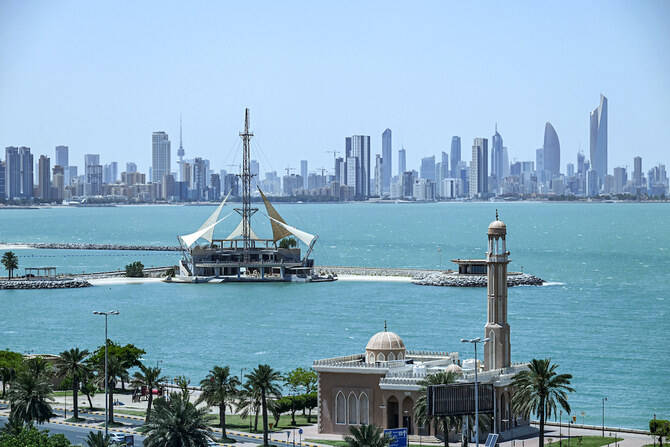
Kuwait to boost Islamic finance with sukuk regulation

Kuwait plans to introduce legislation to regulate the issuance of sukuk, or Islamic bonds, both domestically and internationally. (AFP/File)
Short Url
Updated 05 February 2026
Follow

Kuwait to boost Islamic finance with sukuk regulation

  • The move supports sustainable financing and is part of Kuwait’s efforts to diversify its oil-dependent economy

RIYADH: Kuwait is planning to introduce legislation to regulate the issuance of sukuk, or Islamic bonds, both domestically and internationally, as part of efforts to support more sustainable financing for the oil-rich Gulf nation, Prime Minister Sheikh Ahmad Abdullah Al-Ahmad Al-Sabah said on Wednesday.

Speaking at the World Governments Summit in Dubai, Al-Sabah highlighted that Kuwait is exploring a variety of debt instruments to diversify its economy. The country has been implementing fiscal reforms aimed at stimulating growth and controlling its budget deficit amid persistently low oil prices. Hydrocarbons continue to dominate Kuwait’s revenue stream, accounting for nearly 90 percent of government income in 2024.

The Gulf Cooperation Council’s debt capital market is projected to exceed $1.25 trillion by 2026, driven by project funding and government initiatives, representing a 13.6 percent expansion, according to Fitch Ratings.

The region is expected to remain one of the largest sources of US dollar-denominated debt and sukuk issuance among emerging markets. Fitch also noted that cross-sector economic diversification, refinancing needs, and deficit funding are key factors behind this growth.

“We are about to approve the first legislation regulating issuance of government sukuk locally and internationally, in accordance with Islamic laws,” Al-Sabah said.

“This enables us to deal with financial challenges flexibly and responsibly, and to plan for medium and long-term finances.”

Kuwait returned to global debt markets last year with strong results, raising $11.25 billion through a three-part bond sale — the country’s first US dollar issuance since 2017 — drawing substantial investor demand. In March, a new public debt law raised the borrowing ceiling to 30 billion dinars ($98 billion) from 10 billion dinars, enabling longer-term borrowing.

The Gulf’s debt capital markets, which totaled $1.1 trillion at the end of the third quarter of 2025, have evolved from primarily sovereign funding tools into increasingly sophisticated instruments serving governments, banks, and corporates alike. As diversification efforts accelerate and refinancing cycles intensify, regional issuers have become regular participants in global debt markets, reinforcing the GCC’s role in emerging-market capital flows.

In 2025, GCC countries accounted for 35 percent of all emerging-market US dollar debt issuance, excluding China, with growth in US dollar sukuk issuance notably outpacing conventional bonds. The region’s total outstanding debt capital markets grew more than 14 percent year on year, reaching $1.1 trillion.


Closing Bell: Saudi main market sheds 85 points to finish at 11,098 

Updated 17 February 2026
Follow

Closing Bell: Saudi main market sheds 85 points to finish at 11,098 

RIYADH: Saudi Arabia’s Tadawul All Share Index closed lower in the latest session, falling 85.79 points, or 0.77 percent, to finish at 11,098.06. 

The MSCI Tadawul 30 Index declined 0.63 percent to close at 1,495.23, while the parallel market index Nomu dropped 0.91 percent to 23,548.56.  

Market breadth was firmly negative, with 42 gainers against 218 decliners on the main market. Trading activity saw 226 million shares exchanged, with total turnover reaching SR4.5 billion ($1.19 billion).  

Among the session’s gainers, Tourism Enterprise Co. rose 9.40 percent to SR15.02. SHL Finance Co. advanced 4.51 percent to SR16.00, while Almasar Alshamil for Education Co. gained 3.56 percent to SR23.88.  

Dar Alarkan Real Estate Development Co. added 3.03 percent to SR19.70, and Banque Saudi Fransi climbed 2.61 percent to SR19.30. 

On the losing side, Almasane Alkobra Mining Co. recorded the steepest decline, falling 6.61 percent to SR96.

Al Moammar Information Systems Co. dropped 5.14 percent to SR164.20, while National Company for Learning and Education declined 4.60 percent to SR124.30. Saudi Ceramic Co. slipped 4.14 percent to SR27.30, and Arabian Contracting Services Co. fell 4.12 percent to SR116.50. 

On the announcement front, Saudi Telecom Co. announced the distribution of interim cash dividends for the fourth quarter of 2025 in line with its approved dividend policy.  

The company will distribute SR2.74 billion, equivalent to SR0.55 per share, to shareholders for the quarter.  

The number of shares eligible for dividends stands at approximately 4.99 billion shares. The eligibility date has been set for Feb. 23, with distribution scheduled for March 12.  

The company noted that treasury shares are not entitled to dividends and that payments will be made through Riyad Bank via direct transfer to shareholders’ bank accounts. stc shares last traded at SR44.80, unchanged on the session. 

Separately, National Environmental Recycling Co., known as Tadweer, reported its annual financial results for the year ended Dec. 31, 2025, posting significant growth in revenue and profit.  

Revenue rose 53.5 percent year on year to SR1.24 billion, compared with SR806 million in the previous year. Net profit attributable to shareholders increased 68.4 percent to SR60.9 million, up from SR36.2 million a year earlier, driven by higher sales volumes and operational expansion.

Tadweer shares last traded at SR3.80, up 2.70 percent.