

Pakistan military chief vows ‘terrorists,’ facilitators of Balochistan attacks won’t be spared

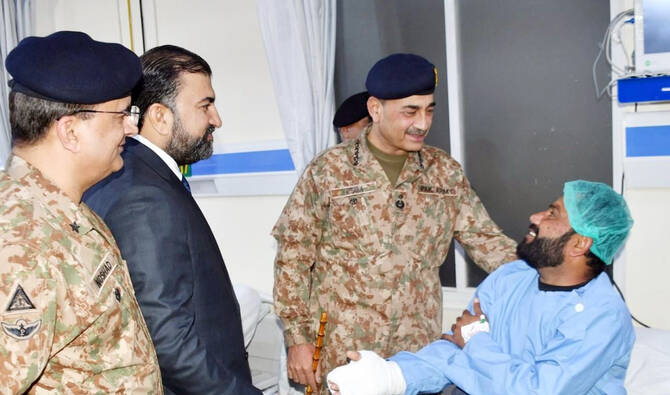
Pakistan’s Chief of Defense Forces Field Marshal Syed Asim Munir (second right) inquires about the health of an injured during a visit to the Combined Military Hospital (CMH) in Quetta on February 4, 2026. (ISPR)
Short Url
Updated 04 February 2026
Follow

Pakistan military chief vows ‘terrorists,’ facilitators of Balochistan attacks won’t be spared

  • Separatist militants launched coordinated attacks in multiple Balochistan cities last week, killing over 30 civilians and 17 law enforcers
  • Field Marshal Syed Asim Munir visits Quetta for detailed briefing on prevailing security, inquires after injured law enforcement personnel

KARACHI: Pakistan’s Chief of Defense Forces Field Marshal Syed Asim Munir on Wednesday vowed that “terrorists” and facilitators of last week’s Balochistan attacks will not be spared, praising security forces for maintaining law and order, the military’s media wing said. 

The Pakistan military chief’s statement came after deadly coordinated attacks in Balochistan on Friday and Saturday. The attacks were claimed by the separatist Baloch Liberation Army (BLA) militant group. Pakistani officials have said 197 militants have been killed since then, while 33 civilians and 17 law enforcement personnel lost their lives in the attacks. 

Munir visited Balochistan’s provincial capital Quetta where he received a detailed briefing on the prevailing security situation and military operations in the area following the attacks, the Inter-Services Public Relations (ISPR) said. 

“The COAS & CDF remarked that no terrorist and its facilitator will be spared and all will be dealt strictly as per law and that no one can rationalize violence and terrorism on any pretext,” the ISPR said. 

“He appreciated the professionalism, valor, and sacrifices of officers and troops of all law enforcement agencies in thwarting nefarious anti-Pakistan designs and maintaining law and order.”

The military chief later visited the Combined Military Hospital (CMH) in Quetta to inquire about the health of the injured army, paramilitary Frontier Corps and police personnel.

Pakistan’s government has accused India of being involved in the Balochistan attacks, charges which New Delhi has dismissed as “baseless.”

Balochistan, Pakistan’s largest province by land area, has long faced a separatist insurgency that has intensified in recent years. Militants frequently target security forces, government officials, infrastructure projects, foreigners and non-local workers.

The province holds vast reserves of minerals and hydrocarbons and is central to the multibillion-dollar China-Pakistan Economic Corridor (CPEC), a flagship component of China’s Belt and Road Initiative.

Separatist groups such as the BLA accuse Islamabad of exploiting Balochistan’s natural resources while denying locals a fair share. Pakistan’s civilian and military leadership reject the claim and say they are investing in the province’s development.


Islamabad dismisses claims about paying up to 8 percent interest on foreign loans as ‘misleading’

Updated 22 February 2026
Follow

Islamabad dismisses claims about paying up to 8 percent interest on foreign loans as ‘misleading’

  • Pakistan has long relied on external loans to help bridge persistent gaps in public finances and foreign exchange reserves
  • Pakistan’s total external debt, liabilities stand at $138 billion at an overall average cost of around 4 percent, ministry says

KARACHI: Pakistan’s finance ministry on Sunday dismissed as “misleading” claims that the country is paying up to 8 percent interest on external loans, saying the overall average cost of external public debt is approximately 4 percent.

Pakistan has long relied on external loans to help bridge persistent gaps in public finances and foreign exchange reserves, driven largely by a narrow tax base, chronic trade deficits, rising debt-servicing costs and repeated balance-of-payments pressures.

Over the decades, successive governments have turned to multilateral and bilateral lenders, including the International Monetary Fund, the World Bank and the Asian Development Bank, to support budgetary needs and shore up foreign exchange reserves.

The finance ministry on Sunday issued a clarification in response to a “recent press commentary” regarding the country’s external debt position and associated interest payments, and said the figures required contextual explanation to ensure accurate understanding of Pakistan’s external debt profile.

“Pakistan’s total external debt and liabilities currently stand at $138 billion. This figure, however, encompasses a broad range of obligations, including public and publicly guaranteed debt, debt of Public Sector Enterprises (both guaranteed and non-guaranteed), bank borrowings, private-sector external debt, and intercompany liabilities to direct investors. It is therefore important to distinguish this aggregate figure from External Public (Government) Debt, which amounts to approximately $92 billion,” it said.

“Of the total External Public Debt, nearly 75 percent comprises concessional and long-term financing obtained from multilateral institutions (excluding the IMF) and bilateral development partners. Only about 7 percent of this debt consists of commercial loans, while another 7 percent relates to long-term Eurobonds. In light of this composition, the claim that Pakistan is paying interest on external loans ‘up to 8 percent’ is misleading.

The overall average cost of External Public Debt is approximately 4 percent, reflecting the predominantly concessional nature of the borrowing portfolio.”

With respect to interest payments, public external debt interest outflows increased from $1.99 billion in Fiscal Year (FY) 2022 to $3.59 billion in FY2025, representing an increase of 80.4 percent, not 84 percent as reported. In absolute terms, interest payments rose by $1.60 billion over this period, not $1.67 billion, it said.

According to the State Bank of Pakistan’s records, Pakistan’s total debt servicing payments to specific creditors during the period under reference were as follows: the IMF received $1.50 billion, of which $580 million constituted interest; Naya Pakistan Certificates payments totaled $1.56 billion, including $94 million in interest; the Asian Development Bank received $1.54 billion, including $615 million in interest; the World Bank received $1.25 billion, including $419 million in interest; and external commercial loans amounted to nearly $3 billion, of which $327 million represented interest payments.

“While interest payments have increased in absolute terms, this rise cannot be attributed solely to an expansion in the debt stock,” the ministry said. “Although the overall debt stock has increased slightly since FY2022, the additional inflows have primarily originated from concessional multilateral sources and the IMF’s Extended Fund Facility (EFF) under the ongoing IMF-supported program.”

Pakistan secured a $7 billion IMF bailout in Sept. 2024 as part of Prime Minister Shehbaz Sharif’s efforts to stabilize the South Asian economy that narrowly averted a default in 2023. The government has since been making efforts to boost trade and bring in foreign investment to consolidate recovery.

“It is also important to note that the increase in interest payments reflects prevailing global interest rate dynamics. In response to the inflation surge of 2021–22, the US Federal Reserve raised the federal funds rate from 0.75-1.00 percent in May 2022 to 5.25–5.50 percent by July 2023. Although rates have since moderated to around 3.75 percent, they remain significantly higher than 2022 levels,” the finance ministry said.

“The government remains committed to prudent debt management, transparency, and the continued strengthening of Pakistan’s macroeconomic stability,” it added.