

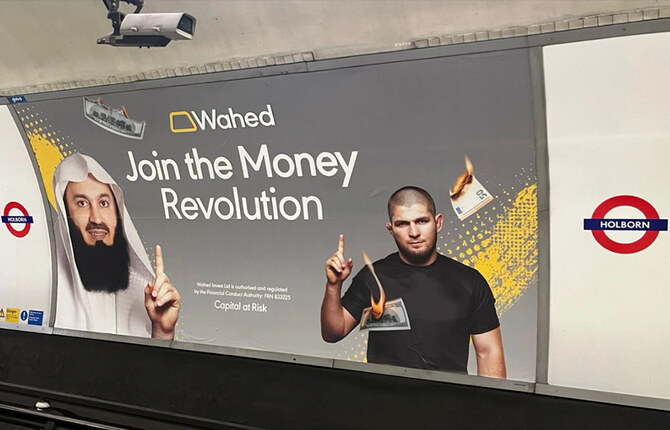
‘Offensive’ Muslim fintech ads banned in UK for showing burning banknotes

Wahed defended the campaign, explaining that the burning banknotes symbolized money “going up in flames” due to inflation outpacing savings growth. (X/File)
Short Url
Updated 08 January 2025
Follow

‘Offensive’ Muslim fintech ads banned in UK for showing burning banknotes

  • Posters by Wahed Invest were banned by Advertising Standards Authority after agency received 75 complaints

LONDON: Adverts by Muslim fintech company Wahed Invest have been banned in the UK for featuring burning banknotes, which the country’s advertising watchdog deemed “offensive.”

The New York-based investment platform, which targets the Muslim community, ran a series of posters across London’s transport system in September and October.

The ads showed US dollar and euro banknotes on fire alongside slogans such as “Join the money revolution” and “Withdraw from Riba” — a term referring to the Islamic prohibition of interest.

The Advertising Standards Authority said it received 75 complaints that the ads were offensive.

“The ads represented the expression that viewers’ money was ‘going up in flames’ and that images of burning money were commonly encountered,” the ASA said in a statement.

“However, regardless of whether viewers would have understood that message or understood it as a defiant act designed to show a challenge to financial institutions, the currencies which were burned in all of the ads were clearly visible as US dollar and euro banknotes.”

The advert also featured images of Muslim preacher Ismail ibn Musa Menk and Russian former professional mixed martial artist Khabib Abdulmanapovich Nurmagomedov.

Three of the posters showed Menk holding an open briefcase filled with US dollar and euro banknotes on fire, with two of them stating “Withdraw from Exploitation.”

Wahed defended the campaign, explaining that the burning banknotes symbolized money “going up in flames” due to inflation outpacing savings growth.

The company, which describe itself as an investment platform allowing consumers who were predominantly Muslim to invest in a manner which aligned with their faith and values, launched in the US in 2017 and is backed by the oil company Saudi Aramco and the French footballer Paul Pogba.

Wahed acknowledged that the currencies depicted in the ads could be viewed as symbols of national identity but argued that the imagery of burning money was a powerful reference to hyperinflation, a concept often depicted in popular culture through film and television.

A spokesperson added: “We understand that visuals like those included in our campaign can elicit strong reactions.

“While our intention was to spark thought and awareness, we recognize the importance of ensuring that messaging resonates positively with the diverse audiences that may consume them.”

The ASA said that the adverts would have been seen by many people, including people from the US and eurozone countries, who “would have viewed their nation’s currency as being culturally significant.

“Although we acknowledged Wahed Invest’s view that they had not directly criticized a specific group, and that depictions of burning banknotes were commonly encountered, we considered the burning of banknotes would have caused serious offense to some viewers,” the regulator said.

“We therefore concluded that the ads were likely to cause serious offense.”


EU warns Meta it must open up WhatsApp to rival AI chatbots

Updated 09 February 2026
Follow

EU warns Meta it must open up WhatsApp to rival AI chatbots

  • The EU executive on Monday told Meta to give rival chatbots access to WhatsApp after an antitrust probe found the US giant to be in breach of the bloc’s competition rules

BRUSSELS: The EU executive on Monday told Meta to give rival chatbots access to WhatsApp after an antitrust probe found the US giant to be in breach of the bloc’s competition rules.
The European Commission said a change in Meta’s terms had “effectively” barred third-party artificial intelligence assistants from connecting to customers via the messaging platform since January.
Competition chief Teresa Ribera said the EU was “considering quickly imposing interim measures on Meta, to preserve access for competitors to WhatsApp while the investigation is ongoing, and avoid Meta’s new policy irreparably harming competition in Europe.”
The EU executive, which is in charge of competition policy, sent Meta a warning known as a “statement of objections,” a formal step in antitrust probes.
Meta now has a chance to reply and defend itself. Monday’s step does not prejudge the outcome of the probe, the commission said.
The tech giant rejected the commission’s preliminary findings.
“The facts are that there is no reason for the EU to intervene,” a Meta spokesperson said.
“There are many AI options and people can use them from app stores, operating systems, devices, websites, and industry partnerships. The commission’s logic incorrectly assumes the WhatsApp Business API is a key distribution channel for these chatbots,” the spokesperson said.
Opened in December, the EU probe marks the latest attempt by the 27-nation bloc to rein in Big Tech, many of whom are based in the United States, in the face of strong pushback by the government of US President Donald Trump.
- Meta in the firing line -
The investigation covers the European Economic Area (EEA), made up of the bloc’s 27 states, Iceland, Liechtenstein and Norway — with the exception of Italy, which opened a separate investigation into Meta in July.
The commission said that Meta is “likely to be dominant” in the EEA for consumer messaging apps, notably through WhatsApp, and accused Meta of “abusing this dominant position by refusing access” to competitors.
“We cannot allow dominant tech companies to illegally leverage their dominance to give themselves an unfair advantage,” Ribera said in a statement.
There is no legal deadline for concluding an antitrust probe.
Meta is already under investigation under different laws in the European Union.
EU regulators are also investigating its platforms Facebook and Instagram over fears they are not doing enough to tackle the risk of social media addiction for children.
The company also appealed a 200-million-euro fine imposed last year by the commission under the online competition law, the Digital Markets Act.
That case focused on its policy asking users to choose between an ad-free subscription and a free, ad-supported service, and Brussels and Meta remain in discussions over finding an alternative that would address the EU’s concerns.