Trump, Al-Sharaa and the future of Syria

https://arab.news/pfnw9
It was during US President Donald Trump’s visit to the Middle East in May that he first met Syrian President Ahmad Al-Sharaa, after being urged to by Saudi Crown Prince Mohammed bin Salman and Turkish President Recep Tayyip Erdogan. It was a bold move.
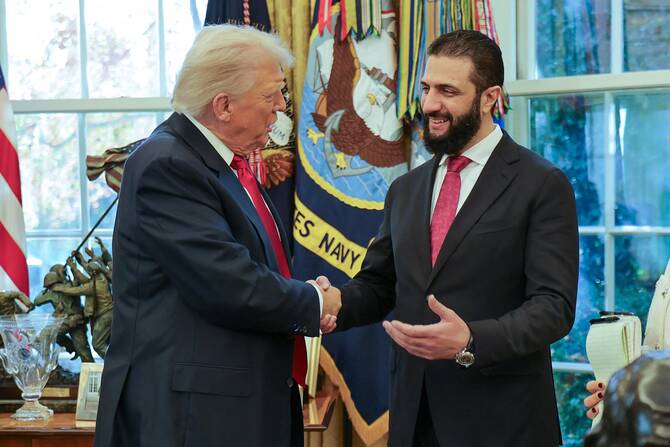
But bolder still was Trump’s later invitation for Al-Sharaa to visit the White House, which he did on Nov. 10. It is rumored that the president’s move drew the ire of cautious advisers, who were subsequently fired.
During Al-Sharaa’s White House visit, the Syrian leader held discussions for several hours with key Cabinet officials. Not every foreign leader gets to visit the Oval Office, albeit there was none of the pageantry that came with the big ceremonial state welcome given to the crown prince a week later. Still, Al-Sharaa’s visit was significant, not least for Trump’s public comments. “He’s a very strong leader,” Trump said of his opposite number. “He comes from a very tough place … I like him. I get along with him … He has had a rough past. We’ve all had a rough past.”
This was the first time a sitting Syrian leader had been to the White House and the first time a sitting American president had spoken supportively of a former member of Al-Qaeda. Trump, who appreciates leaders who take decisive action, believes Al-Sharaa’s terror links are a thing of the past and expressed his “confidence” that the former Hayat Tahrir Al-Sham leader could help Syria be a “successful” element of stability and peace in the region. For his part, Al-Sharaa spoke about shared bilateral interests and goals, such as regional stability and counterterrorism.
Getting Washington to permanently lift the economic sanctions is a top diplomatic priority for Al-Sharaa
Robert Ford
After hearing about Syria’s key role in the Middle East from leaders in Turkiye, Saudi Arabia, Qatar and from Al-Sharaa himself, Trump repeats it regularly when talking to the media. Yet he has had some quiet pushback. Some members of his Republican base reject his characterization of Al-Sharaa. Laura Loomer, a social media personality, was among those to condemn Al-Sharaa as a Daesh terrorist and criticize his invitation to the White House.
Despite such criticisms, Trump is ploughing ahead. Some have even suggested that he might accept an invitation to Damascus. American security agencies would have concerns about his safety in the Syrian capital, where the US Embassy has yet to reopen. But if Damascus agreed, the US military could take control of a location inside a Syrian airbase near the capital where Trump could hold meetings with Syrian leaders. They did something similar in Baghdad, allowing high-level American officials to meet their Iraqi counterparts during the Iraq War.
While such a visit seems far off, if he were to travel to Damascus, it would have to be for a very deserving reason, such as the announcement of a historic agreement — one that could change the Middle East, namely a full peace agreement between Syria and Israel.
It is no secret that Trump wants to expand the Abraham Accords, normalizing relations between Israel and other states. In a November social media post, he called on Kazakhstan to join, despite the two countries having had formal diplomatic ties since 1992. The Atlantic Council, a well-informed policy institute in Washington, said Trump’s team was working to bring other Central Asian states into the Abraham Accords to build a coalition of Muslim-majority states that enjoy good relations with Israel.
This would not produce the same immediate political impact and longer-term military implications as a peace agreement between Syria and Israel — Trump knows this, as does Al-Sharaa. Both men will be making their own political calculations. For his part, Al-Sharaa moves carefully. When Fox News asked him about a peace treaty with Israel, he stressed that it still illegally occupies the Golan Heights, as well Syrian territory in Quneitra seized after Assad’s fall a year ago.
In his first administration, Trump officially recognized Israel’s annexation of the Golan. Changing his stance would certainly be difficult, but not outright impossible. Al-Sharaa is therefore focusing on an interim security arrangement in which Israel would withdraw from Quneitra in return for agreed restrictions on Syrian military deployments in southern Syria.
Al-Sharaa is also sensitive to Syrian sovereignty and security risks. Damascus rejected an Israeli demand for humanitarian corridors from the Golan to the restive Druze province of Sweida, well over 100km inside Syria. Israel’s reluctance to withdraw to the 1974 line and Syria’s reluctance to establish a corridor will make clinching an interim security agreement tricky. This means a comprehensive peace treaty looks to be out of reach at present.
Circling back to a point I made earlier, not everyone in Trump’s Republican Party is enamored with Syria’s new rulers and a lot comes down to US sanctions on the country, imposed during the era of Bashar Assad. Getting Washington to permanently lift the economic sanctions is a top diplomatic priority for Al-Sharaa, particularly the Caesar Act sanctions, which intimidate foreign companies from investing in Syria’s devastated economy.
Trump canceled all the other sanctions he could by presidential order, but the Caesar sanctions are enshrined in a law that Trump himself signed in 2019. In May, Trump suspended them for 180 days after meeting Al-Sharaa in Riyadh. When the Syrian president came to Washington, Trump renewed the suspension for another 180 days.
The leaders of Turkiye, Saudi Arabia and Qatar have impressed upon Trump that Syria cannot be an effective counterterrorism partner if the Syrian economy is struggling. The renewed suspension of Caesar sanctions is a positive step for Syria, but the risk of sanctions being renewed against private companies (as happened with Iran in 2018) may discourage foreign investors from betting on Syria’s future.
The Republican Party has majorities in both chambers of Congress, but not all representatives support Trump’s call for the permanent cancellation of Caesar sanctions without conditions. The likes of Sen. Lindsey Graham and Rep. Brian Mast (a former soldier who chairs the House Foreign Affairs Committee) instead urge a temporary suspension until Damascus meets conditions connected to Israeli security, the protection of minorities in Syria and political inclusion.
The shared interest in eliminating Daesh is the foundation of the new Syrian-American relationship
Robert Ford
Leaders of the Syrian-American community have helped Al-Sharaa meet with members of Congress, including Mast, but reports indicate that Israeli officials, such as former Minister for Strategic Affairs Ron Dermer, have urged Trump to delay the cancellation of sanctions so that this can be used as leverage in negotiations between Tel Aviv and Damascus.
One of the key drivers is the shared US-Syrian interest in eliminating Daesh. Indeed, this is the foundation of the new Syrian-American relationship, with Al-Sharaa having signed Syria up to join the international coalition. This earned him credibility with American political leaders and media outlets.
There are clear sensitivities, however. Many of Al-Sharaa’s top security officials have Islamist backgrounds, as does he, so the idea of them fighting Daesh alongside the Americans and their Western allies may not sit comfortably. Indeed, Syria’s information minister was quick to point out that joining the coalition was a political agreement only and that it did not yet involve any military arrangements. The justice minister said it concerned the “sharing of information” and was not a “clear military alliance.”
After Al-Sharaa left the US, the Syrian presidency responded to a report in The New York Times that Al-Sharaa had cooperated with the US against Daesh since 2016. His office called this “untrue and baseless.” Still, the impression today is that relations are good, as seen in a video before Al-Sharaa’s visit to Washington showing him playing basketball with top American military leaders.
Beyond the military realm, the Americans are providing technical advice to the Syrian financial sector, focusing on payments and the new currency. A similar technical set-up is in place in Iraq, aimed at eliminating money laundering and blocking access to banks by terror groups and Iran.
If Damascus is to take on a bigger role in fighting Daesh alongside the Americans in Syria, that poses questions about the future role of the Kurdish-led Syrian Democratic Forces, which has been the main US partner in the fight against Daesh for the past decade and which runs an autonomous, oil-rich territory in the country’s northeast.
The American military has spent years training and arming the SDF’s armed wing. It has no such experience with the Syrian army yet. Building trust and developing joint tactics will take time. For now, at least, Washington still needs the SDF, whose commander, Mazloum Abdi, told a Kurdish newspaper in October that the Americans had proposed a joint force composed of Syrian government and SDF elements to fight Daesh.
The White House wants to facilitate a deal that brings the SDF into the new Syrian armed forces. An SDF source told Al-Arabiya last month that the SDF wants its own full division, composed of two of its brigades, with Kurdish commanders drawn from the SDF. It would be part of the Syrian army but would remain deployed in northeastern Syria. Damascus has remained tight-lipped on the idea, as has the US.
It is worth noting the unusual participation of Turkish Foreign Minister Hakan Fidan in part of the Trump-Al-Sharaa meeting at the White House. Fidan’s presence indicates that Trump is coordinating with Erdogan over Syria, including over the SDF, whose armed fighters have long been seen as a national security threat in Ankara. For this reason, after the Oval Office meeting between Trump and Al-Sharaa, US Secretary of State Marco Rubio sat with his Syrian and Turkish counterparts to discuss Syria, including the future of the SDF, as Fidan told a Turkish network.
Few dispute how important it is to resolve the issue of SDF integration and the future of the autonomous administration in northeastern Syria, yet most also think it will take time. Meanwhile, the US military has immediate operational requirements to fight Daesh. It therefore needs practical, short-term solutions, even as Trump ally and US envoy Tom Barrack convenes more meetings to address Syria’s future.
- Robert Ford is a former US ambassador to Syria and Algeria and is based in Washington D.C.
- This article was first published in Al Majalla.