

Devastating landslides turn Sri Lanka village into burial ground

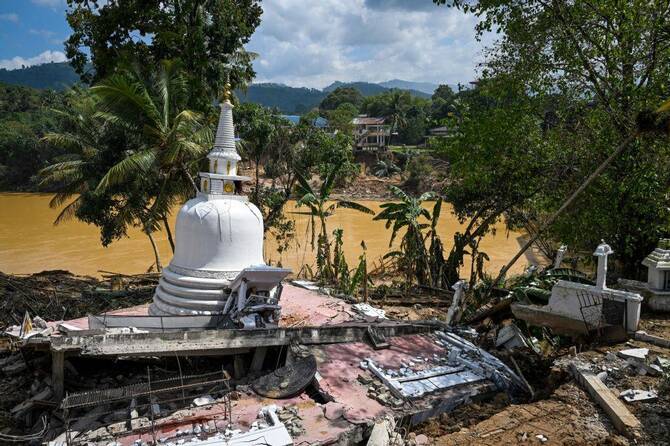
A stupa lies in a damaged state following the landslides in the aftermath of Cyclone Ditwah in Gampola town, in Kandy district on Dec. 4, 2025. (AFP)
Short Url
Updated 04 December 2025
Follow

Devastating landslides turn Sri Lanka village into burial ground

  • In picturesque Hadabima village, surrounded by mountains on one side and a river on the other, 24 people were buried in last week’s mudslides.
  • That is a fraction of the national toll of 481 deaths, more than half in the tea-growing central hills

KANDY, Sri Lanka: Electrician V. K. Muthukrishnan ran to help when a lightning-fast mudslide flattened his neighbor’s home in rural Sri Lanka — only to see his own house swept away minutes later.
A friend whom he directed to the disaster site to aid rescue efforts was also killed in the second cascade of mud and boulders.
“I have nightmares, thinking that I sent my friend to his death,” a tearful Muthukrishnan said as he showed AFP reporters the wreckage of his modest home, destroyed on November 27.
“But it could have been more.”
AFP was among the first news outlets to enter the stricken central province of Kandy, where the main road had been cut off for over a week due to falling boulders and landslides.
Reporters managed to get in when the road opened briefly on Thursday, before it shut again for urgent repairs.
In picturesque Hadabima village, surrounded by mountains on one side and a river on the other, 24 people were buried in last week’s mudslides.
That is a fraction of the national toll of 481 deaths, more than half in the tea-growing central hills. Heavy rains triggered by Cyclone Ditwah had saturated the mountainsides and made them unstable.

- ‘A cemetery now’ -

Tailor Adish Kumaran, 41, said his sister and brother-in-law were buried when they rushed to rescue a neighbor whose home was damaged.
“They were also caught up in a second slide,” Kumaran told AFP, adding that six bodies had not yet been recovered.
“This is a cemetery now. We don’t want to live in this village anymore,” he said.
Nationwide, some 345 people remain missing, according to official figures.
The government has said about 25,000 houses have been damaged or completely destroyed and has promised state help to rebuild.
But the main agency dealing with the recovery effort says Sri Lanka will need up to $7 billion for the task, much of it from international donors.
It is a vast sum for the island of 22 million people, still reeling from an economic meltdown in 2022.
Tea factory worker Mariah Sivakumar, 39, said her immediate priority was her three school-going children.
“All their books and clothes have been lost in the floods,” she said from a relative’s home after authorities warned her own house was at risk from a landslide.
She said there was no way she and her husband — also a tea factory worker — could afford to buy new uniforms and textbooks for the children, let alone build a new house.

- Unprecedented floods -

In the nearby town of Gampola, dozens of young volunteers worked to clear up after the river burst its banks.
Hundreds of families were sleeping at a local mosque, going out during the day to clean their homes, said cleric Faleeldeen Qadiri.
“We have seen floods before, but nothing this severe,” he said.
The state is providing shelter for over 170,000 people, while additional private donations pour in.
A. M. Chandraratna, 70, owned a bread and breakfast overlooking the river in the town of Peradeniya.
But his restaurant had been completely washed away, and he was left trying to salvage what he could.
“I was born and brought up here,” he told AFP. “I thought I knew how this river behaves.”


Georgia’s street dogs stir affection, fear, national debate

Updated 3 sec ago
Follow

Georgia’s street dogs stir affection, fear, national debate

TBILISI: At a bus stop in central Tbilisi, two tagged dogs dozed on a bench as some commuters smiled at them and others cast angry glances.
In the streets of the Georgian capital, such scenes are part of daily life: community-fed “yard dogs,” yellow municipal tags on their ears, lounge outside bakeries, metro entrances and school gates.
The free-roaming canines stir both affection and fear. What to do with their swelling numbers — in the tens of thousands in Tbilisi alone — has become a nationwide dilemma.
Stray animals tied the top spot for public concerns in a poll by the National Democratic Institute, with 22 percent of respondents naming it the most pressing issue.
Many welcome the dogs as a symbol of Tbilisi, a showcase of Georgian hospitality and the warm street life that draws tourists to the capital.
“Street dogs in Georgia have made a more positive impact on tourism and the image of Georgia than people and culture alone,” said journalist Elena Nikoleisvili, 51, who helps street dogs.
“If anything, these adorable creatures should be the symbol of the capital — like the cats of Istanbul.”
On cafe terraces, regulars slip bones under tables as mongrels curl up between patrons’ feet, while each neighborhood and cul-de-sac has its own local canine mascot.

- ‘Drop in the ocean’ -

Others worry about safety.
“They bark and scare folks,” said plumber Oleg Berlovi, 43.
“Two weeks ago, a dog bit my kid and we needed shots. Animals are great, but they need looking after.”
According to the World Health Organization, dogs are the main vectors in human rabies cases globally.
Georgia still records a handful of human deaths from the disease each year and administers tens of thousands of post-exposure treatments, according to the Global Alliance for Rabies Control.
City officials say the answer is steady, humane population control.
“The state’s policy is to manage these animals by the most humane methods possible and to reduce to a minimum the number of stray dogs on the streets,” Nicoloz Aragveli, who heads Tbilisi city hall’s animal monitoring agency, told AFP.
A recent count put the capital’s stray dog population at about 29,000, and around 74 percent have been neutered, Aragveli said.
“We plan to do more so that we reach 100 percent,” he said.
The city runs weekly school lessons and a door-to-door registration drive to raise awareness and track owned pets.
Legislative changes have also tightened penalties for abandoning animals and for violating care and ownership rules — steps officials say will help halt the flow of pets to the streets.
But journalist Nikoleisvili said the authorities only responded after a public backlash, and “could do much more.”
The number of dogs that have been neutered in Tbilisi — around 50,000 over the last decade — is “a drop in the ocean,” she said.

- ‘Guilty party’ -

Volunteers, like theater director Zacharia Dolidze, who builds kennels, also play a big role in caring for the dogs.
“There are days I make 20 kennels. I’ve built about 2,500 in seven years,” the 40-year-old said.
He collects regular donations to help pay for materials.
Shelter operators say there are big gaps in addressing what they call one of Georgia’s biggest issues.
“You can make regulations, but if you cannot enforce them, that’s not going to help,” said Sara Anna Modzmanashvili Kemecsei, who runs a shelter that houses about 50 dogs.
In many regions, “there are absolutely no neutering campaigns.”
“I can’t really see that the government is on top of the issue, so there are lots of volunteers,” she said. “They are really good at managing these animals.”
Politics has also injected fresh uncertainty.
Last year, the government pushed a “foreign influence” law that complicates NGOs’ access to funding from foreign donors such as UK animal welfare charity Mayhew, which runs a program to vaccinate and neuter strays in Tbilisi.
Volunteers meanwhile continue to juggle feeding, sheltering and basic care.
Nino Adeishvili, 50, is a geologist and university lecturer who looks after around 10 dogs.
Her group organizes rabies shots and fundraises on Facebook for deworming, flea treatment and food.
“On the street, a dog is still unprotected,” she said.
“The guilty party is the human.”