

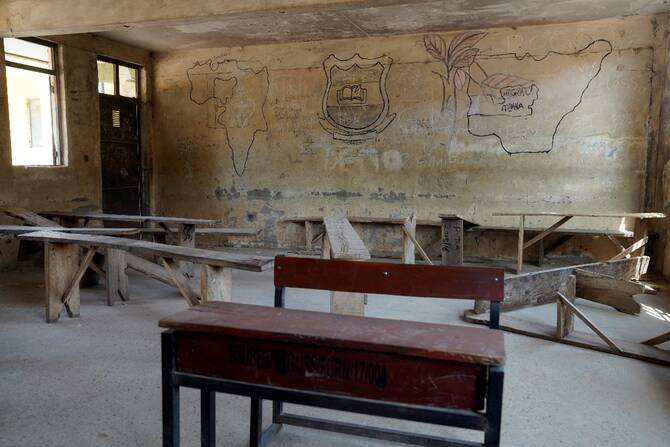

MAIDUGURI: Two weeks after one of Nigeria’s worst school kidnappings, parents of the more than 250 missing children are desperate for news and dismayed at what they see as the slow response from authorities.
Sunday Gbazali, a farmer and father of 12 whose 14-year-old son was among those seized on November 21 in a remote village of northern Nigeria, said he barely sleeps and his wife constantly cries thinking about their boy.
“They (the police) are just telling us to exercise patience, that they are trying to rescue the children.”
“We are not happy with what is happening,” he said.
The Christian Association of Nigeria said 303 children and 12 school staff were kidnapped by gunmen at St. Mary’s Catholic boarding school in Papiri, a hamlet in the state of Niger.
Fifty pupils managed to escape in the following hours, but since then there has been no news on the whereabouts or conditions of the other children, some as young as six, and the missing school staff.
The school was guarded by unarmed volunteer guards, who fled when attackers arrived.
It is one of the worst mass kidnappings since the 2014 abduction of 276 schoolgirls by Boko Haram in Chibok.
“We don’t know if he is sick, healthy, or even alive. How can we find peace when we do not know his current condition?” Gbazali said of his son, his voice cracking over the phone.
“I used to hear about abductions in the news, but I never knew the pain until it happened to me.”
PRESIDENT ORDERS THOUSANDS MORE TROOPS TO BOOST SECURITY
The attack has put a spotlight on the persistent insecurity in Nigeria more than 10 years after the Chibok abductions, at a time when the country is under scrutiny from US President Donald Trump over its alleged ill-treatment of Christians.
President Bola Tinubu denies the accusations of religious persecution but is under pressure. He declared a nationwide security emergency last week and ordered the recruitment of thousands of additional army and police personnel to tackle the surge in violence across the country.
His national security adviser, Nuhu Ribadu, told local Catholic leaders in Kontagora town on Monday that “the children are doing fine and will be back soon,” according to a statement by CAN in Niger state.
But there has been no further update, leaving families in an anxious limbo. The identities of the kidnappers, believed to be hiding in the dense and vast forests dotting Nigeria’s largest state, are unknown and no ransom has been demanded, parents told Reuters.
“The government says that it’s taking action, but up to now, we haven’t got any information,” said Emmanuel Bala, who chairs the school’s parent-teacher association and whose 13-year-old daughter is among those missing.
“The past two weeks have not been easy at all. It is not something that people can imagine. We are feeling deeply sad.”
Another parent who works for Niger state civil service said that after the meeting with Ribadu he hoped a rescue was imminent. “Unfortunately, days have passed, and we are left with little hope,” said the man, who declined to be named fearing reprisals from his employer.
CONFUSION OVER NUMBERS
Parents said they were called to the school last Friday, a full week after the kidnapping, to register their missing children with the police. They came from many different locations, and outside states.
The registration was ordered after the state governor of Niger, Mohammed Umar Bago, said the numbers of those kidnapped had been exaggerated.
“The government and the public need evidence of the fact that children were actually abducted,” Reverend Father Stephen Ndubuisi-Okafor, who is from the Catholic Diocese in charge of the school, said as the registration took place.
They had not made up any numbers or names, he said, “this is actually what is happening.”
Asked why it had taken a week to list the names of the missing children, Niger state police spokesperson Wasiu Abiodun said police did “not want to rush to conclusions while the investigation is ongoing.”
He told Reuters police documentation showed 215 students were still captive, but did not say if all parents had registered their missing children.
Bishop Bulus Yohanna, CAN chairman for Niger state and head of the school, said registration of the missing children was incomplete because some parents had not received the message to come as they were spread over such a remote area, with virtually no network.
“RELENTLESS CYCLE OF TERROR“
The frustration of the families was shared by activists of the “#BringBackOurGirls” global movement sparked by the Boko Haram kidnappings.
While many of the Chibok hostages were liberated in following years, around 90 of the girls are still unaccounted for, and the jihadist group’s tactic has since been adopted by criminal gangs without ideological affiliation seeking ransom payments, with authorities seemingly powerless to stop them.
“These atrocities are not isolated tragedies – they are part of a systemic failure spanning over 11 years,” the movement said in an open letter to Tinubu. It said that since the Chibok abductions, at least another 1,800 students had been kidnapped in “a relentless cycle of terror” in Nigeria.
SECURITY RISKS MEAN CHILDREN LOSING THEIR EDUCATION
Amnesty International said in a statement that the government’s failure to stop the kidnappings was putting the education of millions of Nigerian children at risk. It said nearly 20,500 schools had been closed in seven northern states in the wake of the St. Mary’s school attack.
According to United Nations figures, Nigeria has one of the highest numbers of unschooled children in the world at 20 million, most of them in the north, partly because parents fear kidnappings.
Thirteen-year-old Stephen Samuel, one of the children who managed to escape, told Reuters that even if all the hostages were released he was not sure life could ever go back to normal.
“When these people come back, will we be able to go to school again? Which school will we go to?” he asked.
“I am thinking maybe school has ended.”


