TikTok to comply with ‘upsetting’ Australian under-16 ban

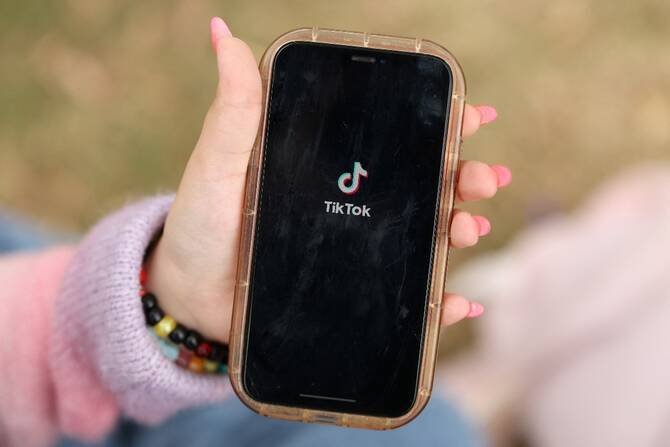
A girl poses while opening the TikTok app on her phone in Sydney, Australia. (Reuters)
Short Url
Updated 05 December 2025
Follow

TikTok to comply with ‘upsetting’ Australian under-16 ban

  • Australia’s world-first legislation comes into effect December 10, curbing the world’s most popular social media platforms and websites, including TikTok, Instagram, and YouTube

SYDNEY: TikTok said Friday it will comply with Australia’s imminent ban on under-16s joining social media on the day it comes into force, but told users the changes “may be upsetting.”
Australia’s world-first legislation comes into effect December 10, curbing the world’s most popular social media platforms and websites, including TikTok, Instagram, and YouTube.
Companies face fines of Aus$49.5 million ($32 million) if they fail to take “reasonable steps” to comply.
TikTok will block under-16s in Australia on the day the law comes into effect, it said, meaning they will no longer be able to hold or create an account.
“Teens with an existing account will be notified that they will no longer be able to use their existing account, which will become inactive,” it said.
“If they previously published content, it will no longer be available for others to view on TikTok.”
The social media giant said youngsters who have been blocked can submit an appeal to prove their age, including by facial images, credit card authorization or official ID.
“We understand that these changes may be upsetting, but they are necessary to ensure that TikTok complies with Australian law,” the company said in a statement.
Teens who fall under the law will have a choice of confirming their age, downloading their information, deleting their account, or asking for a reminder to recover their TikTok accounts when they turn 16.
TikTok urged parents to “have conversations” with their teens to ensure they are truthful about their age.
“We understand that these changes may be upsetting, but they are necessary to ensure that TikTok complies with Australian law.”
An Internet rights group last week launched a legal challenge to halt the ban.
The Digital Freedom Project said it had challenged the laws in Australia’s High Court, calling them an “unfair” assault on freedom of speech.
Australia’s restrictions have generated interest around the world as regulators wrestle with the potential dangers of social media.
Malaysia indicated it was planning to block children under 16 from signing up to social media accounts next year, while New Zealand will introduce a similar ban.


Report highlights role of British Muslim charitable giving in supporting UK public services

Updated 05 December 2025
Follow

Report highlights role of British Muslim charitable giving in supporting UK public services

  • The study, “Building Britain: British Muslims Giving Back,” finds that donations from British Muslims are helping to bolster overstretched service

LONDON: British Muslim charitable giving is playing an increasingly significant role in supporting frontline public services across the UK, according to a new report by policy and research organization Equi.

The study, “Building Britain: British Muslims Giving Back,” finds that donations from British Muslims are helping to bolster overstretched services, including local councils, the NHS and welfare systems, at a time of growing financial pressure.

The report estimates that Muslim donors contribute around £2.2 billion ($2.9 billion) annually, making them the UK’s most generous community.

This figure is around four times the national giving average and rises to almost 10 times the average among higher earners.

According to the findings, Muslim-led charities are providing a wide range of support, including housing assistance, emergency cash grants, food provision and mental health services, easing demand on statutory services.

Equi points to evidence from 2023 showing that housing support delivered by the National Zakat Foundation helped prevent evictions that would have cost councils an estimated £28.8 million, with every £1 of charitable spending generating £73 in public sector savings.

The report also highlights a generational shift, with younger British Muslims increasingly directing their donations toward domestic causes such as homelessness, child poverty and mental health challenges.

Despite their growing impact, Muslim charities face a number of barriers, including de-banking, restrictive funding rules, securitization measures and what the report describes as limited recognition from government. Equi argues that these challenges are constraining the sector’s ability to maximize its contribution.

“British Muslim giving is not just generosity but a lifeline for public services that needs recognizing,” said Equi Managing Director Prof. Javed Khan.

“From preventing evictions to supporting mental health, these donations are saving millions for the taxpayer and strengthening communities across Britain. The evidence is clear that Muslim-led action is delivering frontline support where the state is struggling,” he added.

Equi is calling on policymakers to engage more closely with Muslim-led charities and to move beyond what it describes as symbolic recognition.

The report recommends measures such as UK-based match-funding schemes and greater faith literacy within policymaking, which it says could unlock billions of pounds in additional domestic spending while maintaining the UK’s global humanitarian commitments.

The study concluded that with greater collaboration between government and Muslim charities, charitable giving could play an even more transformative role in strengthening public services and social cohesion across the country.