

Georgia’s street dogs stir affection, fear, national debate

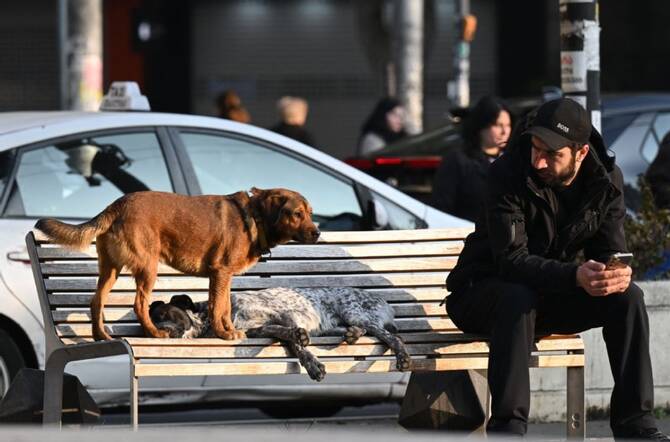
A photograph shows street dogs in the Georgian capital of Tbilisi, Georgia. (AFP)
Short Url
Updated 05 December 2025
Follow

Georgia’s street dogs stir affection, fear, national debate

  • City officials say the answer is steady, humane population control

TBILISI: At a bus stop in central Tbilisi, two tagged dogs dozed on a bench as some commuters smiled at them and others cast angry glances.
In the streets of the Georgian capital, such scenes are part of daily life: community-fed “yard dogs,” yellow municipal tags on their ears, lounge outside bakeries, metro entrances and school gates.
The free-roaming canines stir both affection and fear. What to do with their swelling numbers — in the tens of thousands in Tbilisi alone — has become a nationwide dilemma.
Stray animals tied the top spot for public concerns in a poll by the National Democratic Institute, with 22 percent of respondents naming it the most pressing issue.
Many welcome the dogs as a symbol of Tbilisi, a showcase of Georgian hospitality and the warm street life that draws tourists to the capital.
“Street dogs in Georgia have made a more positive impact on tourism and the image of Georgia than people and culture alone,” said journalist Elena Nikoleisvili, 51, who helps street dogs.
“If anything, these adorable creatures should be the symbol of the capital — like the cats of Istanbul.”
On cafe terraces, regulars slip bones under tables as mongrels curl up between patrons’ feet, while each neighborhood and cul-de-sac has its own local canine mascot.

- ‘Drop in the ocean’ -

Others worry about safety.
“They bark and scare folks,” said plumber Oleg Berlovi, 43.
“Two weeks ago, a dog bit my kid and we needed shots. Animals are great, but they need looking after.”
According to the World Health Organization, dogs are the main vectors in human rabies cases globally.
Georgia still records a handful of human deaths from the disease each year and administers tens of thousands of post-exposure treatments, according to the Global Alliance for Rabies Control.
City officials say the answer is steady, humane population control.
“The state’s policy is to manage these animals by the most humane methods possible and to reduce to a minimum the number of stray dogs on the streets,” Nicoloz Aragveli, who heads Tbilisi city hall’s animal monitoring agency, told AFP.
A recent count put the capital’s stray dog population at about 29,000, and around 74 percent have been neutered, Aragveli said.
“We plan to do more so that we reach 100 percent,” he said.
The city runs weekly school lessons and a door-to-door registration drive to raise awareness and track owned pets.
Legislative changes have also tightened penalties for abandoning animals and for violating care and ownership rules — steps officials say will help halt the flow of pets to the streets.
But journalist Nikoleisvili said the authorities only responded after a public backlash, and “could do much more.”
The number of dogs that have been neutered in Tbilisi — around 50,000 over the last decade — is “a drop in the ocean,” she said.

- ‘Guilty party’ -

Volunteers, like theater director Zacharia Dolidze, who builds kennels, also play a big role in caring for the dogs.
“There are days I make 20 kennels. I’ve built about 2,500 in seven years,” the 40-year-old said.
He collects regular donations to help pay for materials.
Shelter operators say there are big gaps in addressing what they call one of Georgia’s biggest issues.
“You can make regulations, but if you cannot enforce them, that’s not going to help,” said Sara Anna Modzmanashvili Kemecsei, who runs a shelter that houses about 50 dogs.
In many regions, “there are absolutely no neutering campaigns.”
“I can’t really see that the government is on top of the issue, so there are lots of volunteers,” she said. “They are really good at managing these animals.”
Politics has also injected fresh uncertainty.
Last year, the government pushed a “foreign influence” law that complicates NGOs’ access to funding from foreign donors such as UK animal welfare charity Mayhew, which runs a program to vaccinate and neuter strays in Tbilisi.
Volunteers meanwhile continue to juggle feeding, sheltering and basic care.
Nino Adeishvili, 50, is a geologist and university lecturer who looks after around 10 dogs.
Her group organizes rabies shots and fundraises on Facebook for deworming, flea treatment and food.
“On the street, a dog is still unprotected,” she said.
“The guilty party is the human.”


Leaders of Indonesia and Australia sign a new security treaty to affirm deeper ties

Updated 3 sec ago
Follow

Leaders of Indonesia and Australia sign a new security treaty to affirm deeper ties

JAKARTA: Indonesian and Australian leaders signed a new bilateral security treaty Friday that both governments say will deepen ties between the often-testy neighbors.
The treaty was signed in Indonesia’s capital, Jakarta, three months after Australian Prime Minister Anthony Albanese and Indonesian President Prabowo Subianto announced in Sydney that negotiations on the pact had been substantively concluded, highlighting their ambition to better utilize the two country’s past security agreements inked in 1995 and 2006.
Albanese has cast the agreement as a “watershed moment” in relations with its major closest neighbor, saying in a statement ahead of his arrival in Jakarta late Thursday, that it marks a major extension of existing security and defense cooperation and reflects a relationship “as strong as it has ever been.” He is traveling with Foreign Minister Penny Wong, who called it the most important step in the partnership in three decades.
Analysts said the treaty is becoming increasingly important to Australia in face of growing tensions with China in the region. However, it is expected to echo elements of a 1995 security agreement inked between then-Prime Minister Paul Keating and Indonesia’s former authoritarian President Suharto — Prabowo ‘s former father-in-law.
That agreement committed both nations to consult on security issues and respond to adverse challenges, but was terminated by Indonesia four years later following Australia’s decision to lead a peacekeeping mission into East Timor. The two countries improved their security relationship over the next decade by signing a new treaty in 2006, known as the Lombok Treaty, which they expanded on in 2014.
Susannah Patton from the Lowy Institute, a Sydney-based international policy think tank, said the agreement, whose text has not been published, is largely about the political commitment to consult. She described it as a “symbolic agreement,” noting the 2024 defense cooperation accord was more focused on practical military collaboration.
Patton said the new treaty sits below Australia’s alliance with the United States and the security agreement signed with Papua New Guinea in terms of obligations. She did not expect to find clarity in the agreement on whether Indonesia would come to Australia’s defense in the event of a security threat in the region.
“So it’s very much not a mutual defense treaty because I think that would not be politically acceptable to Indonesia as a non-aligned country,” Patton said.
Despite that, she praised the agreement as a huge success for Albanese, because not many people would have predicted this kind of agreement would be possible with Indonesia as a non-aligned country with “a very big difference between the way that Australia and Indonesia see the world.”
She said that Australia has very much taken advantage of the fact that the Southeast Asia country is now under Prabowo, a president who is really much more willing to break with Indonesian foreign policy tradition and to strike leader-led agreements.
Albanese’s office framed the visit as his fifth official trip to Indonesia and part of a broader push to expand cooperation beyond security into trade, investment, education and development.
Albanese is scheduled to meet Prabowo and Indonesian officials through Sunday before returning to Australia.
Although Indonesia, a vast archipelago nation of more than 280 million people, is often presented as one of Australia’s most important neighbors and strategic allies, the relationship has undergone various ups and downs. Recent disagreements include allegations of wiretapping by the Australian Signals Directorate to monitor the private phone calls of Indonesia’s former President Susilo Bambang Yudhoyono, his wife and other senior officials, as well as Indonesia’s execution of Australian drug smugglers, and cases of people smuggling.