

Mass wedding in Gaza celebrates new life after years of war and tragedy

1 / 2
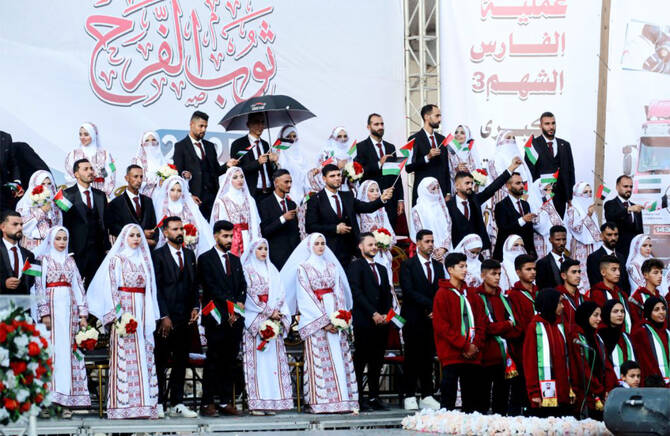
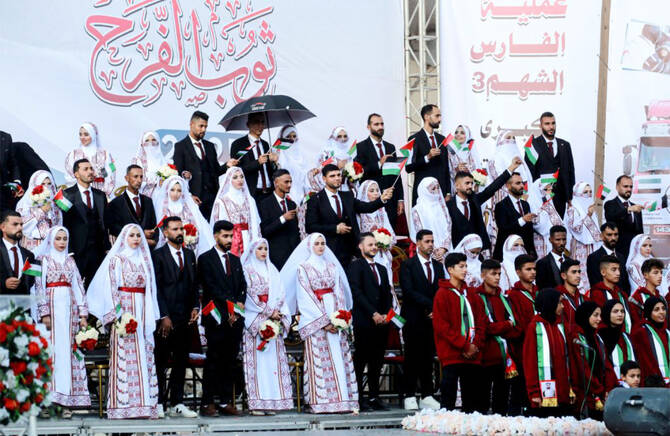
Some of the 54 brides and grooms gather on a stage during a mass wedding dubbed the "The Dress of Joy", organised by the Al-Fares Al-Shahm Foundation, in Khan Yunis, southern Gaza Strip on December 2, 2025. (AFP)
2 / 2
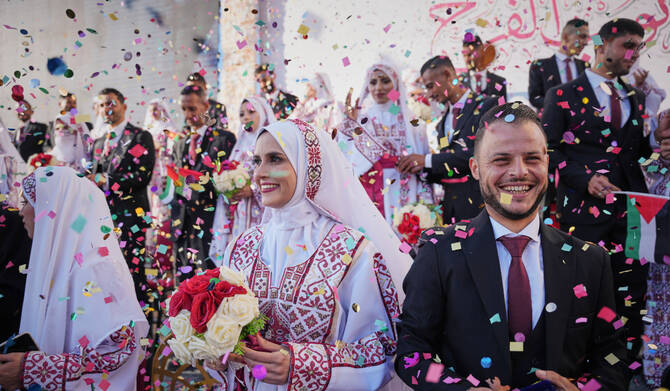
​ Palestinian couples participate in a mass wedding ceremony in Hamad City in Khan Younis, Gaza Strip, Tuesday, Dec. 2, 2025. (AP) ​
Short Url
Updated 04 December 2025
Follow

Mass wedding in Gaza celebrates new life after years of war and tragedy

  • As roaring crowds waved Palestinian flags in the southern city of Khan Younis, the celebrations were dampened by the ongoing crisis across Gaza

KHAN YOUNIS, Gaza Strip: Eman Hassan Lawwa was dressed in traditional Palestinian prints and Hikmat Lawwa wore a suit as they walked hand-in-hand past the crumbled buildings of southern Gaza in a line of other couples dressed in exactly the same way.
The 27-year-old Palestinians were among 54 couples to get married Tuesday in a mass wedding in war-ravaged Gaza that represented a rare moment of hope after two years of devastation, death and conflict.
"Despite everything that has happened, we will begin a new life," Lawwa said. “God willing, this will be the end of the war.”


Weddings are a key part of Palestinian culture that have become rare in Gaza during the war. The tradition has begun to resume in the wake of a fragile ceasefire, even if the weddings are different from the elaborate ceremonies once held in the territory.
As roaring crowds waved Palestinian flags in the southern city of Khan Younis, the celebrations were dampened by the ongoing crisis across Gaza. Most of Gaza's 2 million residents, including Eman and Hikmet, have been displaced by the war, entire areas of cities have been flattened and aid shortages and outbursts in conflict continue to plague the daily lives of people.
The young couple, who are distant relatives, fled to the nearby town of Deir al-Balah during the war and have struggled to find basics like food and shelter. They said they don’t know how they’re going to build their lives together given the situation around them.


A convoy of Palestinian grooms travels to Hamad City in Khan Yunis, in the Gaza Strip, to take part in a mass wedding ceremony Tuesday, Dec. 2, 2025. (AP)

“We want to be happy like the rest of the world. I used to dream of having a home, a job, and being like everyone else," Hikmet said. “Today, my dream is to find a tent to live in.”
“Life has started to return, but it's not like we hoped it would," he added.
The celebration was funded by Al Fares Al Shahim, a humanitarian aid operation backed by the United Arab Emirates. In addition to holding the event, the organization offered couples a small sum of money and other supplies to start their lives together.


Palestinians gather on the rubble of building destroyed by the Israeli military as watch and celebrate the mass wedding of 54 couples dubbed the "The Dress of Joy", organised by the Al-Fares Al-Shahm Foundation, in Khan Yunis, southern Gaza Strip on December 2, 2025. (AFP)

For Palestinians, weddings are often elaborate dayslong celebrations, seen as both an important social and economic choice that spells out the future for many families. They include joyful dances and processions through the streets by massive families in fabric patterns donned by the couple and their loved ones and heaping plates of food.
Weddings can also be a symbol of resilience and a celebration of new generations of families carrying on Palestinian traditions, said Randa Serhan, a professor of sociology at Barnard College who has studied Palestinian weddings.
“With every new wedding is going to come children and it means that the memories and the lineages are not going to die,” Serhan said. “The couples are going to continue life in an impossible situation.”


Palestinian watch and celebrate a mass wedding ceremony in Hamad City in Khan Yunis, Gaza Strip, Tuesday, Dec. 2, 2025. (AP)

On Tuesday, a procession of cars carrying the couples drove through stretches of collapsed buildings. Hikmat and Eman waved Palestinian flags with other couples as families surrounding them danced to music blaring over crowds.
Lawwa and Eman, who was cloaked in a white, red and green traditional dress on Tuesday, said the wedding offered them a small moment of relief after years of suffering.
But Eman said she was also marked by the loss of her father, mother, and other family members who were killed during the war.
"It’s hard to experience joy after such sorrow," she said, tears streaming down her face. “God willing, we will rebuild brick-by-brick.”


Syria nears anniversary of Assad’s fall amid renewed ‘deeply troubling’ abuses, UN warns

Updated 05 December 2025
Follow

Syria nears anniversary of Assad’s fall amid renewed ‘deeply troubling’ abuses, UN warns

  • Early steps by interim leadership ‘encouraging but only the beginning’ of long process of accountability, human rights chief says
  • Concern that rising hate speech, both online and on the streets, has intensified violence against Alawite, Druze, Christian, Bedouin communities 

NEW YORK: Syria is days away from marking the first anniversary of the fall of President Bashar Assad’s regime, but the country’s interim authorities face mounting criticism over continuing abuses and a fragile security environment, the UN human rights chief said. 

In a statement on Friday, UN High Commissioner for Human Rights Volker Turk said early steps by the interim leadership, including the creation of national commissions for transitional justice and missing persons, and investigative bodies examining violence in coastal areas and in Suweida, were “encouraging but only the beginning” of a long process of accountability. 

Trials for suspects linked to last year’s coastal violence have begun, and a draft law on transitional justice has been announced. But Turk said the human rights situation remains deeply troubling. 

According to the UN, hundreds of people have been killed over the past year in summary executions, arbitrary killings, and abductions. Victims include members of minority communities and individuals accused of ties to the former government. Deaths were attributed to gunfire, stabbings, blunt-force attacks, shelling, hand grenades and explosive remnants of war. 

The UN said perpetrators include security forces under the interim authorities, armed groups aligned with them, remnants of the former government’s forces, local militias, and unidentified armed actors. 

Investigators also documented reports of sexual violence, arbitrary detention, looting, destruction of homes, forced evictions, and property confiscations, along with restrictions on free expression and peaceful assembly. 

Turk warned that rising hate speech, both online and on the streets, had intensified violence against Alawite, Druze, Christian, and Bedouin communities. 

The past year has also seen repeated Israeli military operations inside Syrian territory, including incursions and the occupation of additional areas. The UN said it had received reports of civilian casualties in a recent Israeli strike near Damascus, along with arrests and home searches carried out during military actions. 

Turk expressed concern that former armed groups have been integrated into new security forces without adequate human rights checks, raising the risk of repeat violations. 

“Proper vetting and comprehensive security sector reform are essential to prevent individuals responsible for serious abuses from entering the security forces,” he said. 

He urged Syria’s interim authorities to ensure independent and transparent investigations into all violations, past and present, and to hold those responsible to account. 

“Accountability, justice, peace, and the security of all Syrians are absolute prerequisites for a successful transition,” Turk said, adding that victims must have access to remedies and reparation. 

The UN Human Rights Office said its Damascus program is supporting efforts to advance inclusive transitional justice and strengthen the rule of law as Syria navigates a post-Assad transition.