


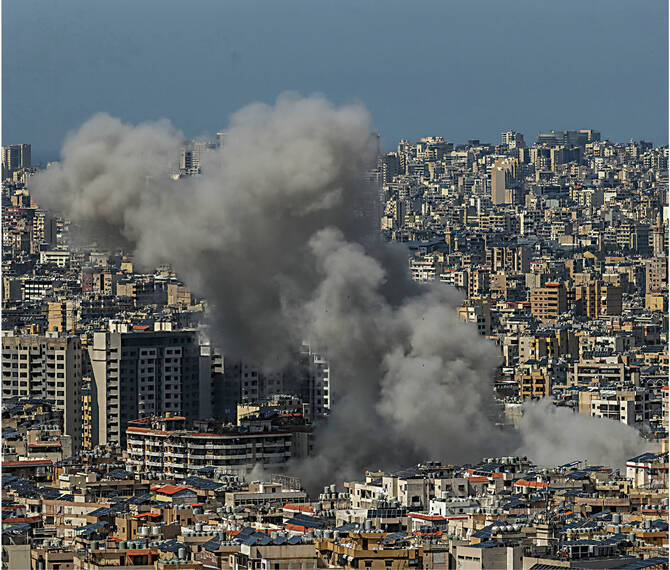

LONDON: As Israeli military operations against Hezbollah fighters in southern Lebanon drive more than a million civilians from their homes, kill over 1,000 people in less than three weeks, and flatten entire residential blocks with no ceasefire in sight, many are holding their breath in fear as the devastation traces a familiar path — Gaza.
While Israeli attacks on Lebanon have not stopped despite a fragile ceasefire in effect since November 2024, a March 2 Hezbollah strike on Haifa and other targets — reportedly the Iran-backed group’s first offensive action in 15 months — triggered a sharp escalation.
Hezbollah said it launched the strikes in retaliation for the killing of Iran’s supreme leader, Ali Khamenei, that kicked off a joint Israeli-US military campaign against Iran that began on Feb. 28.

The outbreak of fighting between Hezbollah and Israel is reshaping daily life in southern Lebanon. Families are sleeping in cars, schools have turned into overcrowded shelters and entire neighborhoods have been reduced to rubble.
The human toll is mounting as well: as of March 21, Israeli attacks had killed 1,024 people, injured 2,740 and displaced about 1.2 million, according to Lebanese authorities.
Israel has also been accused in an Amnesty International report of targeting healthcare workers and first responders, to which it has responded by claiming that Hezbollah is using medical sites for military activities.

First aid responders evacuated the wounded from the site of an Israeli airstrike that targeted a neighborhood in the town of Mieh Mieh, some five kilometers east of the southern Lebanese city of Sidon on March 13, 2026. (AFP)
On the Israeli side, particularly in the north, Hezbollah’s missile and drone attacks have caused casualties. On March 13, the Jewish Weekly reported that dozens of people were injured after a rocket struck a residential area, causing widespread damage.
On Sunday morning, the Israeli military reported a deadly strike on the northern border community of Misgav Am, according to the Times of Israel. Hezbollah claimed responsibility, saying it targeted a “gathering of Israeli enemy army soldiers.”
The Lebanese government on March 2 quickly condemned the Iran-backed group’s activities as “illegal,” while the European Union, on March 9, called Israel’s response “heavy-handed,” causing mass displacement and risking “severe humanitarian consequences.
Opinion
This section contains relevant reference points, placed in (Opinion field)
Amid condemnations, the deepest fear is that southern Lebanon is heading toward the same fate as Palestine’s Gaza Strip, where rights groups and UN officials have said Israel’s military campaign against Hamas and other Palestinian armed groups since Oct. 7, 2023, amounts to genocide.
Analysts say the fear is not unfounded.
“It’s no surprise that people are starting to worry the situation in Lebanon could come to resemble what we’ve seen in Gaza, especially since Israeli politicians are explicitly saying so,” David Wood, a senior Lebanon analyst at the International Crisis Group, told Arab News.

This photograph taken during a media tour organized by the Hezbollah shows a crater left by a rocket that targeted the Nabi Sheet town after an Israeli military operation in the Bekaa Valley of Lebanon, on March 7, 2026. (AFP)
He pointed to remarks by Bezalel Smotrich, Israel’s finance minister, who said that Dahiyeh, Beirut’s southern suburb, will “very soon look like Khan Younis,” a city in southern Gaza that has been largely flattened during Israel’s military campaign.
Israel Katz, Israel’s defense minister, has issued similar warnings, saying that unless Lebanon acts against Hezbollah, the country “will look like Gaza.”
“This isn’t alarmist,” Wood said. “It’s grounded in what Israeli officials themselves are saying.”

A fireball erupts from the site of an Israeli airstrike that targeted a building in the southern Lebanese village of Abbasiyyeh on March 13, 2026. (AFP)
Beyond the rhetoric, analysts say those warning signs were already visible in the months after the November 2024 ceasefire, when Israeli operations continued at lower intensity along the border.
From late 2024 through early 2026, Lebanese authorities and UN agencies report that Israel had killed more than 500 people in Lebanon, including at least 127 civilians, in near‑daily attacks even while an official ceasefire was in place.
The ceasefire brokered by the US and France, which took effect on Nov. 27, 2024, ended more than a year of cross-border conflict between Israel and Hezbollah, sparked by the groups’ support for Gaza.
INNUMBERS
• 822,000 People registered as displaced in Lebanon since March 2.
• 3 million Already required assistance before the latest escalation.
(Source: OCHA)
Key terms required Israel to withdraw troops from southern Lebanon within 60 days, Hezbollah to retreat north of the Litani River, and Lebanese forces plus UNIFIL to secure the border area against militants. But these terms have not been fully implemented.
Today, after the resumption of fighting, the scale of displacement has overwhelmed Lebanon’s infrastructure. Hundreds of schools and other public buildings have been converted into shelters, yet they barely accommodate about 10 percent of those newly displaced as conditions deteriorate rapidly.

Abu Ali, displaced from the southern Lebanese town of Nabatieh, speaks with people, as he opens a charity stand in Beirut on March 20, 2026, following an escalation between Hezbollah and Israel amid the US-Israeli conflict with Iran. (REUTERS)
“There is overcrowding, insufficient food and a lack of basic sanitation,” Wood said, adding that those who were able to find shelter were “the lucky ones.”
As of March 12, about 125,800 displaced people are staying in collective shelters, according to Lebanon’s Disaster Risk Management Unit.
The strain is beginning to fracture social bonds as well. Fear that hosting displaced families could attract further strikes is raising alarm in some communities, particularly where there are perceived links — however indirect — to Hezbollah.
“This risks creating a situation where some communities become reluctant to host displaced families,” Wood said.

First aid responders are seen at the site of an Israeli airstrike that targeted an area in the Palestinian refugees camp of Ain al-Helweh, on the outskirts of the southern Lebanese coastal city of Sidon on March 8, 2026.
If that reluctance spreads, it could accelerate not only the humanitarian crisis but also internal tensions in a country already defined by delicate sectarian balances.
“If the situation continues, there is a real risk of sectarian tensions escalating,” Wood said.
The widening conflict has also renewed questions about how the war is being conducted, particularly in densely populated areas.
Israeli strikes on southern Beirut and other urban centers have drawn growing concern from rights organizations, with analysts warning that the scale of destruction may breach international humanitarian law.

An Israeli self-propelled howitzer artillery gun fires rounds towards southern Lebanon from a position in the upper Galilee in northern Israel near the border on March 15, 2026. (AFP)
Simon Mabon, a professor of international politics and director of the SEPAD research center at Lancaster University, said such operations “raise serious questions about adherence to international law,” given the density of the civilian populations involved.
Hezbollah’s conduct has also come under scrutiny. As a party to the conflict, the non-state armed group is equally bound by the laws of war, including the obligation to distinguish between civilians and combatants.
“As a party to the conflict, Hezbollah is required to adhere to proportionality and to distinguish between combatants and civilians,” Mabon said.
The consequences for civilians in northern Israel are also visible. About 60,000 residents were evacuated when cross-border fire intensified in October 2023, the BBC reported. While some had begun to return after the November 2024 ceasefire, renewed strikes have again forced people from their homes.

Israeli security officers inspect a house hit by a rocket reportedly fired by the Tehran-backed militant group Hezbollah in Haniel, near Kfar Yona in central Israel, on March 12, 2026. (AFP)

Electricians work at a house that was damaged by a rocket reportedly fired by the Tehran-backed militant group Hezbollah in Haniel, near Kfar Yona in central Israel, on March 12, 2026. (AFP)
The conflict exposes a fundamental gap in how international humanitarian law operates in practice. While mechanisms for accountability exist, enforcement ultimately depends on the political will of states themselves.
“There is no international police force with enforcement powers,” said Cordula Droege, chief legal officer at the International Committee of the Red Cross.
“In the absence of an international enforcement mechanism, compliance with (international humanitarian law) relies on political will — not only of the parties, but also those surrounding them,” she told Arab News.
She said that states often criticize their adversaries while failing to hold their own allies to the same standards. More fundamentally, she said, compliance depends on whether the rules of war are embedded within institutions and society.

Mourners hold a portrait of Youssef Assaf, a Lebanese Red Cross volunteer killed during a rescue mission in southern Lebanon, at his funeral in Tyre on March 11, 2026. (AFP)
International humanitarian law “has to be deeply anchored in the system and in society for it to withstand pressures once conflict breaks out,” she said. “When it is not just ‘the law’ but ‘who we are,’ compliance becomes more resilient.”
Those legal concerns are already being expressed in government statements.
Calling on Israel to halt its offensive, Jose Manuel Albares, the Spanish foreign minister, said that the scale of destruction and displacement had reached a critical level.
He described attacks on civilian infrastructure as contrary to international humanitarian law, while also condemning Hezbollah rocket fire, underscoring that offences are not limited to one side.
The continued exchange of fire has locked both sides in a vicious cycle in which civilians bear the cost while neither party comes closer to lasting security.

United Nations peacekeepers with the UN Interim Force in Lebanon (UNIFIL) drive past a destroyed healthcare center building in the aftermath of an Israeli strike in the southern Lebanese town of Burj Qalawiya on March 14, 2026. (AFP)
The escalation is a clear collapse of the November 2024 ceasefire that had briefly reduced hostilities.
Israel and Hezbollah each blame the other for its breakdown, and the continued exchanges of fire have underscored how fragile such arrangements can be — and how difficult they are to enforce.
For Lebanon’s government, meanwhile, the situation presents an enormous challenge.
Under pressure from Israel to act against Hezbollah, analysts say the Lebanese state lacks the capacity and political space to do so. The army is underfunded and overstretched, and any attempt to confront Hezbollah risks triggering internal fragmentation.

Unable to be of any consequence, Lebanese army soldiers could only watch as civil defense members inspect a building that burned following Israeli bombardment on the village of Marjayoun in southern Lebanon close to the border with Israel on March 17, 2026. (AFP)
“The government simply does not have the means to meaningfully influence events,” Wood said.
With neither party willing to halt the fighting, civilians continue to bear the brunt of a war they had no part in starting. The central question now is not whether the conflict will continue, but how far it will go — and at what cost.
“What counts as success?” Wood asked. “A buffer zone? The destruction of Hezbollah’s capabilities? A longer-term presence?”


