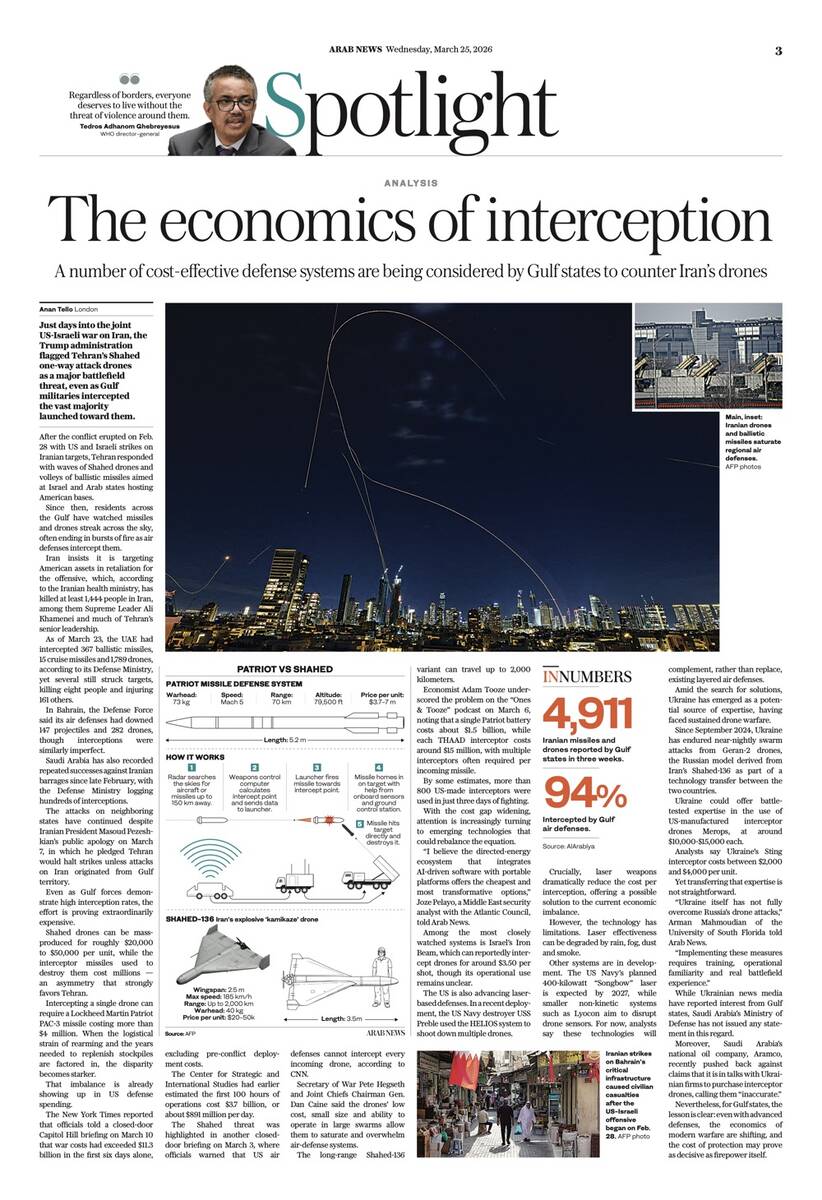
- Defense forces are intercepting most Shahed drones and missiles launched at them, but at a very high cost
- With the cost gap between offense and defense widening, analysts say emerging technologies could offer a solution
LONDON: Just days into the joint US-Israeli war on Iran, the Trump administration flagged Tehran’s Shahed one-way attack drones as a major battlefield threat, even as Gulf militaries intercepted the vast majority launched toward them.
After the conflict erupted on Feb. 28 with US and Israeli strikes on Iranian targets, Tehran responded with waves of Shahed drones and volleys of ballistic missiles aimed at Israel and Arab states hosting American bases.
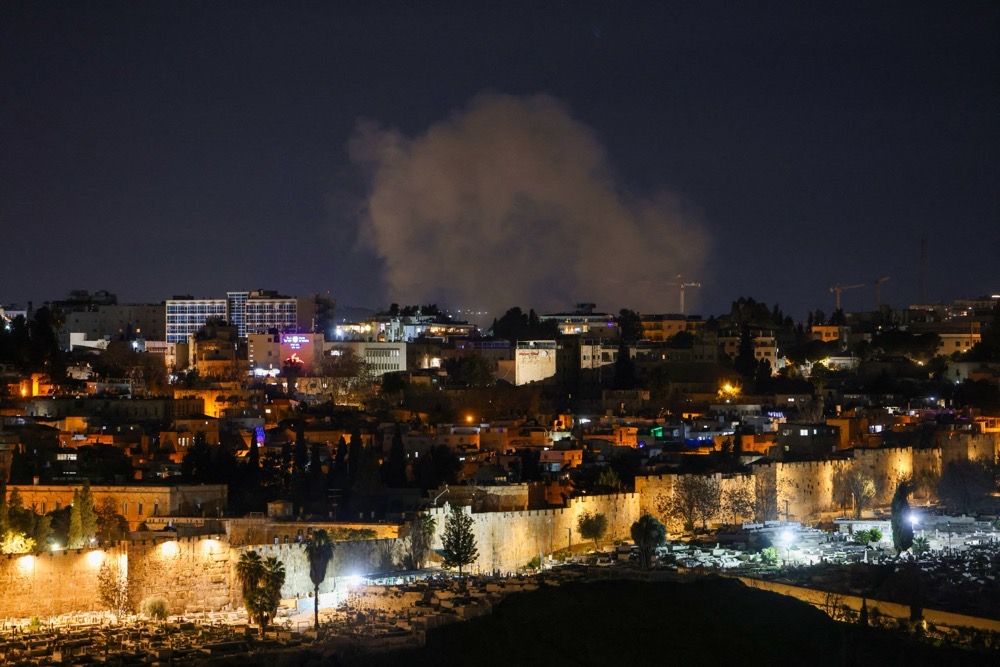
Since then, residents across the Gulf have watched missiles and drones streak across the sky, often ending in bursts of fire as air defenses intercept them.
Iran insists it is targeting American assets in retaliation for the offensive, which, according to the Iranian health ministry, has killed at least 1,444 people in Iran, among them Supreme Leader Ali Khamenei and much of Tehran’s senior leadership.
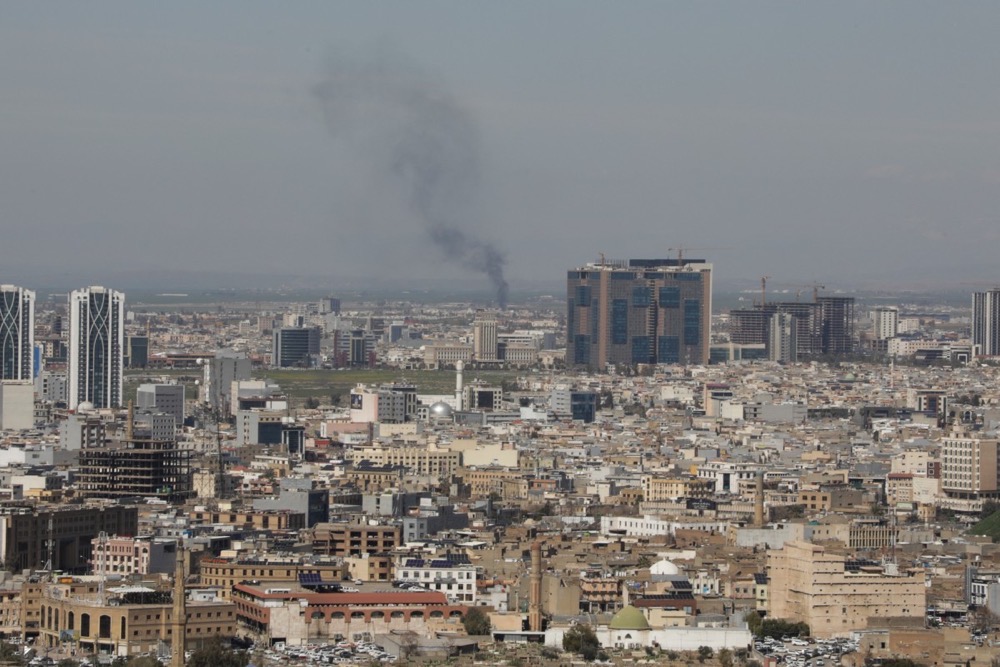
As of March 23, the UAE had intercepted 367 ballistic missiles, 15 cruise missiles and 1,789 drones, according to its Defense Ministry, yet several still struck targets, killing eight people and injuring 161 others.
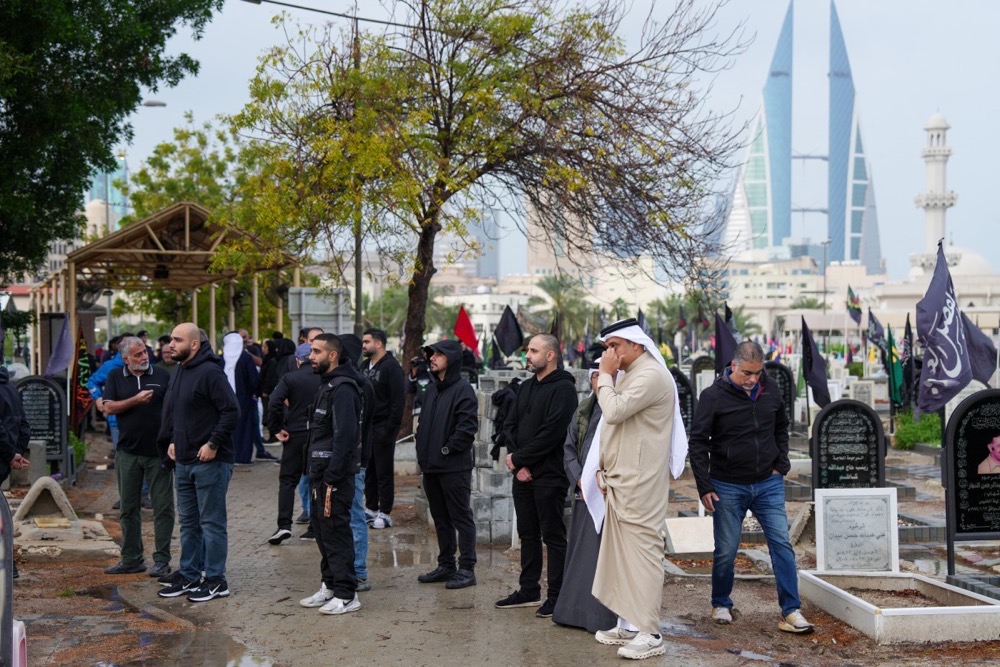
In Bahrain, the Defense Force said its air defenses had downed 147 projectiles and 282 drones, though interceptions were similarly imperfect.
Saudi Arabia has also recorded repeated successes against Iranian barrages since late February, with the Defense Ministry logging hundreds of interceptions.
The attacks on neighboring states have continued despite Iranian President Masoud Pezeshkian’s public apology on March 7, in which he pledged Tehran would halt strikes unless attacks on Iran originated from Gulf territory.
Even as Gulf forces demonstrate high interception rates, the effort is proving extraordinarily expensive.
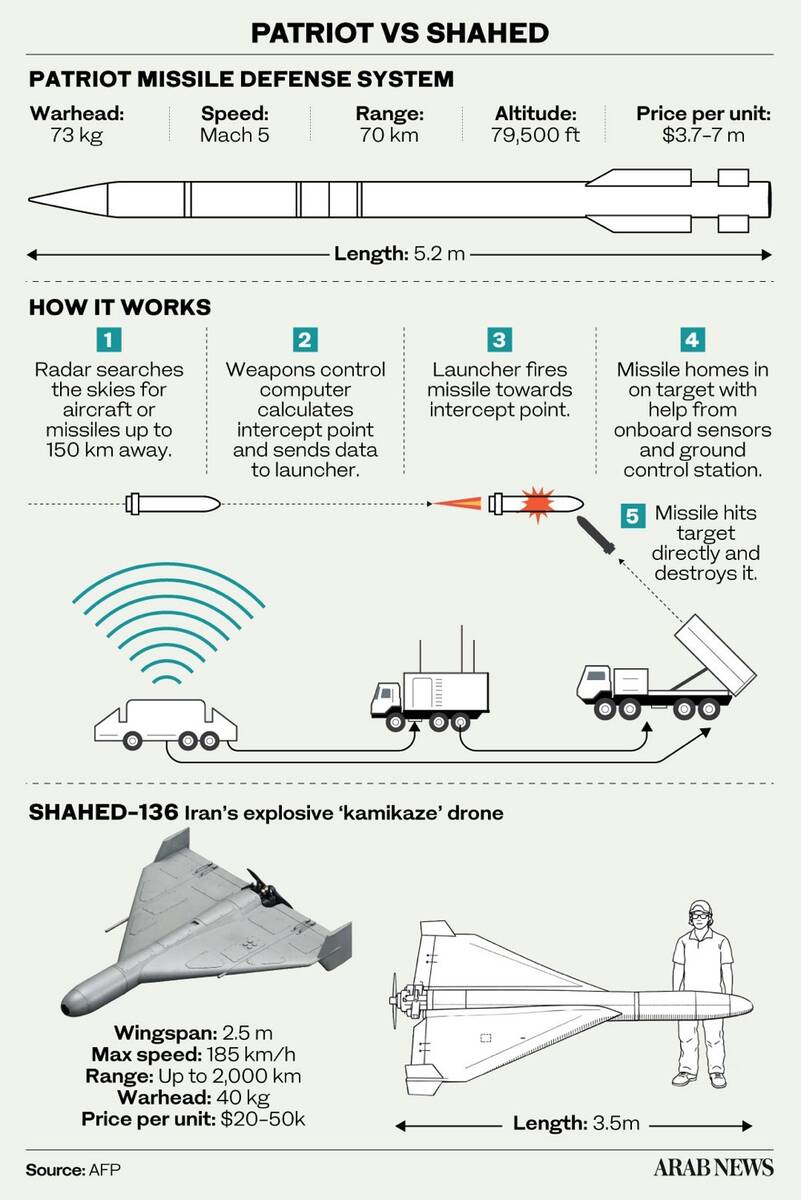
Shahed drones can be mass-produced for roughly $20,000 to $50,000 per unit, while the interceptor missiles used to destroy them cost millions — an asymmetry that strongly favors Tehran.
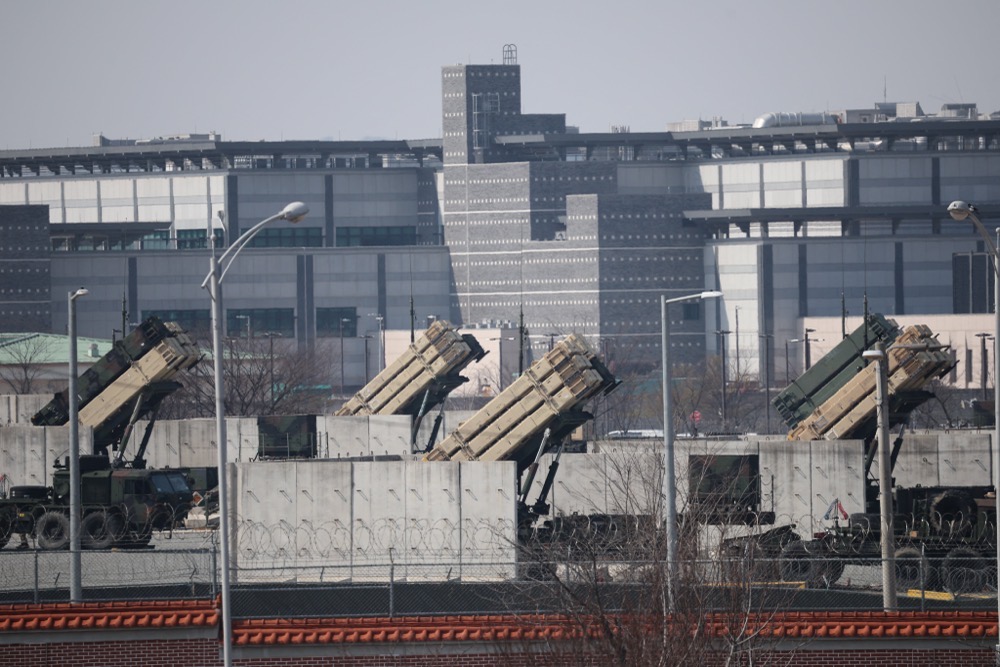
Intercepting a single drone can require a Lockheed Martin Patriot PAC-3 missile costing more than $4 million. When the logistical strain of rearming and the years needed to replenish stockpiles are factored in, the disparity becomes starker.
Iran’s ability to produce these drones cheaply stems from its use of aluminium, composites and commercial off-the-shelf components, with manufacturing that more closely resembles a car assembly line than traditional aerospace production.
Despite years of sanctions, Iran’s automotive and mechanical sectors remain resilient, with domestic firms producing engines, airframes and guidance systems at a fraction of Western costs.
“It’s a money game,” Arthur Erickson, CEO and co-founder of Texas-based drone manufacturer Hylio, told The New York Times on March 4, estimating the cost ratio per interception could reach 10-to-1 or even 60- or 70-to-1 in Iran’s favor.
That imbalance is already showing up in US defense spending.
The New York Times reported that officials told a closed-door Capitol Hill briefing on March 10 that war costs had exceeded $11.3 billion in the first six days alone, excluding pre-conflict deployment costs.
Separately, The Washington Post reported that roughly $5.6 billion worth of munitions were expended in just the first two days — far higher than publicly disclosed figures.
The Center for Strategic and International Studies had earlier estimated the first 100 hours of operations cost $3.7 billion, or about $891 million per day.
The Shahed threat was highlighted in another closed-door briefing on March 3, where officials warned that US air defenses cannot intercept every incoming drone, according to CNN.
Secretary of War Pete Hegseth and Joint Chiefs Chairman Gen. Dan Caine said the drones’ low cost, small size and ability to operate in large swarms allow them to saturate and overwhelm air-defense systems.
Shaheds — small, delta-winged munitions roughly 3.5 meters long — carry explosive warheads and emit a distinctive buzzing sound as they descend on targets. Launched from trucks, they are difficult to track and easy to deploy.
The long-range Shahed-136 variant can travel up to 2,000 kilometers, placing virtually any target in the Middle East within reach.
Economist Adam Tooze underscored the problem on the “Ones & Tooze” podcast on March 6, noting that modern warfare is increasingly defined not by offensive weapons but by defensive interceptors and their scarcity.
INNUMBERS
• Iran’s most frequently deployed drone is the Shahed-136, which carries a 110-lb satellite-guided warhead.
• Advanced Patriot interceptors cost around $4 million each to shoot down a $35k drone; even the cheaper Coyote runs $125k per shot.
“The Gulf states, Israel itself and Ukraine are all desperately dependent on one of these tight supply chains for interceptors,” he said.
“They’re fiendishly expensive — millions and millions of dollars per shot.”
He noted that a single Patriot battery costs about $1.5 billion, while each THAAD interceptor costs around $15 million, with multiple interceptors often required per incoming missile.
By some estimates, more than 800 US-made interceptors were used in just three days of fighting, underscoring the intensity of the burn rate.
With the cost gap widening, attention is increasingly turning to emerging technologies that could rebalance the equation.
“I believe the directed-energy ecosystem that integrates AI-driven software with portable platforms offers the cheapest and most transformative options,” Joze Pelayo, a Middle East security analyst with the Atlantic Council, told Arab News.
Among the most closely watched systems is Israel’s Iron Beam, which can reportedly intercept drones for around $3.50 per shot, though its operational use remains unclear.
The US is also advancing laser-based defenses. In a recent deployment, the US Navy destroyer USS Preble used the HELIOS system, short for High Energy Laser with Integrated Optical-dazzler and Surveillance, to shoot down multiple drones.
Developed by Lockheed Martin, HELIOS is a 60-kilowatt laser weapon designed to counter drones, aircraft and missiles. It can disable targets either by “dazzling” their sensors, confusing guidance systems, or by delivering a higher-energy beam that physically destroys them through intense heat.
The system also doubles as a surveillance platform, using thermal imaging and high-resolution sensors to detect and track targets at distances of up to 8 kilometers.
Crucially, laser weapons dramatically reduce the cost per interception, potentially from millions of dollars to just a few cents per shot, offering a possible solution to the current economic imbalance.
However, the technology has limitations. Laser effectiveness can be degraded by rain, fog, dust and smoke, which scatter the beam, while power requirements and range constraints also remain challenges.
Other systems are in development. The US Navy’s planned 400-kilowatt “Songbow” laser is expected by 2027, while smaller non-kinetic systems such as Lyocon aim to disrupt drone sensors.
For now, analysts say these technologies will complement, rather than replace, existing layered air defenses.
Amid the search for solutions, Ukraine has emerged as a potential source of expertise, having faced sustained drone warfare.
Since September 2024, Ukraine has endured near-nightly swarm attacks from Geran-2 drones, the Russian model derived from Iran’s Shahed-136 as part of a technology transfer between the two countries.
In January 2026 alone, Russia launched more than 4,400 Shahed-type drones against Ukrainian targets, averaging about 140 per day, according to the Institute for Science and International Security.
Ukraine could offer battle-tested expertise in the use of US-manufactured interceptor drones Merops, at around $10,000-$15,000 each.
Analysts say Kyiv can offer interceptor drones at costs that narrow the economic gap with Shahed munitions. Ukraine’s Sting interceptor, developed in early 2024 by Wild Hornets as Kyiv faced mounting financial strain, costs between $2,000 and $4,000 per unit.
Small, fast and highly maneuverable, some Sting variants can reach altitudes of about 11.3 kilometers, carrying payloads of up to 1.8 kilograms, with interception rates reportedly exceeding 85 percent.
Almost 1,000 can be produced daily by a dozen manufacturers, and their designs are continuously updated to counter shifting drone tactics, The Telegraph reported on March 5.
AI-enabled interceptor drones, capable of autonomous targeting and swarm coordination, are becoming an increasingly important part of that defense.
Yet transferring that expertise is not straightforward.
“Ukraine itself has not fully overcome Russia’s drone attacks,” Arman Mahmoudian of the University of South Florida told Arab News.
“Implementing these measures requires training, operational familiarity and real battlefield experience.”
While Ukrainian news media have reported interest from Gulf states, Saudi Arabia’s Ministry of Defense has not issued any statement in this regard.
Moreover, Saudi Arabia’s national oil company, Aramco, recently pushed back against claims that it is in talks with Ukrainian firms to purchase interceptor drones, calling them “inaccurate.”
“Aramco is aware of recent media reports regarding the company being in discussions with Ukrainian companies regarding the procurement of interceptor drones. These claims are inaccurate,” the company told Reuters.
Nevertheless, for Gulf states, the lesson is clear: even with advanced defenses, the economics of modern warfare are shifting, and the cost of protection may prove as decisive as firepower itself.